Green Chair Parts: Using Moisture on Purpose
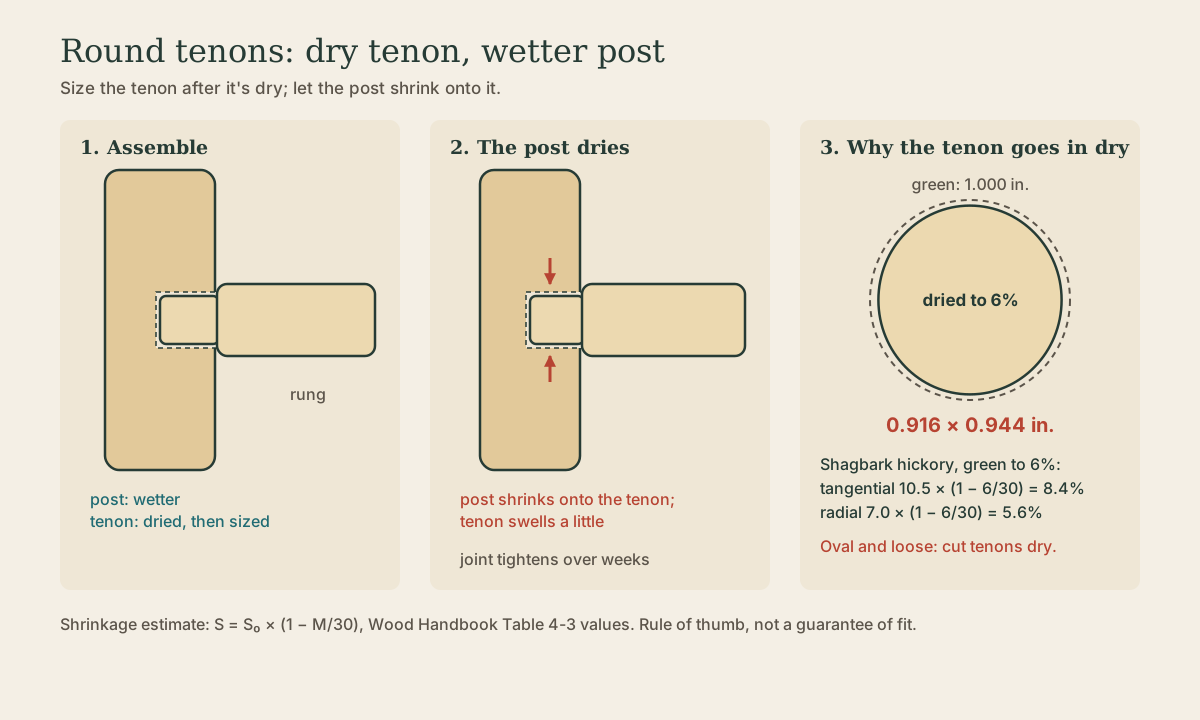
Traditional chairmakers dry tenons hard and leave mortised parts wetter, so the mortise shrinks onto the tenon and the tenon swells in it - a joint locked by drying itself.
- 4 min
- 7 steps
- 3 questions
- Lesson 21 of 160
In this lesson
- Wet wood is easy wood
- Rive, don’t saw
- The moisture-difference joint
- Getting tenons drier than the room
- Bending green
- Matching the wood to the joint
- What to take from this
Picking up where you left off.
Wet wood is easy wood
Green woodworking takes advantage of what this course has been warning about. Freshly split wood is soft and easy to shave, bend, and shape. It also shrinks predictably. Chairmakers working in the post-and-rung and Windsor traditions turn both facts into joinery: they control which parts are dry and which are wet at assembly, so the drying locks the joints instead of loosening them.
Rive, don’t saw
Chair parts are split (riven) from logs with a froe and maul, then shaved on a shaving horse with a drawknife and spokeshave. Splitting follows the fibers, so a riven part has no runout, no cross grain, and no short grain to break. A riven green rung only an inch or so across dries in days to weeks indoors, not the months a board needs, and because its fibers are continuous it seasons with little distortion. White oak, hickory, and ash, which rive cleanly, are the traditional choices.
Riven parts also tell you their ring orientation: you can see on the end exactly where radial and tangential lie, which matters for the joint.
The moisture-difference joint
In a post-and-rung chair like the ladderbacks in Jennie Alexander’s Make a Chair from a Tree, the rungs’ tenons are dried hard, well below normal room moisture, often in a warm box or over a stove, while the posts that receive them are left at a higher moisture content 1. The rungs are driven into holes bored in the still-moist posts. Then two things happen as the chair comes into equilibrium:
- The post shrinks around the tenon. Chairmakers orient the parts with the shrinkage directions in mind so the post’s larger tangential shrinkage closes on the tenon.
- The tenon swells slightly as it takes up moisture from the post and the room.
The result is a joint that tightens as it seasons, and often needs no glue. Peter Galbert’s Chairmaker’s Notebook uses the same principle for Windsor and stick-chair joints, with tenons dried dry before they go into wetter or equilibrium parts 2.
Quick check
Tenons are dried well below the posts. After assembly the wetter post shrinks around the tenon while the dry tenon takes up a little moisture and swells.
Quick check
That’s why tenons are dried below room moisture and posts are left wetter.
Getting tenons drier than the room
Room air in a Wisconsin winter puts wood at around 5 to 7 percent; summer, 10 to 12 3. Tenons for a moisture-difference joint need to be drier than they’ll ever be in service, so they always swell a little after assembly rather than shrink. Chairmakers do this in a simple hot box: an insulated box warmed by a light bulb or small heater, where tenons sit for a few days. Weighing a test tenon until its weight stops dropping tells you it’s there.
Because the dried tenon will swell back, it’s turned or shaved to fit the hole snugly after drying, and assembled promptly before it regains much moisture.
Bending green
Steam bending, used for chair backs and bent rungs, also works best on wet, straight-grained, air-dried or green wood. Kiln-dried wood generally bends less reliably than green or air-dried stock. After bending, parts are held on forms until they dry and set, which takes days to a couple of weeks for chair-sized parts.
Matching the wood to the joint
The principles from the rest of this course still apply:
- Use the shrinkage directions: tangential shrinkage is about twice radial, so the orientation of post and tenon decides how hard the drying clamps the joint.
- Know the target: assembled chairs end up at the equilibrium of the house, so design for the indoor range.
- Weigh test pieces to know where you are, instead of guessing.
What to take from this
Green chairmaking rives parts from straight-grained logs, shaves them green, and dries them quickly because they’re small. Tenons are dried below room moisture in a hot box and fit after drying; mortised posts are left wetter. As the chair seasons, the posts shrink onto the tenons and the tenons swell, locking the joints, so the drying does the work that glue would.
Practice
Riven parts have continuous fibers, small cross-sections that dry quickly, and no runout, so they season with little distortion.
Lesson complete
Nice work.
Sources for this lesson
- 1Jennie Alexander. Make a Chair from a Tree: Third Edition. Lost Art Press. 2021. verifiedPublisher contents and excerpts for post-and-rung construction, moisture management, bending, assembly, and hickory-bark seating.
- 2Peter Galbert. Chairmaker's Notebook. Lost Art Press. 2015. verifiedDetailed chairmaking reference for drilling, reaming, sightlines, and compound geometry.
- 3Samuel V. Glass, Samuel L. Zelinka. Moisture Relations and Physical Properties of Wood (Wood Handbook, Chapter 4). USDA Forest Service, Forest Products Laboratory, FPL-GTR-282. 2021. verifiedFree and bound water, fiber saturation (~30%), EMC table (Table 4-2), green moisture by species (Table 4-1), shrinkage by species (Table 4-3), and the shrinkage equation. Cited at: Table 4-2.
Further reading
- Richard Bergman. Drying and Control of Moisture Content and Dimensional Changes (Wood Handbook, Chapter 13). USDA Forest Service, Forest Products Laboratory, FPL-GTR-282. 2021. verifiedOven-dry and meter methods, outdoor EMC by city incl. Madison (Table 13-1), recommended MC (Table 13-2), kiln schedules (Table 13-3), drying defects, and dimensional change coefficients (Table 13-5).