Reading Tool Marks on Old Furniture
How researchers like Peter Follansbee and Joshua Klein rebuild lost methods from the furniture itself: plane scallops, gauge lines and saw overcuts, saw marks, hand-cut versus machine dovetails, oval turnings, and nails, plus the written evidence of inventories and diaries.
- 4 min
- 6 steps
- 3 questions
- Lesson 51 of 160
In this lesson
- The furniture is the manual
- What to look for
- What the inventories add
- Putting it together
- Try it
- What to take from this
Picking up where you left off.
The furniture is the manual
Few pre-industrial joiners wrote down how they worked. Peter Follansbee spent decades studying 17th-century New England oak furniture in museums and private collections because the tool marks left on an object are a roadmap to techniques lost to modern woodworkers 1. He pairs that with written evidence: Moxon’s Mechanick Exercises (1678), Randle Holme’s Academy of Armory (1688), and probate inventories listing every tool in a dead craftsman’s shop 1.
Joshua Klein, founder of Mortise & Tenon Magazine, had unusually rich evidence for one maker: Jonathan Fisher (1768-1847), the Harvard-educated first settled minister of Blue Hill, Maine, who built furniture for his community and recorded his work. Klein combined Fisher’s papers, his surviving tools, and 38 pieces of his furniture to reconstruct how he worked 2.
What to look for
Turn the piece over, pull the drawers, and use a raking light.
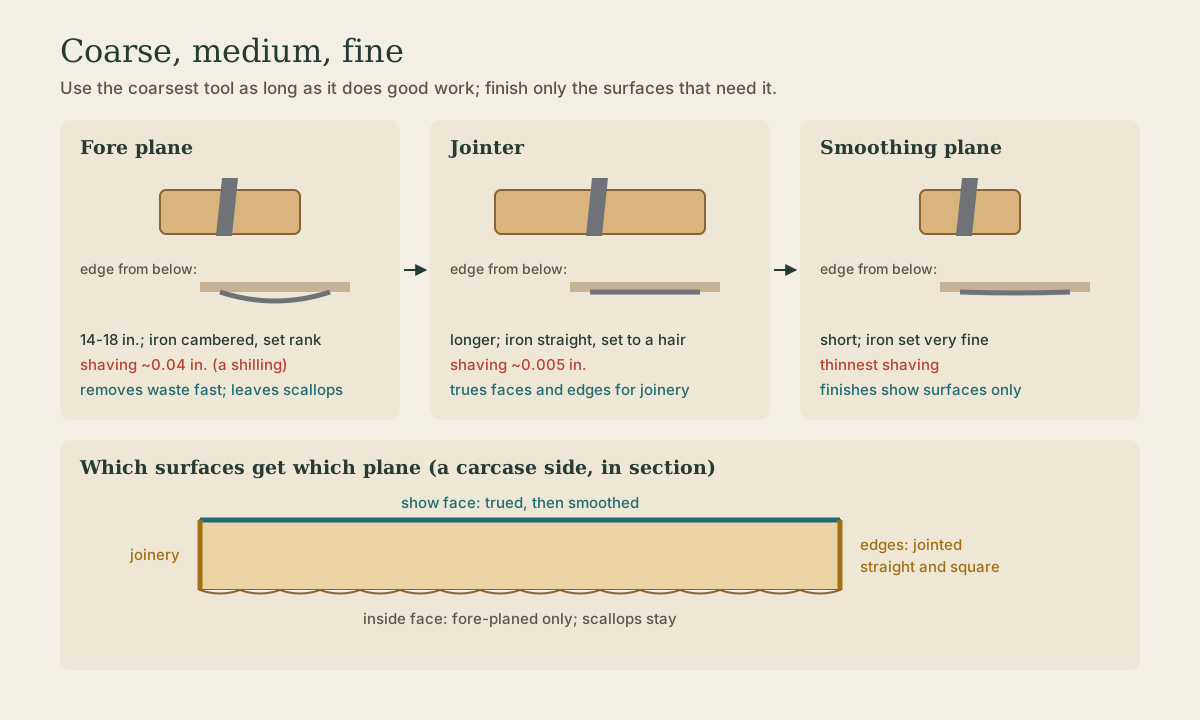
- Plane scallops: shallow hollows across drawer bottoms, case backs, and the undersides of tops, left by a cambered fore plane on surfaces no one would see 3.
- Layout lines left in: scribed gauge lines marking dovetail baselines, scratched lines for mortises, compass arcs for decoration.
- Saw overcuts: kerfs that run a little past the baseline on the inside face of a drawer front, where the maker sawed past the line rather than stopping carefully.
- Saw marks on boards: straight, slightly irregular marks from a pit saw or frame saw; regular curved arcs come from a circular saw and mean machine-sawn stock.
- Dovetails: hand-cut dovetails are usually few, with narrow pins and slight irregularity. Evenly spaced, identical dovetails, or the round “pin-and-scallop” Knapp joint used from about 1870 to 1900, mean machines.
- Oval turnings and round tops: wood shrinks more tangentially than radially, so parts turned round when green or damp go oval as they dry (see Shrinkage in Three Directions in Wood Drying).
- Riven stock: oak split along the rays shows broad ray fleck on its faces and tapering thicknesses; Follansbee notes riven boards present the radial plane, the most stable surface there is 1.
- Nails: wrought, early cut, perfected cut, or wire, each with its own period (see Reading Nails) 4.
Quick check
Overcuts and gauge lines left in place show a maker working efficiently by hand.
Quick check
Wood shrinks about twice as much tangentially as radially, so round parts go oval as they dry.
What the inventories add
Probate inventories show which tools a shop actually had. A 1633 Plymouth estate lists a great gouge, squares, a hatchet, handsaws, a broad axe, a holdfast, chisels and gouges, augers, a jointer plane, a fore plane, a smoothing plane, a half-round plane, an adze, and a felling axe 1. That’s a joiner’s kit with no machine in it, and close to Moxon’s list.
Playback is optional. If the player is unavailable, open the video at its source.
Putting it together
- Use several clues: drawer construction, saw marks, nails, hardware, secondary woods, and style. Old pieces were repaired, parts were reused, and older methods ran alongside newer ones; Lee Nelson’s warning about nails, never date by a single one, applies to every clue 4.
- Expect variation: a rural maker in 1820 may work like a city shop of 1760.
- Look before you restore: tool marks are evidence. Sanding off scallops and gauge lines erases the record and the value.
Quick check
Parts were reused and repaired, and old methods persisted alongside new ones.
Try it
Find an old chest of drawers at an antique shop or a relative’s house. Pull a drawer and look for gauge lines, overcuts, fore-plane scallops on the bottom, the grain direction of the bottom, and how the bottom is fastened. Note the nails. Write down what you think the maker did, step by step.
What to take from this
Old furniture records how it was made: fore-plane scallops on hidden faces, gauge lines and saw overcuts left in, straight pit-saw or curved circular-saw marks, hand or machine dovetails, oval turnings, riven ray fleck, and nail types. Researchers combine these with inventories and writings, as Follansbee did for 17th-century joiners and Klein did for Jonathan Fisher. Date nothing from a single clue.
Lesson complete
Nice work.
Sources for this lesson
- 1Peter Follansbee. Joiner's Work. Lost Art Press. 2019. verifiedNew England oak joinery from about 1620-1630 to the late 17th century, when joiners' riven oak work gave way to cabinetmakers' sawn maple, pine, and later mahogany; frame-and-panel, carving, carved boxes, joined chests; 1633 Plymouth probate inventories of tools.
- 2Joshua A. Klein. Hands Employed Aright: The Furniture Making of Jonathan Fisher (1768-1847). Lost Art Press. 2018. verifiedFisher, the Harvard-educated first settled minister of Blue Hill, Maine, built furniture for his community and recorded his work; the book uses his papers, tools, and 38 surviving pieces.
- 3Joseph Moxon, Christopher Schwarz. The Art of Joinery (2nd ed.). Lost Art Press. 2013. verifiedMoxon's 1678/1703 Mechanick Exercises joinery section with commentary. Fore plane with cambered iron set rank (shilling-thick shavings, about 0.04 in.), jointer set to a hair, smoothing plane set very fine; traversing; holdfast and planing stop; use the coarsest tool as long as possible.
- 4Lee H. Nelson. Nail Chronology as an Aid to Dating Old Buildings (Technical Leaflet 48). American Association for State and Local History. 1968. verifiedWrought, cut, and wire nails. Cut-nail phases 1790s-1830s; perfected cut nails late 1830s on; early cut nails have crosswise fibers and could not be clinched, so wrought nails were kept for clinching; wire nails dominant in the 1890s; never date by a single nail.