What Makes a Chair Good
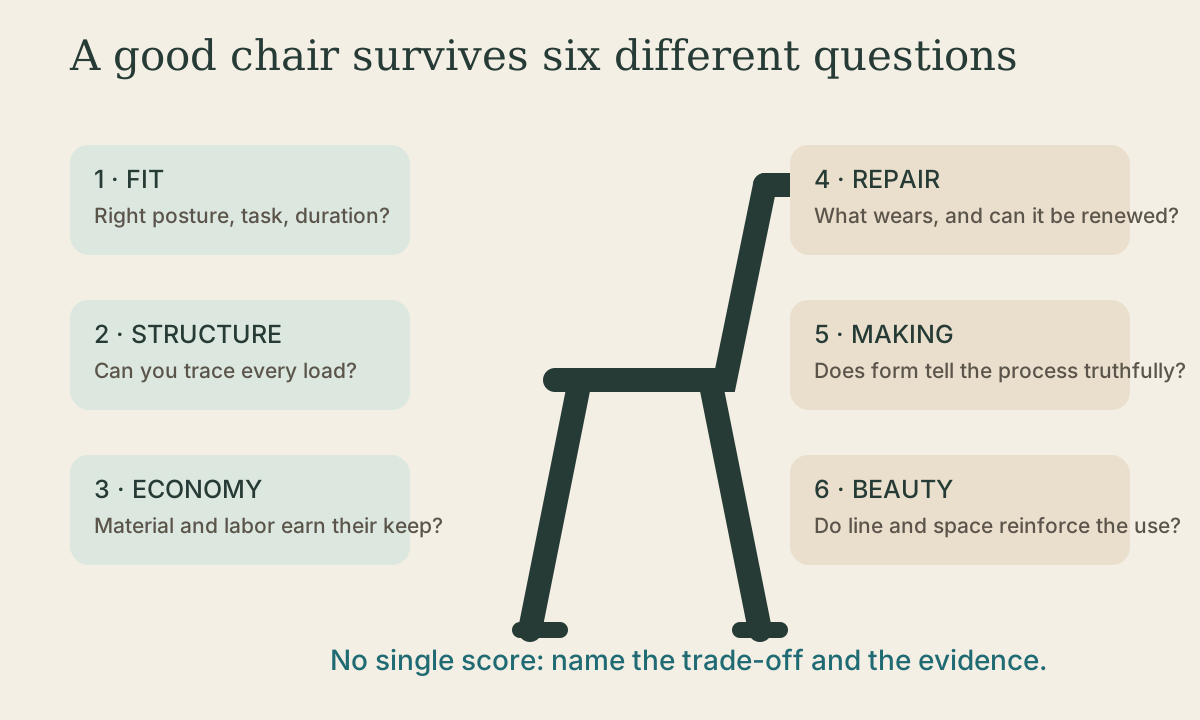
Judging a chair in six written findings instead of a score: fit for its task, a load path you can trace, economy of material and labor, repairability, David Pye's workmanship of risk and certainty, and beauty described as stance, line, and space.
- 7 min
- 9 steps
- 3 questions
- Lesson 111 of 160
In this lesson
- 1. Fit: good for which sitting?
- 2. Structure: can you tell the load story?
- 3. Economy: does every cost earn its place?
- 4. Repair: what is the second life?
- 5. Making: does the object tell the truth?
- 6. Beauty: what are line and space doing?
- Use a written verdict, not a score
- A pre-build and post-build audit
Picking up where you left off.
A chair must be light enough to move and strong enough to survive behavior no careful diagram would recommend. People drop into it, drag it sideways, perch on one edge, lean on the crest, and sometimes tip it onto two feet. Commercial seating standards therefore evaluate strength and durability through multiple prescribed tests rather than one static weight 1. A hand-built chair does not need a certification laboratory to deserve clear criteria.
Use six questions: fit, structure, economy, repair, making, beauty. Keep the six-question card beside the bench and answer each heading with one observation and one piece of evidence; the order matters less than covering the whole set.
1. Fit: good for which sitting?
Comfort is task- and time-specific. A dining chair should let the sitter approach a table and rise without a campaign. A reading chair may support a deeper recline and head position. A stool meant for ten-minute conversations need not behave like a desk chair used all day.
Evaluate fit at three times:
- Landing: any immediate pressure point or instability?
- Ten minutes: does the sitter begin to slide, perch, or abandon the back?
- One hour: can posture change without losing support?
Then apply Lesson 1.2’s contacts: feet, knees, hips, back. “It feels hard” is an impression; “the 17-inch depth prevents this sitter from reaching the back” is a diagnosis.
2. Structure: can you tell the load story?
Trace load from sitter to floor and from leaning back to the resisting joints. Good structure does not have to be visible, but it should be intelligible. Ask:
- Which members carry vertical load?
- Which joints resist the lever of the back?
- What resists side-to-side racking?
- Where has drilling or carving reduced the remaining wall?
- Is a mechanical lock—wedge, pin, taper, shoulder, or shrink fit—helping the glue?
A thick part is not automatically strong if its fibers run out or its joint leaves a thin cross-grain wall. A light frame can be durable if its joints are long, shoulders close cleanly, and members work as a connected system.
3. Economy: does every cost earn its place?
Economy is not cheapness. It is proportion between means and ends. Material should appear where it carries load or supports the body. Labor should improve fit, durability, surface, or expression rather than merely advertise difficulty.
Make a rough “value map” for a proposed chair. Estimate hours in four buckets:
| Work | Hours | What the sitter receives |
|---|---|---|
| Stock and joinery | 14 | strength and repeatability |
| Seat and back fitting | 8 | comfort |
| Shaping | 10 | touch, weight, line |
| Decorative detail | 12 | visual character |
There is no correct split. The table makes the trade visible. If decorative detail doubles the build while comfort has never been tested, the sequence is backwards.
Vernacular stick chairs are useful teachers because common material, direct tooling, and accumulated patterns produce durable seating without pretending labor is free 2. Shaker seating offers a different economy: a permanent post-and-rung frame receives a replaceable woven surface 3.
4. Repair: what is the second life?
Every chair has consumable parts. Woven seats stretch and wear. Finish abrades at hands and feet. Joints loosen after moisture cycles. A repairable chair acknowledges this.
Run a future disassembly thought experiment:
- Can the seat material be replaced without sawing the frame?
- Can a loose joint be reached, cleaned, and reassembled?
- Is the finish locally renewable or must the entire chair be stripped?
- Are fasteners standard and accessible?
- Will a repairer understand what the original maker intended?
A pinned joint can be difficult to open, but at least its lock is legible. An unknown adhesive mass buried under filler is neither visible nor reversible. Repairability is also documentation: note finish recipe, cord type, and unusual assembly order beneath the seat or in the chair log.
Quick check
Shaker chairs pair a durable post-and-rung frame with a replaceable seat - consumable parts can be renewed without destroying the structure.
5. Making: does the object tell the truth?
David Pye distinguished the workmanship of risk, in which quality depends continuously on judgment and dexterity, from the workmanship of certainty, in which jigs, tooling, or machinery predetermine more of the result 4. He did not assign moral superiority to handwork. A clean molded shell and a lively drawknifed spindle can both be excellent.
Evaluate whether the process serves the chair:
- Repetition may deserve a jig.
- A tactile transition may deserve hand shaping.
- A machined surface may be the honest final surface.
- Variation may be welcome in spindles but harmful at mating joints.
The warning sign is counterfeit evidence: fake adze marks, distressed edges placed where use would never create them, or machine precision marketed as spontaneous handwork. Let the surface record the real process you chose.
Quick check
Pye contrasted it with the workmanship of certainty, where tooling fixes the outcome. Neither is morally superior.
6. Beauty: what are line and space doing?
Beauty is not an escape from evidence. Describe what you see:
- Stance: alert, planted, formal, crouched?
- Line: where does the eye travel without interruption?
- Visual weight: where does mass collect, and does that match structural work?
- Negative space: are the holes rhythmic and coherent?
- Touch: do edges invite the hand where the hand actually lands?
Then ask whether those qualities reinforce use and structure. Splay can look energetic and widen the footprint. Taper can look light and remove material where stress is lower. A continuous arm can guide the eye and carry load. Beauty does not have to be functional, but the strongest chairs rarely ask appearance and engineering to tell opposite stories.
Use a written verdict, not a score
Numeric scores imply that one chair with 48 points is simply better than one with 44. That hides purpose and trade-offs. Instead, write six short findings:
Fit: excellent for an upright meal; too shallow for lounging. Structure: clear frame load path; rear rail shoulders need inspection. Economy: high labor concentrated in a durable woven seat and touch surfaces. Repair: seat replaceable; finish locally renewable. Making: turned repetition and hand-shaped transitions are both legible. Beauty: vertical stance is formal; taper prevents heaviness.
That paragraph is useful to a builder. “8/10” is not.
Quick check
‘Too shallow for lounging; rear rail shoulders need inspection’ is actionable. ‘8/10’ isn’t.
A pre-build and post-build audit
Before milling, answer the rubric from the drawing. Circle assumptions. After assembly, answer it again from the object. For an established serviceable chair, ask three sitters to answer only fit and visible structure without hearing your explanation. For an unproven prototype, keep people off it and gather fit observations with the fitting rig from Lesson 1.2 instead. Differences are information, not insults.
Finally, revisit the chair after six months. Look for polished contact areas, finish wear, cord stretch, joint lines, and how people actually move it. Use tells you what the design drawing could not.
A good chair is not one that maximizes all six questions. It is one whose trade-offs are appropriate, durable, and understood. The rubric keeps fame, style labels, and the maker’s effort from substituting for judgment.
Lesson complete
Nice work.
Sources for this lesson
- 1ANSI/BIFMA X5.1-2017(R2022): General-Purpose Office Chairs — Tests. Business and Institutional Furniture Manufacturers Association. verifiedOfficial scope summary for structural strength and durability testing of general-purpose seating. Cited at: X5.1 scope.
- 2Christopher Schwarz. The Stick Chair Book. 2nd revised ed. Lost Art Press. verifiedPublisher page with the complete book available as a free PDF. Cited at: Thinking About Chairs.
- 3Nicholas C. Vincent. Shaker Furniture. The Metropolitan Museum of Art. 2012. verifiedMuseum overview of Shaker post-and-rung chairs, ladder backs, and woven seats. Cited at: Shaker chair construction and seating.
- 4David Pye. The Nature and Art of Workmanship. Herbert Press / Bloomsbury Publishing. 2007. verifiedPublisher page for the revised edition; the work was first published in 1968. Primary source for Pye's workmanship-of-risk and workmanship-of-certainty distinction. Cited at: Chapter 2.