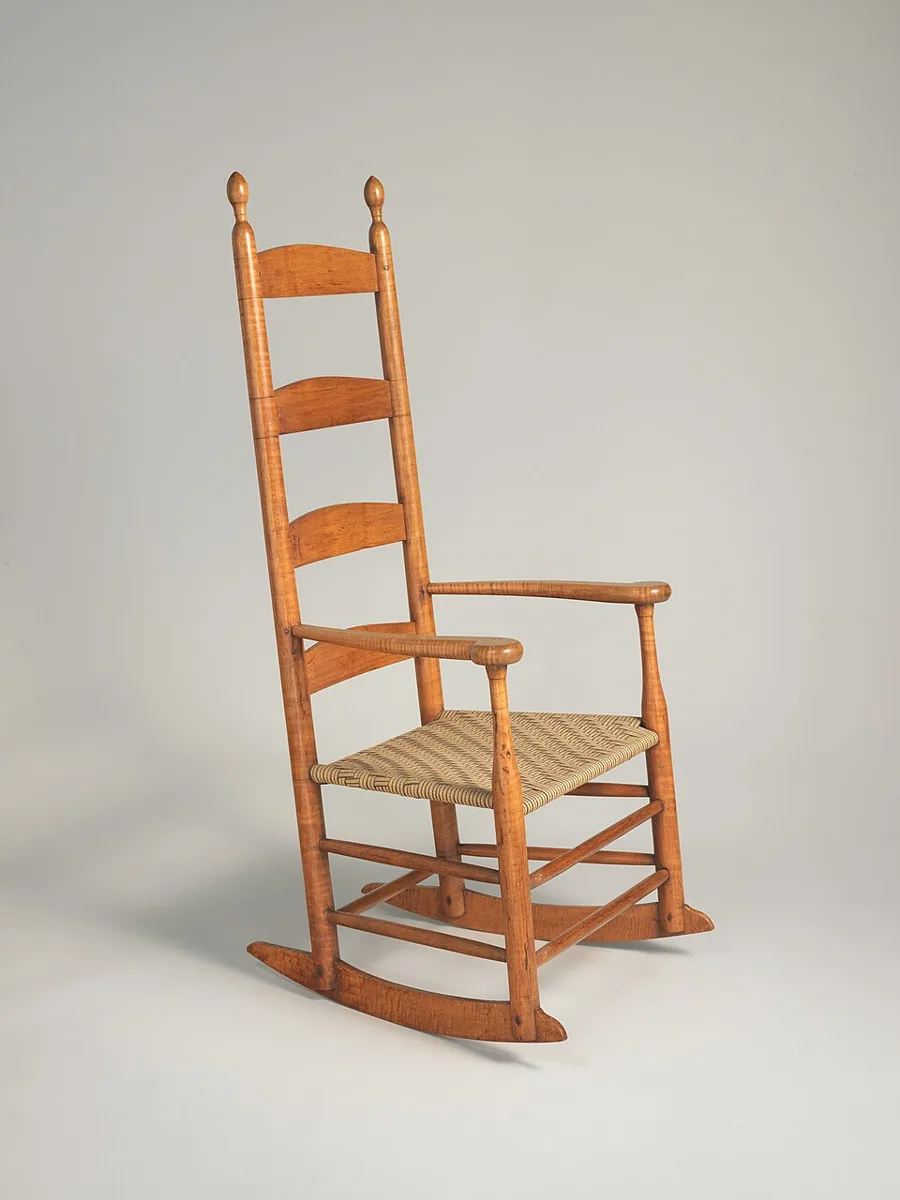
Rocking Chairs
What makes a rocker rock: the rocker as part of a circle, why the sitter's center of gravity must sit well below its center, choosing a radius (30 inches tippy, about 39 to 42 good, 80 dead), how little of the rocker is used, a neutral recline near 25 degrees, moving rockers fore and aft, making a matched pair, and prototyping before committing.
- 7 min
- 9 steps
- 3 questions
- Lesson 124 of 160
In this lesson
- A weighted wheel
- Where the center of gravity is
- Choosing a radius
- How little of the rocker rocks
- The resting position
- Prototype it
- Building notes
- Try it
Picking up where you left off.
A rocking chair is a chair that moves, which adds a design problem the other chairs in this course don’t have: dynamic balance. Does it tip you back far enough, or too far? Does it settle into a resting position on its own, or take effort? Is the rhythm calm or quick? Can you get in and out of it without a struggle? Furniture maker Jeff Miller set out to answer those questions after building several rockers that didn’t rock as well as he wanted, and found the “book research” full of lore and conflicting opinions 1. What survived was a simple model and a prototype.
A weighted wheel
Miller’s model: picture a wheel standing on edge with a lead weight fixed somewhere between its center and its rim. The wheel rolls until the weight is as low as it can get, overshoots, rolls back, and eventually settles with the weight at the bottom. Put the weight near the rim and the wheel settles quickly; put it near the center and it swings slowly, far, and wildly 1.
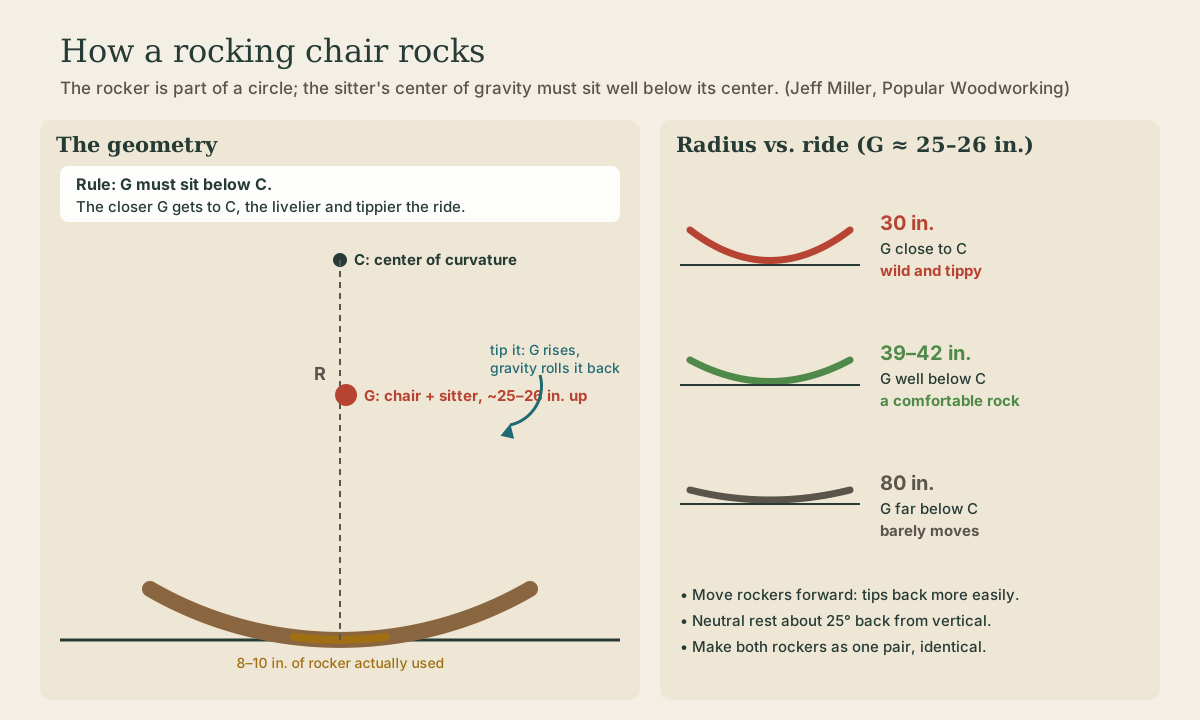
A rocking chair is that wheel. The rocker’s working edge is a piece of a circle. Its center of curvature is the wheel’s center, sitting one radius above the floor. The center of gravity of chair plus sitter is the weight 1. Tip the chair and the center of gravity rises, so gravity pulls it back: the same restoring-torque reasoning as any object in stable equilibrium 2. The rule follows directly:
The center of gravity must sit below the rockers’ center of curvature. The closer it gets to that center, the livelier and tippier the chair; the farther below, the more it just sits there.
Quick check
Like a weighted wheel, the chair rolls until the weight is as low as it can get; the closer the weight is to the wheel’s center, the wilder the motion.
Where the center of gravity is
For a person sitting upright, the center of gravity is roughly an inch in front of the navel, and in a typical rocking chair that puts it around 25 to 26 inches off the floor 1. It moves with body type, posture (feet out, feet tucked, slouching), and slightly with the chair’s own weight distribution, which is one reason rocking chairs feel more personal than ordinary chairs. Miller works from the height of the center of gravity rather than seat height, because seat shapes and angles vary too much to give a consistent reference 1.
Choosing a radius
With the center of gravity at 25 to 26 inches 1:
| Rocker radius | Center of gravity vs. center | Ride |
|---|---|---|
| 30 in. | close to the center | very tippy, and odd-looking |
| 39–42 in. | well below the center | a reasonable range |
| 80 in. | far below the center | tends to just sit there |
In Miller’s prototype, the difference between a 39-inch and a 40-inch radius was very subtle; smaller radii felt less stable, larger ones too unresponsive 1.
Quick check
30 inches puts the center of gravity near the center of the circle (tippy); 80 inches makes a chair that just sits there.
How little of the rocker rocks
People argue over arcs, ellipses, catenaries, and the S-shaped cyma that Sam Maloof called a “cygnet curve.” But a normal rocking motion uses only about 8 to 10 inches of each rocker, perhaps 14 inches counting settling in and pushing far back. That working stretch is most likely very close to a true arc. Beyond it, the curve’s shape is mostly appearance, or there to limit tipping in an extreme case, like a child standing on the seat and leaning back 1. Shape the working zone as a fair arc of your chosen radius; let the ends do what they need to.

The resting position
A rocking chair should tip you back to a position that takes work off your back muscles: as you recline, the chair’s back, with gravity’s help, supports your spine. Miller found a neutral rest around 25 degrees behind vertical works well 1. The second goal is the motion itself, a rhythm into and out of that neutral position that simply feels calming 1. Seat geometry still follows Lesson 1.2; a rocker’s seat and back must be comfortable before the rocking is tuned.
Prototype it
No formula reliably predicts how a rocker will feel, Miller concluded, because each chair generates its own requirements 1. So he built an adjustable prototype 1:
- Two plywood sides, about 21 by 40 inches, carry a seat and back slats located by dowels so both sides match.
- A pair of rockers, cut together from two boards screwed face to face so they’re identical, is drilled with a row of dowel holes that act as a track: the rockers slide fore and aft along the sides and screw in place.
- New rows of holes move the rockers up or down; new pairs test other radii and shapes.
What he learned: moving the rockers forward made the chair rock back more easily, and vice versa, and rocker position mattered more than radius or curve shape 1. He knew he had it when he fell asleep in the prototype at lunch.
Playback is optional. If the player is unavailable, open the video at its source.
Quick check
He found rocker position more significant than small changes in radius or curve shape.
Building notes
- Make the rockers as one pair. Cut and fair them together so the result is as if both were sliced from the surface of one large cylinder 1. A mismatched pair walks across the floor.
- Fit the rockers to the legs, then level. The rockers replace the floor as the leveling reference: set the chair on its rockers on a flat surface, check that both touch along their working zone, and correct the leg joints rather than the arcs.
- Treat it as a structural change. Rockers add new joints at the bottom of every leg and new loads as the chair tips. That’s an amber-to-red change in Lesson 3.6’s terms if you add rockers to a chair not designed for them.
- Buy the plan for a sculpted rocker. Charles Brock sells full-size patterns and video for sculpted rockers; for those designs, follow the maker’s patterns (Build 4) 3.
Load-test the finished rocker with weights before anyone sits, including tipped back to its stops, and check that it can’t go over backward under a reasonable push.
Try it
Sit in any rocking chair you can find. Rock gently and note how far back it settles on its own, then estimate where your navel is above the floor. Push it back hard and feel whether it wants to keep going or returns firmly. You’re feeling the distance between your center of gravity and the center of the rockers.
Lesson complete
Nice work.
Sources for this lesson
- 1Jeff Miller. Make a Chair That Rocks. Popular Woodworking. 2020. verifiedA rocking chair is the relationship between the center of gravity of chair and sitter and the shape of the rockers (the weighted-wheel analogy). A seated person's center of gravity is roughly an inch in front of the navel, about 25-26 in. off the floor in a typical rocker; a 30-in. rocker radius is tippy, 80 in. barely moves, 39-42 in. is reasonable. Only about 8-10 in. of rocker (up to about 14 in.) is used, close to an arc. A neutral position around 25 degrees behind vertical relaxes the spine. Rockers must be identical, cut as a pair. A plywood prototype with rockers on a dowel track showed that moving the rockers forward makes the chair rock back more easily; 39 vs 40 in. radius felt very subtle. Cited at: introduction; What Makes a Rocking Chair Work; What Did I Discover?; Rocking Chair Goals; Prototype to the Rescue.
- 2University Physics, Volumes 1–3. OpenStax (Rice University). verifiedOpen calculus-based physics. Vol 1 mechanics; Vol 2 thermodynamics and electricity & magnetism; Vol 3 optics & modern physics. Cited at: Volume 1, static equilibrium and stability.
- 3Build a Sculpted Rocker. Charles Brock Chairmaker. verifiedMaker's official site for current full-size patterns, companion material, and complete project video series. Cited at: patterns and video series.