The Japanese-American Synthesis
Movement between Japan and America under pressure: George Nakashima's path through wartime incarceration to his Conoid chair and butterfly keys, Isamu Noguchi, Charlotte Perriand's translation of steel designs into bamboo, and Toshio Odate's writing on tools.
- 7 min
- 8 steps
- 3 questions
- Lesson 113 of 160
In this lesson
- George Nakashima: architecture, incarceration, workshop
- Read the Conoid chair as a structural argument
- Isamu Noguchi: a different wartime path
- Charlotte Perriand: translate a design through material
- Toshio Odate: tools as cultural practice
- Comparison exercise: four kinds of crossing
- Build response: technique before replica
Picking up where you left off.
“Japanese-American” does not name a single style. In this lesson it names movement between places, materials, institutions, and identities—often under pressure. George Nakashima, Isamu Noguchi, Charlotte Perriand, and Toshio Odate carried different experiences across the Pacific. Their work should not be flattened into an image of timeless Japanese simplicity.
George Nakashima: architecture, incarceration, workshop
Nakashima trained in architecture at the University of Washington and MIT, traveled and worked abroad, and became associated with Antonin Raymond. The National Park Service documents that architectural education as part of the wider legacy of Japanese-American design 1. His own studio chronology records work in India, the Sanskrit name Sundarananda, the family’s forced removal to Minidoka in 1942, and Antonin Raymond’s role in securing their release to New Hope, Pennsylvania, in 1943 2.
That chronology matters because a popular summary—“East meets West in natural wood”—erases the institutions and coercion through which the meeting occurred. Nakashima’s later workshop was not an abstract fusion. It grew from architectural training, global travel, Japanese carpentry knowledge, wartime incarceration, rural Pennsylvania, and a particular inventory of American hardwoods.
Read the Conoid chair as a structural argument
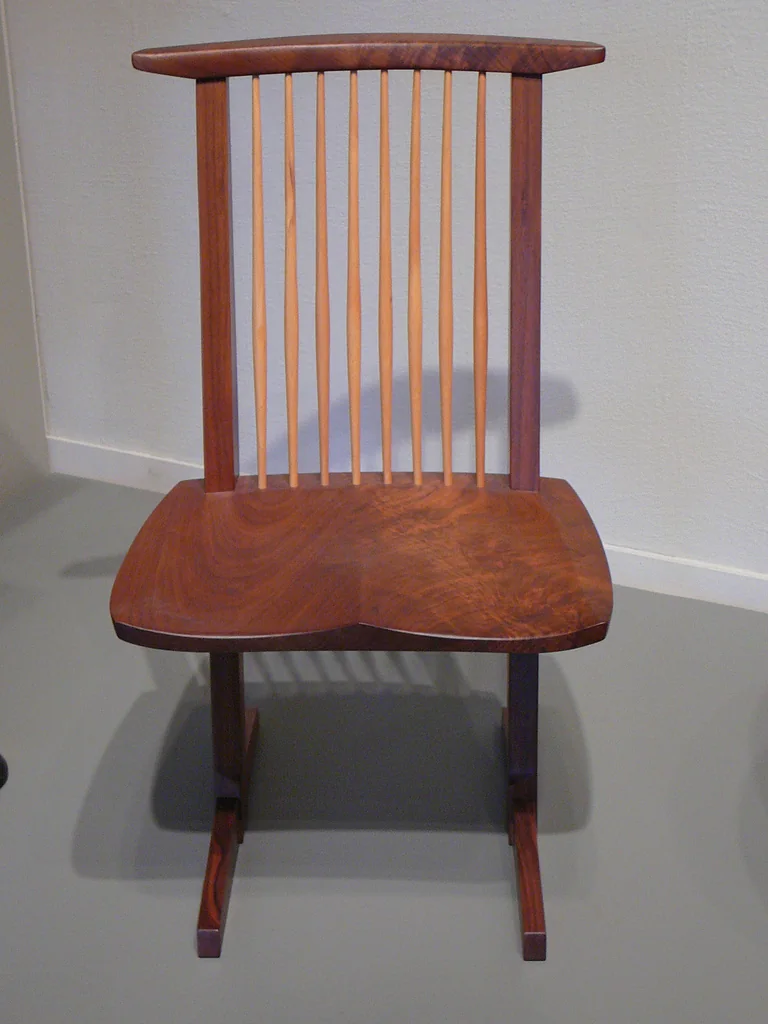
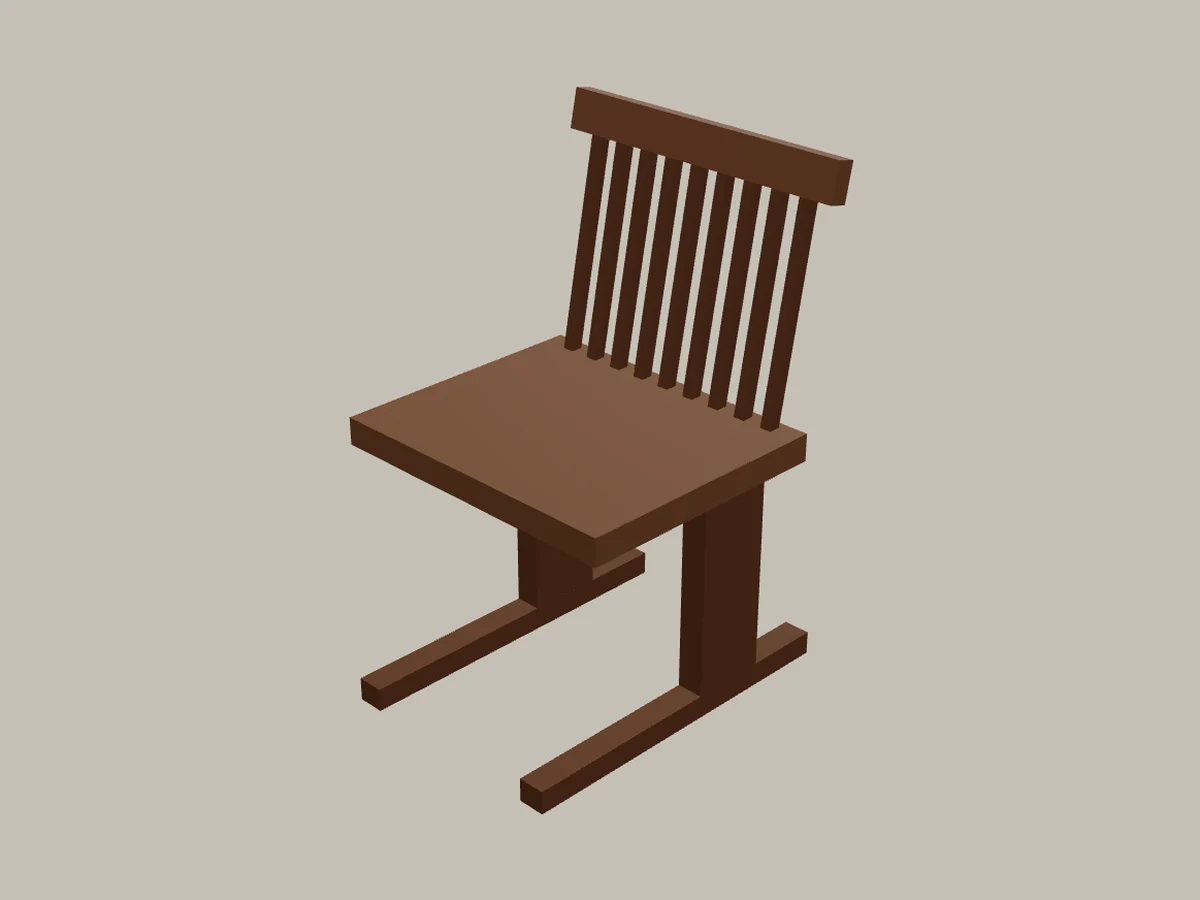
The Conoid chair takes the familiar upper vocabulary of a plank seat and slender back sticks, then gives it an unusual base. Two legs connect to longitudinal sled feet; the seat projects beyond their support. The name relates to the shell-roofed Conoid Studio on the New Hope property.

Use Seat–Spine–Sled to read it:
- Seat: a thick plank is both body support and structural beam.
- Spine: many narrow sticks distribute back load into that plank.
- Sled: long floor members extend the support polygon beyond the two visible legs.
This is not a beginner’s “delete two legs” variation. A conventional four-leg chair can distribute seat load near four supports. Here, the seat and its leg joints resist significant bending and cantilever action. The sled feet stabilize the chair in the fore-and-aft direction, but side loading and joint integrity remain critical. Copying the silhouette without understanding the load path is precisely the red-light change warned about in Lesson 3.6.
Butterfly keys: observation before metaphor
Nakashima is also associated with live edges and butterfly keys—double-tapered inlays crossing a check. Mechanically, a key resists the two sides moving farther apart at the surface. It does not erase the crack, restore uninterrupted fibers, or make every unstable slab safe. Placement, grain direction, depth, and the continuing moisture behavior of the slab matter.
It is tempting to call the key “woodworking kintsugi.” That can be a helpful visual analogy, but it is interpretation, not technical equivalence. A lacquer repair in ceramics and an inlaid restraint in wood solve different material problems. Say what the joint does before saying what it symbolizes.
Quick check
The sled feet extend the support polygon fore and aft, but the cantilever puts real demands on the seat and leg joints - not a beginner’s ‘delete two legs’ change.
Quick check
A key restrains opening at the surface; it doesn’t heal the crack or stabilize a slab whose moisture keeps changing.
Isamu Noguchi: a different wartime path
Noguchi was a sculptor whose practice crossed sculpture, landscape, interiors, lighting, and some furniture. He was exempt from the forced removal applied to West Coast Japanese Americans because he lived in New York, but he voluntarily entered the Poston camp in 1942 hoping to develop gardens, recreation spaces, and arts programs. The Noguchi Museum describes both the ambition and the failure to secure institutional support for those plans 3.
This experience should not be used as a colorful biographical preface to an object. It complicates the language of choice, belonging, and “hybrid” identity. Noguchi’s movement between Japan and the United States was neither a smooth design exchange nor identical to the forced incarceration of the Nakashima family.
For chair study, Noguchi is useful as a boundary case. Ask when a seat becomes sculpture and when sculpture accepts the obligations of a seat: stability, repeated load, touch, and repair. His wider practice reminds us that furniture occupies rooms and landscapes, not only product photographs.
Charlotte Perriand: translate a design through material
Charlotte Perriand arrived in Japan in 1940 as an official adviser on industrial design to the Ministry for Trade and Industry, a role documented by the Design Museum 4. A direct way to see the exchange is to compare her earlier tubular-metal seating with later work in bamboo. Separately, MoMA’s object record documents a Perriand low chair designed in 1940, manufactured in 1946, and made in bamboo 5.
The important lesson is not that bamboo makes a European modern chair “Japanese.” It is that material substitution forces a redesign of sections, connections, and making sequence:
- Tube can take a tight continuous bend with a hollow section.
- Bamboo brings nodes, taper, directional splitting, and craft-specific joints.
- Steel connections can be welded or mechanically fastened.
- Bamboo members often need bindings, pegs, sockets, or lapped assemblies.
A successful translation preserves the posture and load logic while allowing the new material to change the form. The result is evidence that a design idea is not identical to its first material—but also that material is never a neutral skin.
Quick check
A successful translation keeps the posture and load logic while letting the new material change sections, joints, and sequence.
Toshio Odate: tools as cultural practice
Odate’s writing on Japanese woodworking tools is valuable because it joins technique to apprenticeship and shop culture 6. A Japanese saw is not culturally significant merely because it cuts on the pull stroke. Sharpening, body mechanics, workholding, sequence, and standards of attention form the operating system around the tool.
When Module 4 introduces Japanese joinery and hand tools, avoid the souvenir approach of collecting exotic implements. Use a four-part tool reading:
- Action: what movement does the tool make?
- Workholding: what keeps the part stable during that movement?
- Preparation: what sharpening and setup make the action possible?
- Sequence: where does the tool belong among marking, roughing, fitting, and finishing?
The tool is understood only when all four answers cooperate.
Comparison exercise: four kinds of crossing
Make a table for the four figures:
| Figure | What crossed | What changed | What must not be romanticized |
|---|---|---|---|
| Nakashima | architecture, carpentry, US hardwood | workshop furniture and structural expression | forced incarceration |
| Noguchi | sculpture, landscape, two national contexts | scale and category | voluntary entry did not make camp benign |
| Perriand | European modern furniture and Japanese craft | material, joint, and fabrication | “influence” was reciprocal, not decorative borrowing |
| Odate | apprenticeship knowledge and US teaching | how tools were explained | a tool is not the whole culture |
Then choose one chair and label claims as documented fact, mechanical inference, or interpretation. This is the same discipline used in the mingei lesson.
Build response: technique before replica
The Nakashima studio remains active. The responsible beginner response is not an uncredited Conoid copy. Practice a technique and design a different object:
- Make butterfly-key samples across test splits and see how much each key resists the split opening further.
- Design a plank-seat stool whose support polygon is conventional, then study how much structure a true cantilever would add.
- Translate one familiar joint into a local wood species and record what its grain changes.
The mock-up below is one way into that cantilever exercise. It keeps the Seat-Spine-Sled reading but uses chosen dimensions: the plank seat projects about 11 inches beyond its two uprights, and the sled runners reach forward under it to keep a sitter’s weight inside the support polygon. Model the conventional stool beside it and compare where each carries its load. Label your own version the same way: a study after Nakashima, not a Conoid.
Credit the source explicitly: “butterfly-key study after Nakashima,” or “material-translation exercise after Perriand.” The most meaningful synthesis does not borrow a silhouette. It carries forward a method while telling the history that made the method visible.
Lesson complete
Nice work.
Sources for this lesson
- 1The Architectural Legacy of Japanese America. National Park Service. verifiedScholarly National Historic Landmarks theme-study essay documenting Nakashima's education and career. Cited at: Nakashima section.
- 2History & Team. George Nakashima Woodworkers. verifiedStudio chronology covering Nakashima's architecture, Minidoka incarceration, release, and New Hope workshop. Cited at: 1930s–1940s chronology.
- 3I Become a Nisei. The Noguchi Museum. verifiedMuseum account of Noguchi's voluntary entry into Poston in 1942 and his plans for community facilities. Cited at: publication description.
- 4Charlotte Perriand. Design Museum, London. verifiedMuseum biography documenting Perriand's 1940 appointment as official industrial-design adviser to Japan's Ministry for Trade and Industry. Cited at: biography.
- 5Charlotte Perriand, Low chair, designed 1940; manufactured 1946. The Museum of Modern Art. verifiedMuseum object record for Perriand's bamboo seating developed from her Japanese work. Cited at: object record.
- 6Toshio Odate. Japanese Woodworking Tools: Their Tradition, Spirit and Use. Linden Publishing. 1998. verifiedPublisher description confirms coverage of pull saws, laminated hollow-backed chisels, planes, marking tools, waterstones, and tool care. Cited at: publisher description.