The Two (and a Half) Families of Chairs
Sorting chairs by structure rather than style: plank chairs where the seat is the hub for legs and sticks, frame chairs where posts and rungs come first and the seat fills in, molded shells where the surface is the structure, and a sixty-second field test.
- 6 min
- 5 steps
- 3 questions
- Lesson 108 of 160
In this lesson
- Family one: the seat is the hub
- Family two: the seat is infill
- The “half” family: the surface becomes structure
- A sixty-second field test
Picking up where you left off.
Chair styles multiply quickly: Windsor, ladderback, wingback, café chair, office chair. Structure is simpler. For hand-built wooden chairs, a useful first sorting rule is to ask one question:
Where does the sitter’s load go first?
If it enters a thick seat that receives the legs and back, call the chair plank-built. If it enters a skeleton of posts and rails around a seat opening, call it frame-built. If a shaped surface carries the sitter and supplies much of the stiffness itself, call it a shell. This is a workshop model, not a universal scholarly taxonomy; hybrids exist. Its value is predictive: it tells you what must be made first, which joints matter most, and where to look for damage.
Use the mnemonic PLANK plugs, FRAME frames, SHELL spreads:
- Parts plug into a plank seat.
- Posts and rails frame an opening.
- A continuous shell spreads load through its surface.
Family one: the seat is the hub
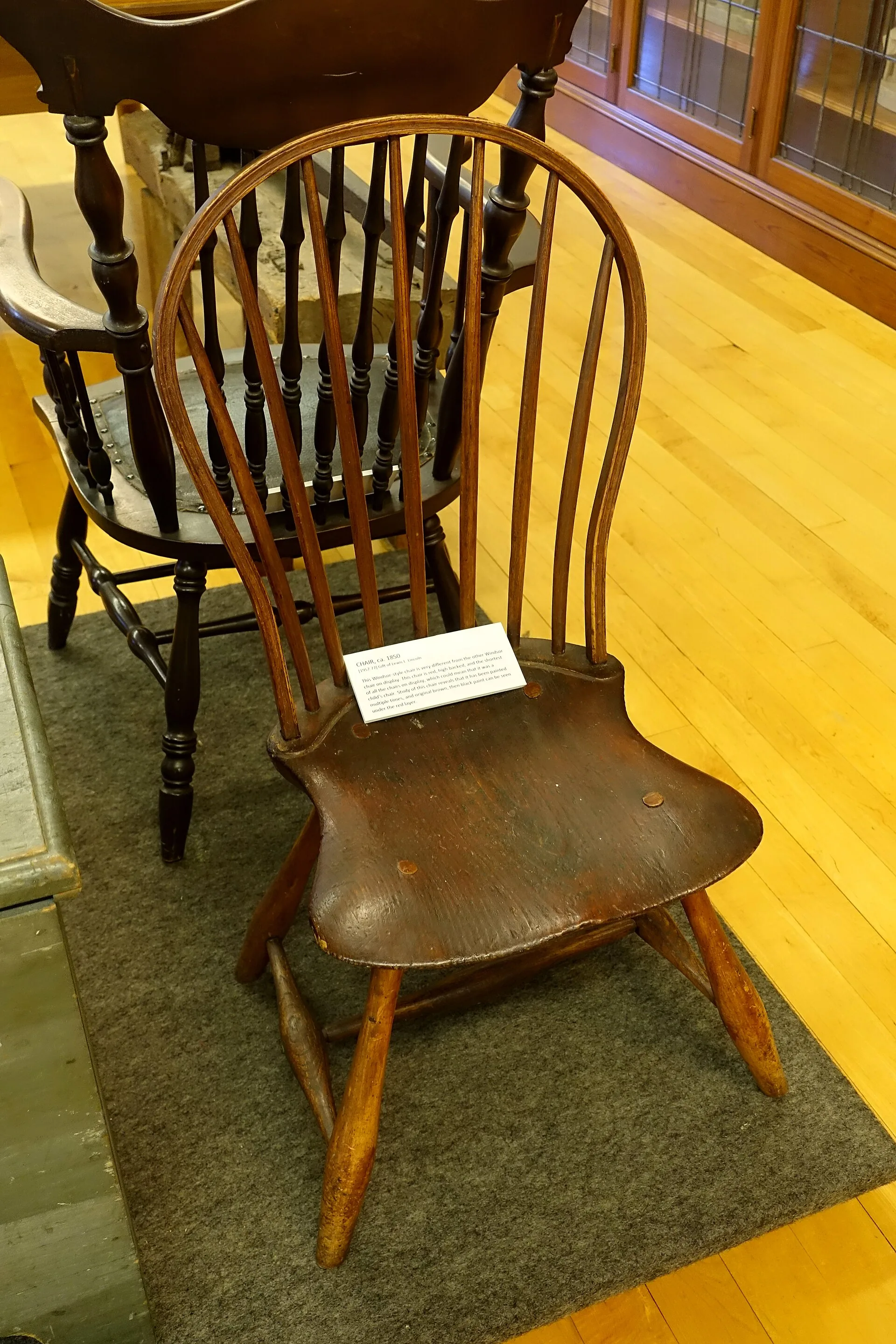
In a Windsor or vernacular stick chair, the seat is not merely something to sit on. It is the junction between two assemblies. Legs enter from below; sticks or spindles enter from above. In an armchair, heavier posts may support an arm bow, with more sticks running from the seat to the arm or comb. Schwarz uses this seat-centered anatomy throughout The Stick Chair Book 1.
That explains the characteristic parts:
- The undercarriage is the legs and, when present, the stretchers tying them together.
- The superstructure is the sticks, posts, arm, and comb or crest above the seat.
- A saddled seat has a shallow carved hollow. Its thickness is also useful structure: it gives angled mortises enough wood to hold.
- Rake is the apparent front-to-back lean; splay is the apparent side-to-side lean. Together they widen the footprint and triangulate the chair.

Follow the load in the Windsor photo. The sitter loads the seat; the seat loads four angled leg joints; stretchers help the legs behave as an undercarriage rather than four independent sticks. A person leaning against the back loads many smaller back joints into the same seat. The chair is stiff because its members point in different directions, not because every joint is massive.
Likely trouble: loose leg sockets, splits that run into mortises, or a damaged seat around clustered holes. A loose joint is not just a glue problem. Check whether the mortise is enlarged, the tenon has shrunk, or the surrounding seat has cracked before choosing a repair.
Quick check
Windsors and stick chairs route the sitter’s load into the seat, which joins the undercarriage below to the superstructure above.
Family two: the seat is infill
In a post-and-rung or joined chair, the skeleton comes first. Rear posts often continue from the floor through the chair back. Front and rear posts are connected by rails (rectangular members) or rungs (round members). Horizontal back pieces are slats; a broad central back board is a splat. The seat may be rush, splint, tape, cord, upholstery, or a removable slip seat.
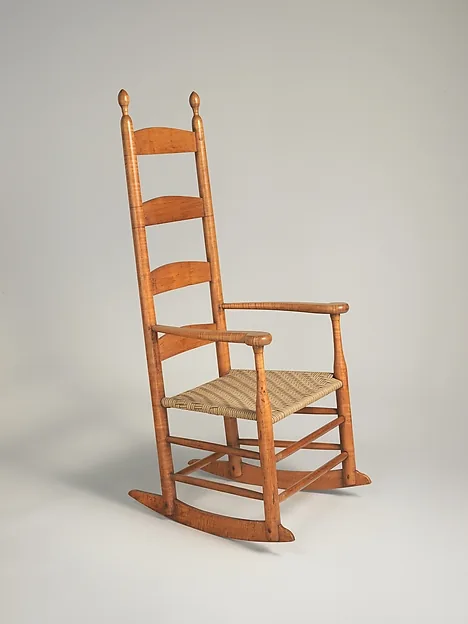
The Shaker rocking chair above makes the distinction visible. The woven seat does not hold the legs together. The posts, rungs, arms, and slats do. Shaker examples commonly combine turned posts, ladder-like backs, and woven seats in this way 2.
Follow a side load now. A rectangular frame wants to rack into a parallelogram. Long joints, sound shoulders, well-fitted rungs, and sometimes low stretchers resist that movement. This is why a frame chair can feel light yet remain durable: it places material in a connected skeleton rather than concentrating it in a thick seat.
Likely trouble: loose rail or rung tenons, broken seat weaving, or a frame that rocks side-to-side. Replacing a woven seat can leave the wooden structure untouched. Repairing a racked frame requires finding the loose structural joints, not simply tightening the new seat material.
Quick check
In a frame-built chair the posts and rungs carry and brace the load. The weave is infill; a racking frame means loose joints.
The “half” family: the surface becomes structure
A molded plywood, fiberglass, or plastic chair may combine seat and back into one continuous shell attached to a separate base. Here curvature and thickness distribute load through a surface. Some shells are flexible; others gain stiffness from ribs, folded edges, or compound curves.
Do not classify by material alone. Bent plywood can be a structural shell, a non-structural panel inside a frame, or one component in a hybrid. Tubular steel does not automatically make a shell chair either; many cantilever chairs are better read as a continuous metal frame carrying upholstery or a seat panel.
Likely trouble: cracking at high-stress curves or fasteners, delamination in plywood, degraded upholstery, or failed connections between shell and base. The repair logic differs sharply from tightening a wooden mortise.
A sixty-second field test
When you meet an unfamiliar chair, ignore its style name for a minute and perform this sequence:
- Find the load receiver. Is the sitter on a plank, an opening filled with weave/upholstery, or a shaped surface?
- Trace one path to the floor. Point from seat to joint to leg. If you cannot trace it, look underneath.
- Nudge, do not abuse. With permission, apply a small side load. Does a frame rack, do sockets click, or does a shell flex?
- Name the probable failure before the style. “Loose front rung” is more useful than “old ladderback.”
- Check for a hybrid. A thick seat with side rails, or a shell on a wooden post-and-rung base, may legitimately use more than one system.
Worked classifications
- A stick chair with no stretchers is still plank-built: the seat receives its legs and back.
- A dining chair with an upholstered drop-in pad is usually frame-built: lift the pad and the rail skeleton remains.
- A molded plastic seat on four metal legs is a shell on a base: the shell carries the body; the base carries the shell.
- A bent-willow chair joined by nails is still structurally frame-like if its posts and bent rails define the load-bearing skeleton.
The most common beginner mistake is classifying by silhouette: “spindles mean Windsor,” or “woven seat means ladderback.” Instead, remember PLANK plugs, FRAME frames, SHELL spreads, then trace the load. That habit will carry directly into the course builds: you will plan the plank-chair capstone around its seat and sockets, and the ladderback around its post-and-rung frame.
Quick check
Classify by load path, not silhouette. Where the load lands first predicts what was made first, which joints matter, and how it fails.
Lesson complete
Nice work.
Sources for this lesson
- 1Christopher Schwarz. The Stick Chair Book. 2nd revised ed. Lost Art Press. verifiedPublisher page with the complete book available as a free PDF. Cited at: Parts of a Chair.
- 2Nicholas C. Vincent. Shaker Furniture. The Metropolitan Museum of Art. 2012. verifiedMuseum overview of Shaker post-and-rung chairs, ladder backs, and woven seats. Cited at: essay.