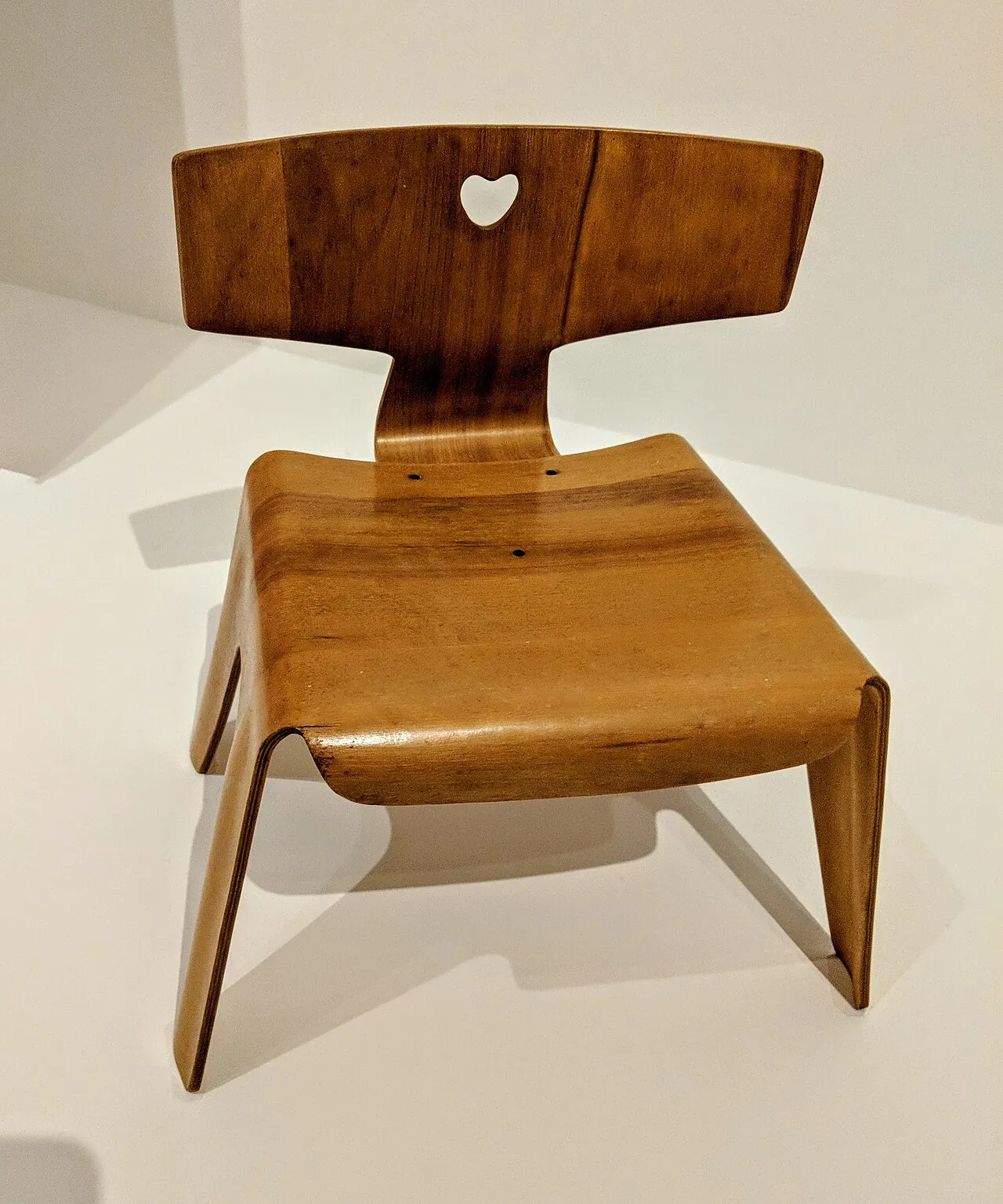
American Studio Furniture (and Eames, Briefly)
American studio furniture: Wharton Esherick's Hammer Handle chairs from tool handles, Sam Maloof's sculpted joints, Tage Frid's three-legged stool and its stability triangle, the Eames Office's molded plywood experiments, and estimating a sculpted chair honestly.
- 7 min
- 9 steps
- 3 questions
- Lesson 117 of 160
In this lesson
- Wharton Esherick reuses a constraint
- Sam Maloof sculpts transitions
- Tage Frid teaches a compact structural lesson
- The Eames Office iterates a process
- Studio and industry are not opposites
- Estimate a sculpted-chair project honestly
- Observation exercise: name the stored knowledge
- Build responses
Picking up where you left off.
American studio furniture centers the independent workshop: one maker or a small team develops a recognizable body of work, often outside a large factory. That independence does not mean isolation. Suppliers, schools, magazines, galleries, museums, and clients all shape what the workshop can make.
Four construction lessons organize this survey: Esherick reuses, Maloof sculpts, Frid teaches, the Eames Office iterates. The verbs are more useful than a shared style, because the objects do not look alike.
Wharton Esherick reuses a constraint
Esherick’s Hammer Handle Chairs turn standardized tool handles into frame members. Research from the Wharton Esherick Museum documents chairs made from 1938 into the early 1950s, invoices for hundreds of purchased handles, and industrial belting used for seating 1. This corrects the vague legend that he merely found a few handles and improvised one chair.
Read the chair as a supply problem:
- Turned handles arrive as strong, repeated, tapered members.
- The maker assigns those existing geometries to legs and braces.
- Flexible belting spans the frame without requiring a carved seat.
- Triangulation compensates for an unconventional inventory.
The creative act is not applying rustic texture. It is recognizing capabilities in an available part. A modern response could begin with rejected tool handles, agricultural stakes, or another reliable local component—but only after inspecting grain and soundness.
Reuse audit
For any salvaged component, write four answers:
- What was it engineered to do originally?
- Which loads in the chair are similar?
- What holes, wear, or grain deviations weaken it?
- Can a future repairer replace it?
Reuse without this audit is decoration with a structural risk attached.
Quick check
Museum research shows invoices for hundreds of handles; the creative act was seeing structural capability in a repeated part.
Sam Maloof sculpts transitions
Sam Maloof was self-taught and developed a studio practice in California. The MacArthur Foundation, which named him a fellow in 1985, describes his sculptural furniture and the rocking chair as his signature form 2.
Maloof’s work is best understood through hard joint, soft transition. Leg-to-seat connections remain mechanically explicit, often with a crisp line and plugged fasteners, while surrounding surfaces are rasped and shaped into continuous tactile curves. The hand can follow the chair through a junction the eye can still read.
That balance solves two different problems:
- The joint needs repeatable bearing, fasteners, and sufficient wall thickness.
- The body and eye want a gradual change of section, no bruising arris, and a coherent line.
Do not imitate the style by rounding every edge. Preserve a datum through the joint, assemble it accurately, then shape outside the structural core.
Shaping rule of thumb
Use Joint–Line–Blend:
- Joint: mark the no-cut structural zone around fasteners and bearing surfaces.
- Line: draw the intended high line on both adjacent parts.
- Blend: remove facets progressively until the transitions meet, checking with hand and raking light.
Stop before all evidence of section disappears. A uniform melted surface can be as lifeless as an untouched rectangle.
Tage Frid teaches a compact structural lesson
Tage Frid brought Danish guild training into American furniture education and publishing. His three-legged stool with a small back condenses chairmaking into a few consequential elements: three splayed legs, through joinery, a narrow seat, and a large connection carrying the back. Yale’s object record provides a museum anchor for the form 3.
Three legs automatically contact an uneven floor, but stability still depends on the support triangle. Plot the feet in plan. The sitter’s center of mass must remain inside that triangle during normal use. A rear leg placed too far forward makes leaning dangerous; a front footprint too narrow makes side reach unstable.
Triangle check
On a full-size floor plan:
- Mark the center of each foot.
- Connect the three points.
- Mark the center of the seat and an estimated forward perch point.
- Confirm both lie comfortably inside the triangle.
- Add the direction of likely back force and check that the rear vertex opposes it.
This geometric check explains more than the slogan “three legs never rock.” A stool can contact the floor perfectly and still tip easily.
Quick check
Plot the foot triangle in plan and keep the seat center and perch point well inside it.
The Eames Office iterates a process
Charles and Ray Eames developed compound-curved plywood through repeated physical experiments and wartime production. The Eames Office dates the molded plywood leg splint to 1943 and connects it to the tooling, pressure, and production knowledge later used for furniture 4. The office’s archive places the molded plywood furniture group in 1946 and explains the eventual decision to separate seat and back rather than force a single plywood shell beyond what the process would reliably allow 5.

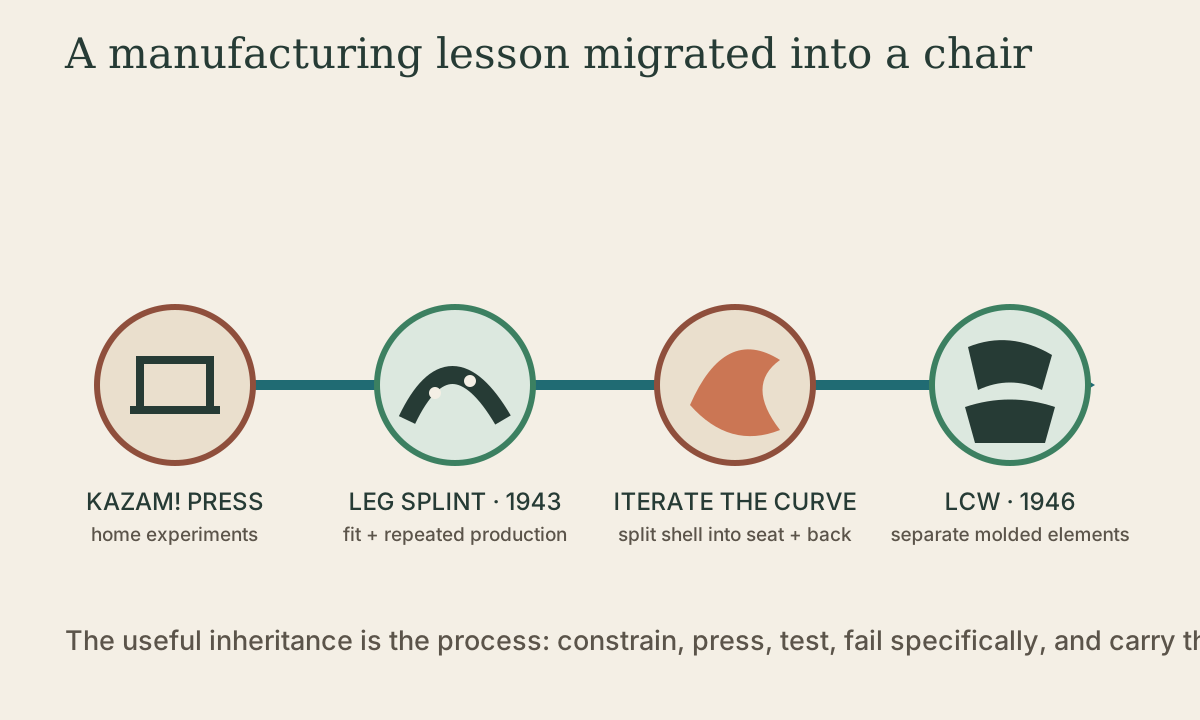
This is a more useful story than “the splint became a chair.” The silhouette did not simply migrate. Knowledge migrated:
- how veneer behaves in compound curvature;
- where stress-relief openings help;
- how heat, pressure, glue, and time interact;
- how tooling repeats a form;
- when a one-piece ambition should become a two-piece solution.
The LCW’s separate molded seat and back are evidence of a design process accepting a material answer.
Quick check
Knowledge from the 1943 leg splint carried over, and the design accepted the material’s answer.
Studio and industry are not opposites
Compare where decisions are stored:
| Practice | Where repeatability lives |
|---|---|
| Esherick | maker’s arrangement of standardized found parts |
| Maloof | patterns, joint method, and trained shaping judgment |
| Frid | drawing, teaching sequence, and repeatable exercise |
| Eames Office | molds, presses, process parameters, and production feedback |
All four combine certainty and judgment differently. Even a one-person shop uses patterns and machines; even a factory depends on skilled decisions and prototype evaluation.
Estimate a sculpted-chair project honestly
Break the build into known work, new work, and risk allowance. If a chair has 55 hours of familiar milling and joinery, 30 hours of unfamiliar sculpting and lamination, and a 25% allowance on the unfamiliar work:
Then add finishing and mockup time explicitly. This prevents a pattern package’s assembly sequence from being mistaken for a total project estimate. A first sculpted rocker is a course of study, not a weekend chair.
Observation exercise: name the stored knowledge
For one object from each maker, identify:
- The riskiest operation.
- The jig, pattern, supply standard, or practiced gesture that controls it.
- The visible trace of that control.
- The part a repairer could reproduce fifty years later.
This moves criticism away from personality. “Maloof had a great eye” may be true but does not tell you how a transition is controlled. “A full-size pattern locates the joint; shaping preserves a marked hard line” can guide work.
Build responses
- Esherick study: make a stool from a batch of sound handles or other repeated salvaged members, inspected for grain and soundness, and triangulate it.
- Maloof study: make one leg-to-seat joint sample at full thickness and sculpt the transition on only one side so the before/after section remains visible.
- Frid study: plot and build the three-leg base before adding a back, and check the support triangle by setting weights at the seat center and perch point.
- Eames study: laminate two small curves with different ply counts, record springback, and compare failure rather than attempting an LCW shell.
Attribution matters here too. “Maloof-inspired” is accurate when using a published method; “after Frid” identifies a study; “Eames process experiment” should not imply an authentic product.
Load-test structural studies with weights (Lesson 3.4), never by sitting on an unproven prototype.
American studio furniture is not a single sculptural look, and industry is not its enemy. The durable lesson is where knowledge accumulates: in an available component, a shaped transition, a teaching project, or a production process refined by specific failures.
Lesson complete
Nice work.
Sources for this lesson
- 1An Exciting Hammer-Handle Discovery. Wharton Esherick Museum. 2025. verifiedMuseum research on Esherick's 1938–1952 Hammer Handle Chairs, purchased handles, and industrial belting seats. Cited at: museum research.
- 2Sam Maloof — Class of 1985. MacArthur Foundation. 1985. verifiedFoundation biography describing Maloof's self-taught practice, rocker, and 1985 fellowship. Cited at: biography.
- 3Tage Frid, Stool. Yale University Art Gallery. verifiedMuseum object record for Frid's three-legged stool with back and construction dimensions. Cited at: object record.
- 4Molded Plywood Leg Splint. Eames Office. verifiedStudio archive tracing the 1943 splint, compound curves, wartime production, and later furniture experiments. Cited at: history.
- 5Molded Plywood Group. Eames Office. verifiedStudio archive describing the 1946 group, separate molded seat and back, and production history. Cited at: development and production.