Continental Currents
Four answers to who gets a designed chair: Thonet's No. 14 of 1859 shipped as six parts in a crate, Rietveld's Red Blue chair of standard members, Ponti's 1.7 kg Superleggera, and Enzo Mari's do-it-yourself Autoprogettazione.
- 7 min
- 7 steps
- 3 questions
- Lesson 116 of 160
In this lesson
- Thonet bends—and redesigns distribution
- Rietveld composes with standard members
- Ponti refines a regional type
- Mari teaches through construction
- Four meanings of access
- Build routes and attribution
Picking up where you left off.
This lesson moves through four distinct answers to one question: who should be able to make or obtain a designed chair? Michael Thonet built a global production and shipping system. Gerrit Rietveld reduced furniture to standardized members and spatial composition. Gio Ponti and Cassina pushed a familiar regional type toward extreme lightness. Enzo Mari published construction as an educational exercise.
Thonet bends—and redesigns distribution
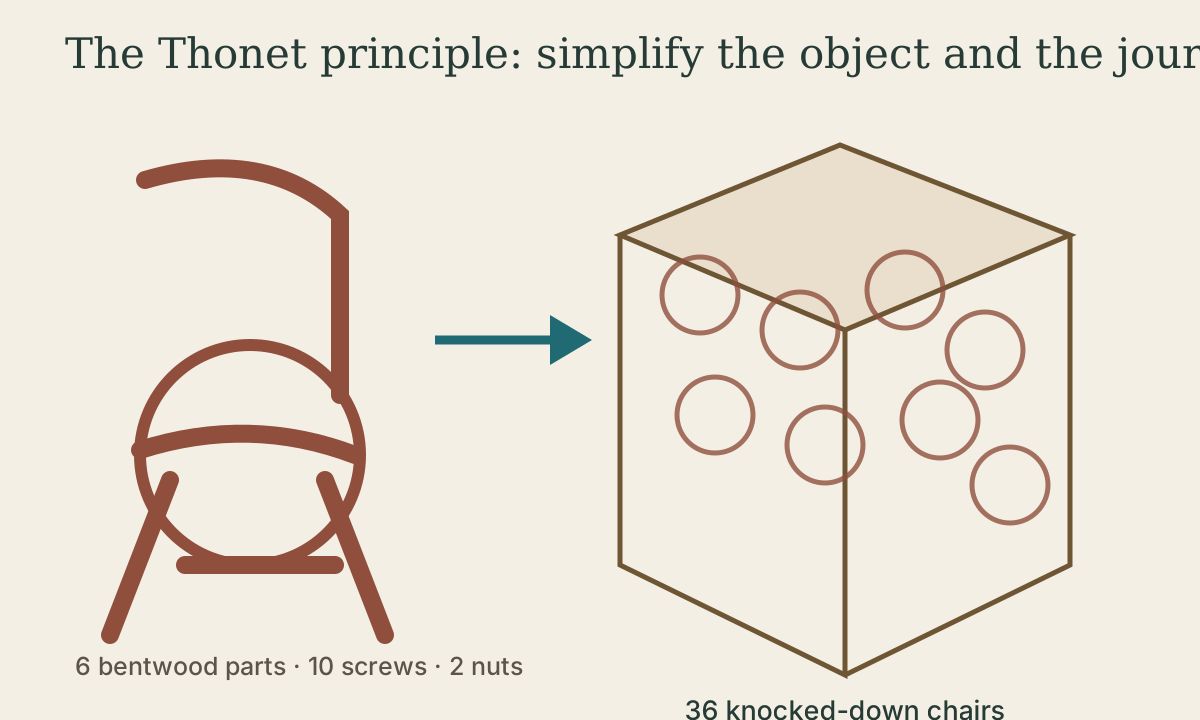
Michael Thonet’s chair No. 14, now sold as model 214, dates to 1859. Thonet’s own history describes a system of six wooden parts, ten screws, and two nuts. Thirty-six disassembled chairs could fit into a one-cubic-metre shipping crate and be assembled at their destination 1.
The famous steam-bent curves matter, but the larger innovation is coordination:
- Solid beech is bent into repeatable components.
- The part count is kept small.
- Mechanical fasteners permit knocked-down shipment.
- Packing density lowers distribution cost.
- Local assembly and replaceable components support a wide market.
A chairmaker normally optimizes the object on the bench. Thonet optimized the object, factory, crate, route, and repair network together.
Packing math as design evidence
If one assembled chair occupied even 0.25 cubic metre of freight space, 36 chairs would need about 9 cubic metres. Thonet’s documented one-cubic-metre crate implies an order-of-magnitude reduction in volume. The exact real-world saving depends on packaging and handling, but the comparison reveals why knock-down construction was not an afterthought.
When evaluating contemporary flat-pack furniture, ask whether disassembly supports repair and efficient transport—or only transfers difficult labor and weak connections to the customer.
Quick check
Thonet optimized the object, factory, crate, and distribution network together.
Rietveld composes with standard members
Gerrit Rietveld’s Red Blue Chair began as an unpainted design around 1918; MoMA notes that its primary-color scheme came later, around 1923, and that the wood elements used standard lumber sizes 2. This distinction prevents a common mistake: treating the color scheme as the original structural idea.
Read the chair in layers:
- Rectilinear sticks extend beyond their intersections.
- Seat and back are planes carried within that open lattice.
- Painted ends emphasize that members continue through space.
- Construction is visually decomposed rather than blended into smooth transitions.
The chair is conceptually reproducible, but “standard lumber” does not mean careless assembly. Repeated offsets, square joints, and a coherent drilling system determine whether it reads as spatial order or as a pile of painted battens.
Rietveld’s later Zig-Zag Chair is a useful opposite. Four broad planes create a wooden cantilever. The part count is tiny, yet the joints carry severe opening moments. Visual reduction can increase structural difficulty.
A copy test before building
Draw a Red Blue elevation from verified dimensions. Then make a joint map:
- Mark every crossing.
- Distinguish structural fasteners from alignment dowels.
- Note which members carry seat load and which establish the visual grid.
- Identify repeated offsets that deserve a spacer block.
If the map is incomplete, a color photograph is not a plan.
Quick check
The color scheme wasn’t the original structural idea; the design is a lattice of standard lumber with seat and back planes.
Ponti refines a regional type
Gio Ponti’s 699 Superleggera, produced by Cassina from 1957, develops the lightweight Chiavari chair tradition. Cassina documents an ash frame, a beech seat frame, triangular leg sections only 18 millimetres across, and a minimum mass of about 1.7 kilograms 3.
Its lesson is not “make every part thinner.” It is remove material by section and species:
- A triangular section can place material where the load needs it while presenting a fine edge.
- Ash supplies a light, resilient frame.
- Denser, closer-grained beech serves the seat frame.
- Joinery and workmanship must become more accurate as safety margins shrink.
The chair is a refinement of a known type, not a rejection of history. Compare it to Lesson 1.3’s hierarchy: grain and soundness become more—not less—important as sections get smaller.
Weight budget
For your own side chair, weigh the rough parts before assembly and group them by subsystem:
| Subsystem | Rough mass | Question |
|---|---|---|
| Front and rear legs | — | Can taper remove low-value mass? |
| Rails and stretchers | — | Are sections oriented for their bending direction? |
| Seat | — | Could weave or saddle replace thickness? |
| Back | — | Can several flexible members share load? |
Do not chase Superleggera’s number. Use the budget to see where your chair is heavy and whether that mass performs structural or ergonomic work.
Quick check
It removes material by section and species, so grain and soundness matter more, not less.
Mari teaches through construction
Enzo Mari’s Autoprogettazione? began as a 1974 project. Corraini describes rough boards and nails, simple furniture drawings, and an exercise whose educational value matters more than the finished object 4. The question mark in the title is important: this is not “be your own celebrity designer.” It is a prompt to understand design by building.
Mari’s Sedia 1 is intentionally direct. Repeated boards, diagonal braces, and visible nails make the load path and sequence available to a novice. The object may appear crude beside a cabinetmade chair, but its success criterion is different. It should make the builder notice:
- why triangles resist racking;
- how repeated dimensions simplify cutting;
- how a seat and back angle emerge from an assembly sequence;
- how errors accumulate when cut lists, stock standards, and real boards disagree.
This is design as curriculum.
Four meanings of access
The lesson’s figures democratize furniture in different ways:
| Strategy | Access gained | Cost or tension |
|---|---|---|
| Thonet | low-cost global product | centralized industrial system |
| Rietveld | standard stock and legible composition | precision still required |
| Ponti/Cassina | extreme material economy in a refined product | high manufacturing control |
| Mari | knowledge transferred to the builder | rough result and personal labor |
Do not collapse them into a single story of modernist simplicity. One distributes objects; one distributes an aesthetic system; one concentrates expertise; one distributes instructions.
Build routes and attribution
For a first project, Mari’s chair or Rietveld’s crate furniture is far more appropriate than a Zig-Zag or Superleggera copy. The governing workflow is:
- Obtain a legitimate plan or primary publication.
- Confirm whether dimensions assume metric dressed stock or nominal US lumber.
- Redraw one full-size side view.
- Make one repeated spacer or drilling jig.
- Build in inexpensive straight stock.
- Record every deviation from the source.
If adapting Sedia 1, do not substitute nominal 1× lumber blindly. Measure the actual boards, preserve outside dimensions deliberately, and recalculate crosspieces or offsets. A 3/4-inch board is not a 20-millimetre board; repeated small differences can move the back and brace geometry.
Credit plainly: “built from Mari’s Autoprogettazione?,” “after Rietveld,” or “a weight-reduction study prompted by Superleggera.” Attribution distinguishes study from invention.
Thonet, Rietveld, Ponti, and Mari show four routes from workshop knowledge to public life. The useful question is where the design intelligence resides: in the bending process, the spatial rule, the calibrated section, or the instructions placed in a builder’s hands.
Lesson complete
Nice work.
Sources for this lesson
- 1Chair 214 — The Thonet Principle. Thonet. verifiedManufacturer documentation of six parts, ten screws, two nuts, and 36 disassembled chairs per cubic-metre crate. Cited at: The Thonet Principle.
- 2Gerrit Rietveld, Red Blue Chair, 1918–1923. The Museum of Modern Art. verifiedMuseum record distinguishing the 1918 design from the later primary-color scheme and noting standard lumber sizes. Cited at: collection text.
- 3699 Superleggera — Product Sheet. Cassina. verifiedManufacturer technical sheet documenting the 1957 design, 1.7-kilogram mass, 18-millimetre triangular legs, ash frame, and beech seat frame. Cited at: product sheet.
- 4Enzo Mari. Autoprogettazione?. Corraini Edizioni. 2002. verifiedPublisher description of Mari's 1974 self-building exercise, rough boards, nails, and educational purpose. Cited at: publisher description.