Danish Modern
Danish modern as an ecosystem: Kaare Klint's method of measuring and improving historical types, Wegner's CH24 Wishbone chair and its paper-cord seat, Mogensen's J39, Finn Juhl's floating seats, and counting process families before choosing a homage.
- 7 min
- 9 steps
- 3 questions
- Lesson 114 of 160
In this lesson
- Kaare Klint: improve a type
- Wegner and the CH24: integration through specialization
- Børge Mogensen and the J39: democratic refinement
- Finn Juhl: separate body support from frame
- Material honesty has several meanings
- A construction-complexity calculation
- Observation workflow at a museum or dealer
- Build response
Picking up where you left off.
Danish modern is often reduced to pale wood and rounded corners. Those are effects, not causes. The stronger explanation is an ecosystem: formal furniture education and historical study, cabinetmaking knowledge, public exhibitions, and manufacturers able to repeat demanding parts. Designmuseum Danmark identifies Kaare Klint’s furniture school and analytic teaching as formative, while its Danish Modern survey explicitly frames the period through historical types, production, and successive generations of designers 1.
Remember the ecosystem as School–Shop–Show–Scale:
- School: formal study of bodies, historical types, drawing, and proportion.
- Shop: designers and cabinetmakers understood joints, grain, tools, and finishing.
- Show: exhibitions created a public laboratory for new work.
- Scale: manufacturers converted selected experiments into repeatable production.
No single chair contains the whole system, but the system explains why many distinct designers emerged in the same place and period.
Kaare Klint: improve a type
Kaare Klint’s teaching at the Royal Danish Academy emphasized measurement and the study of historical furniture. His method was not simple copying. A known type—campaign chair, armchair, storage cabinet—was measured, analyzed, and adjusted to contemporary bodies and production.
Use Klint’s method on any chair:
- Name the type without using the designer’s name.
- Identify the job the type already solves.
- Measure the human and household constraints.
- Preserve what survives those constraints.
- Alter one relationship and test whether it is an improvement.
This is a useful counterweight to novelty. A chair can be original because its proportions and production are resolved, not because no one has seen four legs and a back before.
Quick check
Klint improved types: preserve what works, change one relationship, test it.
Wegner and the CH24: integration through specialization
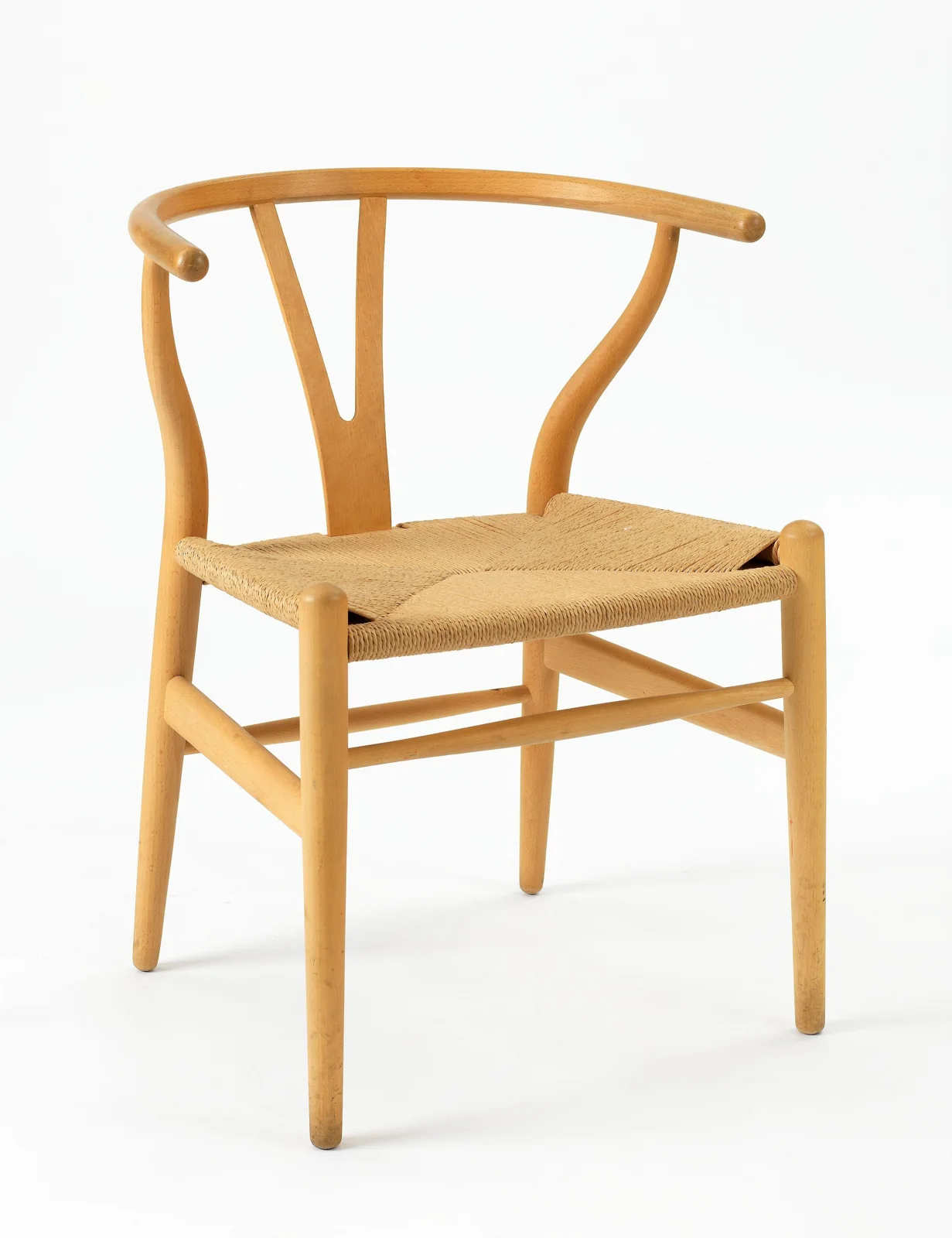
Hans J. Wegner trained as a cabinetmaker before becoming one of the most prolific chair designers of the period. Carl Hansen & Søn records that he designed the CH24, or Wishbone Chair, in 1949 and that it entered production in 1950. The maker identifies a single steam-bent back-and-arm member, a Y-shaped back, more than 100 production steps, and about 120 metres of paper cord in the woven seat 2.

Read it with Bend–Brace–Weave:
- Bend: the continuous top member makes arm and back one sweeping line.
- Brace: the Y supports that curve and transfers back load toward the seat frame.
- Weave: paper cord makes a compliant sitting surface without a thick upholstered pad.
The chair looks simple because operations are visually coordinated. It is not simple to make. Turning, steam bending, joinery, sanding, and weaving each require a different control system. This distinction matters when planning an homage: a clear silhouette can conceal a high tooling and skill count.
What is fact and what is interpretation?
Documented: design and production dates, maker, materials, component functions described by the manufacturer, and the production sequence. Interpretation: that the continuous arm “welcomes” the sitter or the Y reads as organic growth. State the first category with citations and the second as your own visual reading.
Quick check
The maker cites a single steam-bent back-and-arm member, a Y-shaped back, more than 100 production steps, and about 120 m of cord.
Børge Mogensen and the J39: democratic refinement
Mogensen’s J39, introduced in 1947, is a more approachable construction study. Fredericia documents its solid-wood frame, woven seat, long production history, and development from Klint’s 1936 Church Chair 3. Its ladderback ancestry is easy to see, but ancestry is not identity. Compare:
- A traditional post-and-rung chair may use turned round parts and wet/dry joints.
- The J39 regularizes sections and proportions for controlled manufacture.
- The woven surface preserves replaceability and calibrated give.
- A shaped back rail refines contact without abandoning the frame family.
This is why the J39 is a good first Danish-modern analysis project. Its distinction lies in relationships rather than one difficult sculptural component.
Finn Juhl: separate body support from frame
Finn Juhl treated frame, seat, and back as visibly distinct elements. Gaps make the upholstered or shaped body-support surfaces appear to float inside a wooden structure. This changes both visual weight and the sequence of assembly.
His house, completed in 1942 and preserved at Ordrupgaard, presents furniture, architecture, and art as an integrated environment; the museum specifically identifies works such as the Chieftain Chair within the house 4. That context matters. A chair designed for a total interior should not be judged only against a white product background.
Use the two-silhouette test on a Juhl chair:
- Trace only the wooden frame.
- Trace only the surfaces that touch the body.
- Ask where the two systems connect and where air separates them.
The gaps are not leftover space. They are an authored part of the composition.
Material honesty has several meanings
Designmuseum Danmark’s survey moves from Klint’s historically grounded work through designers including Arne Jacobsen, Poul Kjærholm, Verner Panton, and Nanna Ditzel 5. That breadth is enough to correct a common shortcut: “Danish” cannot mean only “solid oak made by hand.”
A better question is whether a design lets a material do characteristic work:
- Solid wood carries along its grain and accepts shaped joints.
- Veneer can be molded into consistent curved surfaces.
- Steel achieves slender continuous tension and compression members.
- Cord forms a replaceable membrane through repeated tension.
- Upholstery distributes pressure and can visually separate body support from frame.
Honesty is not leaving every material raw. It is aligning section, joint, and finish with the process that actually produces the chair.
A construction-complexity calculation
Before choosing a homage, count process families, not parts. Give one point for each new family:
- straight milling
- turning
- angled mortise-and-tenon joinery
- steam bending
- carving/sculpting
- weaving
- upholstery
- metal fabrication
- dedicated press tooling
A J39-style study may need milling, joinery, shaping, and weaving: about four families. A CH24-style study adds turning and a demanding steam bend: perhaps six. A Jacobsen shell adds press tooling that dominates the project even if the shell is only one part.
This is not a difficulty score. It predicts setup changes, samples, and failure modes. Choose the project whose process families match the lesson you want.
Quick check
A one-part molded shell can be harder than a many-part J39 because press tooling dominates the project.
Observation workflow at a museum or dealer
With permission, move around a chair and record:
- Front, side, rear, and underside photographs—not just the iconic angle.
- Which members continue through intersections and which terminate.
- Grain direction at every curve.
- Signs of jigs: repeated transitions, identical facets, centered tool marks.
- Replaceable elements and access to their connections.
- Wear patterns where actual users touch the chair.
Do not take dimensions from a perspective photograph. If measurement is allowed, note overall envelope, clear seat, seat height front and rear, and major joint centers. Label all derived dimensions as estimates.
Build response
For a first study, choose a J39-like post-and-rung side chair or a cord-weaving sample frame. Build one full-size side elevation, one joint sample, and a twelve-inch square of the intended weave before milling the chair set.
For a Wishbone-inspired project, the responsible first artifact is the top-rail bend sample. Record species, blank selection, moisture, bend radius, strap setup, and springback. If the bend is unreliable, no amount of downstream accuracy will save the design.
Danish modern is not a menu of famous silhouettes. School–Shop–Show–Scale created a culture in which measurement, material, craft, and production could continuously correct one another. Carry that system into the shop: study a type, understand its operations, prototype the risky one, and let clarity be the result.
Lesson complete
Nice work.
Sources for this lesson
- 1History and Architecture. Designmuseum Danmark. verifiedMuseum history describing Kaare Klint's furniture school, teaching, analytical study of space, and influence on Danish designers. Cited at: Kaare Klint and the furniture school; @designmuseum-danish-modern|Danish Modern.
- 2CH24 Wishbone Chair. Carl Hansen & Søn. verifiedManufacturer documentation of design date, continuous production, components, steam-bent rail, and paper-cord weaving. Cited at: description and production.
- 375 Years of J39. Fredericia Furniture. verifiedManufacturer history of Børge Mogensen's 1947 J39 and its relationship to Kaare Klint's Church Chair. Cited at: 75 Years of J39.
- 4Finn Juhl's House. Ordrupgaard. verifiedMuseum visitor and collection page for Juhl's 1942 house and its integrated furniture and art. Cited at: house and collection.
- 5Danish Modern. Designmuseum Danmark. verifiedOfficial exhibition overview tracing Danish modernism from Kaare Klint through industrial production and later designers. Cited at: exhibition overview.