Mingei and Modern Japan
Japanese chair design from the mingei folk-craft movement founded in 1925 to Sori Yanagi's molded-plywood Butterfly stool, Isamu Kenmochi, and Naoto Fukasawa's Hiroshima Armchair, with a method for separating observation, construction inference, and cultural interpretation.
- 6 min
- 7 steps
- 3 questions
- Lesson 112 of 160
In this lesson
- Mingei: the documented history
- Sori Yanagi: model first, industry second
- Kenmochi and the range of Japanese modernism
- The contemporary case: Hiroshima Armchair
- Observation exercise: three levels of claim
- Build translation: learn the system, not the silhouette
Picking up where you left off.
Modern Japanese chair design begins with an apparent contradiction: a movement that valued ordinary work by unnamed makers helped shape some of the country’s most recognizable named designers. The contradiction is productive. It asks whether industrial repetition can preserve the practical intelligence of handcraft—or only imitate its surface.
Mingei: the documented history
In 1925, Yanagi Sōetsu, Hamada Shōji, and Kawai Kanjirō coined mingei, literally “folk crafts” or “common crafts.” Yanagi had become interested in the beauty of useful objects made by unknown craftspeople, including Korean ceramics and regional Japanese work. He promoted collecting, exhibitions, writing, and field research, and in 1936 the Japan Folk Crafts Museum opened in Tokyo with Yanagi as its first president 1.
Those are documented institutional facts. Yanagi’s aesthetic claims require more care. He associated beauty with utility, repetition, natural materials, regional practice, and a maker not pursuing individual celebrity. His argument was influential, but it was also selective: a collector and intellectual decided which labor counted as authentic folk craft. Treat mingei as a lens, not as a neutral label placed on every handmade object.
Use the mnemonic U-R-A when applying that lens:
- Use: what daily need disciplined the form?
- Repetition: what did making the type many times teach?
- Anonymity: how much does the object depend on individual authorship?
U-R-A does not deliver a verdict. It gives you three questions that can be asked of a village stool, a factory chair, or your own capstone.
Quick check
The three coined ‘folk crafts’ in 1925; the Japan Folk Crafts Museum opened in Tokyo in 1936 with Yanagi Sōetsu as president.
Sori Yanagi: model first, industry second
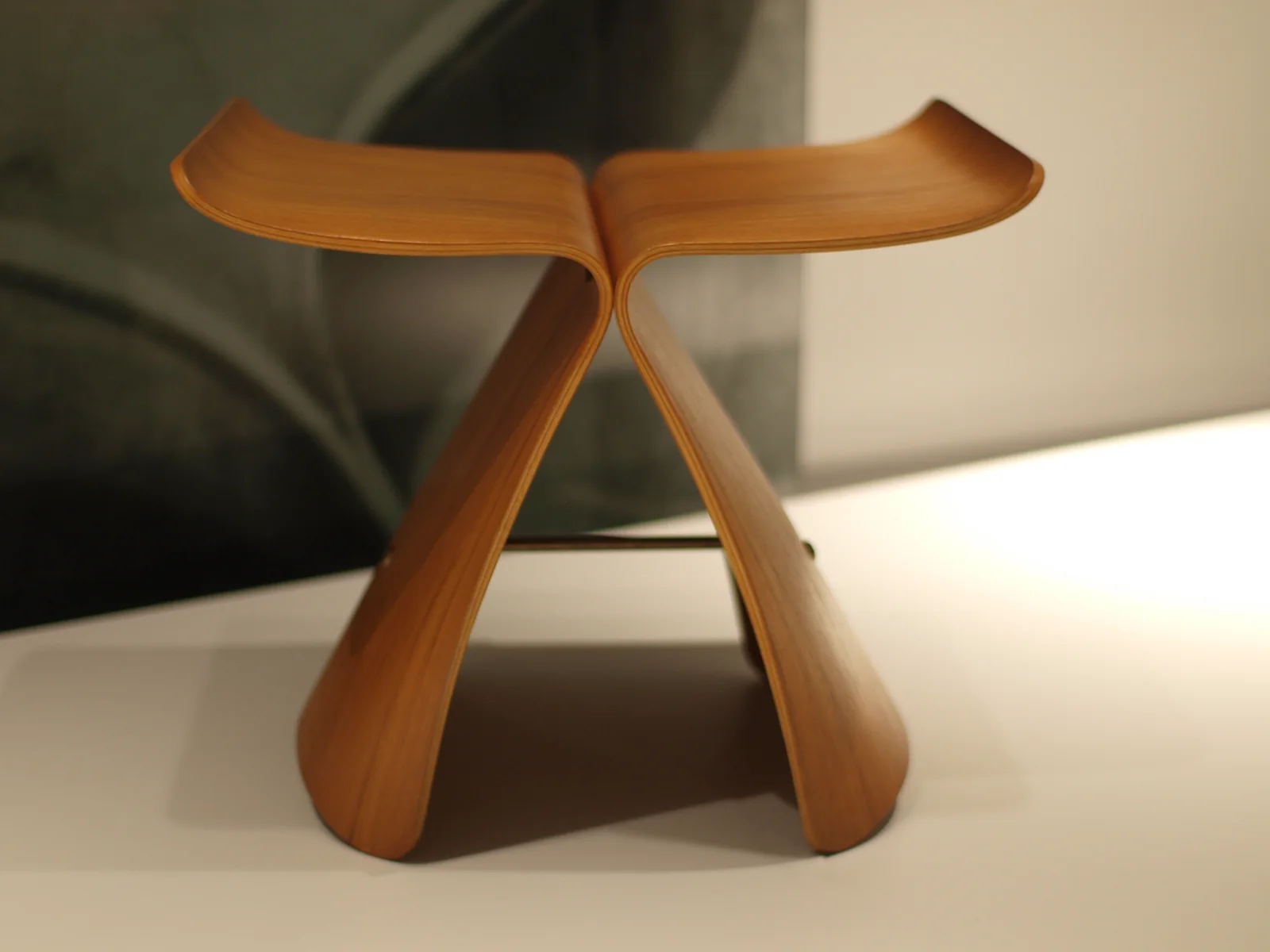
Yanagi’s son, Sori Yanagi, became a prominent industrial designer. Tendo Mokko identifies him among the designers attracted to its molded-plywood capabilities, which combined thin veneers, press forming, and complex curves 2. His Butterfly stool, designed in 1954, uses two equivalent molded-plywood shells mirrored across a narrow center gap and joined near the floor. The Vitra Design Museum describes the object as two bent plywood shells connected by a brass rod 3.
.jpg)
Read the stool structurally
Do not begin with “butterfly” or “torii.” Begin with the load:
- The sitter loads the high inner edges of the two shells.
- Each shell carries load downward while curving outward to create a stable footprint.
- Mirroring balances the visual and structural system.
- The lower connector controls the tendency of the shells to spread or rotate independently.
Now return to association. Many viewers read wings or a shrine gate in the silhouette. Those readings are interpretations, not construction facts. Their usefulness lies in showing how an industrial technique can produce a form legible in more than one cultural vocabulary without applied ornament.
A comparison method: translate, do not paste
When looking for Japanese influence in a modern object, separate three kinds of evidence:
- Material translation: a known form rebuilt in bamboo, plywood, or rattan.
- Process translation: hand-modeling, repeated prototypes, or workshop knowledge guiding factory tooling.
- Formal association: a shape that viewers connect to a gate, fan, wing, or calligraphic line.
The first two can often be documented. The third should be stated as a reading: “the mirrored profile can recall…” rather than “the designer intended…” unless a primary source supplies the intention.
Quick check
Two press-formed shells carry load outward to a stable footprint; the connector keeps them from spreading independently.
Kenmochi and the range of Japanese modernism
Isamu Kenmochi worked across craft and industrial production. His place in this lesson is not a single mandatory icon but a broader problem: how can material knowledge enter standardized production without losing the reason it works? Tendo Mokko’s company history specifically places Kenmochi alongside Sori Yanagi in the development of Japanese molded-plywood furniture 2.
Compare three strategies:
- The Butterfly stool reduces an object to two press-formed equivalents.
- A woven rattan seat distributes load through many repeated fibers and connections.
- A laminated timber seat gains mass and carved continuity from stacked material.
All can be “modern.” The word describes neither one look nor one manufacturing scale.
The contemporary case: Hiroshima Armchair
Maruni Wood Industry dates Naoto Fukasawa’s Hiroshima Armchair to 2008 and describes a development process that began with a foam prototype, continued through repeated testing, and combined precise machining with hand finishing 4. This is useful evidence for a phrase often used too loosely: industrialized craft.
Break the phrase into operations:
- Machines establish repeatable complex geometry.
- Skilled workers inspect and refine transitions the body and hand will meet.
- Prototypes feed observations back into the machine-ready model.
- Production repeats an authored design, but quality still depends on trained judgment.
This does not make the Hiroshima chair mingei in Yanagi’s strict sense; it is a named design made by a branded manufacturer. It does show the persistence of the U-R-A questions. Use disciplines the arm and back. Repetition refines the production method. Anonymity is replaced by collaboration among designer, engineers, machinists, and finishers.
Observation exercise: three levels of claim
Study the Butterfly photograph for five minutes and write three sentences:
- Observation: “Two shells mirror each other and touch the floor at four broad edges.”
- Mechanical inference: “The lower rod likely limits independent spreading.”
- Cultural interpretation: “The central opening can evoke a torii silhouette.”
Labeling the levels prevents interpretation from masquerading as documented fact. It also makes criticism sharper: another viewer can agree with the observation, test the mechanical inference, and disagree with the association without the whole reading collapsing.
Quick check
Observation, mechanical inference, and interpretation are labeled separately so a reading isn’t passed off as fact.
Build translation: learn the system, not the silhouette
The original stool depends on controlled industrial molding. A shop homage made from bent laminations is therefore a translation, not an exact reproduction. Before making a full shell:
- Laminate a narrow test strip to the proposed radius.
- Record species, veneer thickness, ply count, adhesive, open time, and springback.
- Make the two halves from the same batch so their stiffness and color agree.
- Prototype the connector and test side-to-side stability.
- Credit Yanagi and Tendo Mokko when sharing the result.
The deeper exercise is to design a different small seat using the same logic: two repeated components, minimal hardware, and a form that comes from the manufacturing action. That response carries the lesson forward instead of merely tracing an icon.
Mingei and Japanese modernism are not a tidy hand-versus-machine story. They are a continuing argument about use, repetition, authorship, and the intelligence held in a process. Keep U-R-A—Use, Repetition, Anonymity—and state clearly when you move from documented history to your own reading.
Lesson complete
Nice work.
Sources for this lesson
- 1History of the Japan Folk Crafts Museum and Founder Soetsu Yanagi. The Japan Folk Crafts Museum. verifiedOfficial history of Yanagi, the 1925 coinage of mingei, and the museum's 1936 founding. Cited at: museum history.
- 2About Tendo Mokko. Tendo Mokko. verifiedManufacturer account of its molded-plywood development and work with Sori Yanagi and Isamu Kenmochi. Cited at: Beauty and plywood; designer collaborations.
- 3Butterfly Stool — Miniatures Collection. Vitra Design Museum. verifiedMuseum documentation of Sori Yanagi's molded-plywood stool and its construction. Cited at: object description.
- 4HIROSHIMA Armchair — Refined in Form. Maruni Wood Industry. 2026. verifiedManufacturer account of the 2008 Naoto Fukasawa collaboration, prototypes, machining, and hand finishing. Cited at: HIROSHIMA Armchair history.