The Wider North
Finnish and Swedish lessons: Aalto and Korhonen's bent birch L-leg as a product system, Mathsson's Eva chair of laminated beech and hemp webbing, Malmsten's 1942 Lilla Åland stick chair, Krenov's listening to wood, and three kinds of lightness.
- 6 min
- 8 steps
- 3 questions
- Lesson 115 of 160
In this lesson
- Aalto standardizes: the L-leg as a system
- Mathsson suspends: frame plus membrane
- Malmsten humanizes: revise the inherited type
- Krenov listens: material as a design participant
- Three different kinds of lightness
- Observation exercise: isolate the innovation
- Build responses at three scales
Picking up where you left off.
Denmark does not own Nordic modernism. Finland and Sweden offer a different set of lessons: a standardized bent leg that became a product system, a chair that is mostly flexible webbing, a stick chair refined from a church type, and schools that made workshop culture part of the design legacy.
Use four verbs to keep the figures distinct: Aalto standardizes, Mathsson suspends, Malmsten humanizes, Krenov listens. These are study prompts, not complete biographies.
Aalto standardizes: the L-leg as a system
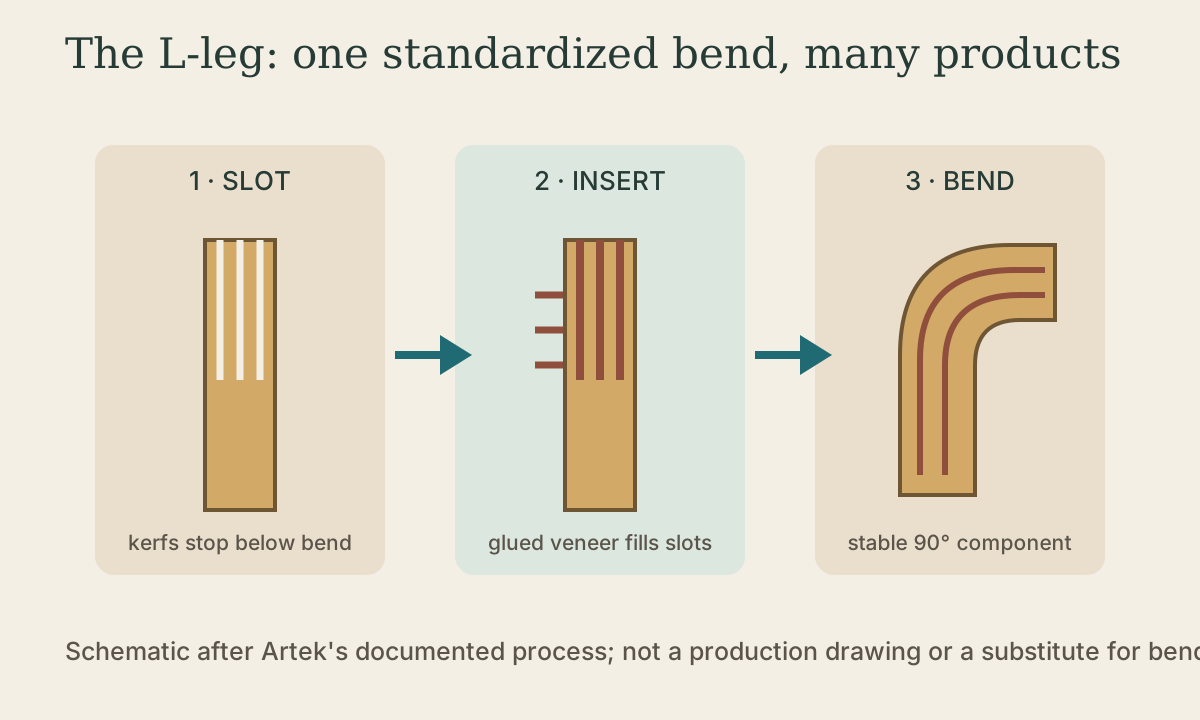
Alvar Aalto and manufacturer Otto Korhonen developed a method for bending solid birch into a stable right-angle component. Artek describes slots cut into the end of a wood member, veneer strips inserted and glued, and the reinforced portion bent to form the L-leg, patented in 1933 1.
The famous Stool 60 is a particularly clear application: three standardized legs attach directly to a round seat. The conceptual achievement is larger than the stool. A repeatable leg can support stools, chairs, benches, and tables. Design shifts from drawing each object independently to building a component grammar.
Calculate the value of a standard part
Suppose a workshop makes five products. Without a shared leg, each needs a separate bend form, drilling jig, and inspection routine: fifteen fixtures. If one L-leg family serves all five, each product may still need a drilling template, but the bend form and leg inspection are shared:
The arithmetic is simplified, but the principle is real: standardization moves effort into one well-developed component and spreads it over many objects.
The caution is equally important. The diagram is explanatory, not a shop plan. Slot depth, veneer thickness, moisture, adhesive, pressure, and bend radius interact. A home builder must prototype. A visual copy of the kerfs is not the patented production knowledge.
Quick check
The 1933 patented L-leg became a standard component used across stools, chairs, benches, and tables.
Mathsson suspends: frame plus membrane
Bruno Mathsson’s Eva Chair, dated 1934 by MoMA, combines bent laminated beechwood with natural hemp webbing 2. Instead of carving a seat to match the body, Mathsson stretched a compliant surface across a light frame.
Read it as two systems:
- The laminated side frames establish the posture and carry load to the floor.
- The continuous webbing distributes the body over many bands and can flex between supports.
The seat is neither mere upholstery nor an independent cushion. Webbing tension affects comfort, sag, and the load delivered to the frame. A loose band concentrates load on its neighbors; an over-tight band can make the surface hard and increase frame stress.
A webbing estimate
For parallel runs across a clear width \(W\), with finished band pitch \(p\), estimate the run count as
A 20-inch width at a 1.5-inch pitch needs about 14 runs. Multiply by the path length for each run, then add at least 15–20% for wrapping, tensioning, and mistakes. This is purchasing math, not a substitute for a proven weaving sequence.
Quick check
n = ceiling(20 / 1.5) = ceiling(13.3) = 14. Then multiply by run length and add 15-20% for wrapping and mistakes.
Malmsten humanizes: revise the inherited type
Carl Malmsten’s Lilla Åland is a stick chair rather than an industrial shell. Stolab dates the chair to 1942 and traces its inspiration to seating Malmsten encountered at Finström church in Åland 3. The chair uses turned legs, a shaped seat, and a rhythm of back sticks: familiar vernacular means, deliberately refined.
Compare it to a Windsor with a four-column reading:
| Feature | Inherited type | Lilla Åland decision |
|---|---|---|
| Seat | thick plank hub | softened oval and edge profile |
| Back | sticks into seat | regular, closely spaced rhythm |
| Legs | splayed sockets | turned, controlled stance |
| Expression | regional variation | repeatable authored proportion |
The interpretation is not that Malmsten “invented” the stick chair. His design value lies in selecting and tuning relationships inside an old structural family.
Quick check
Malmsten refined an inherited stick-chair type rather than inventing a new one.
Krenov listens: material as a design participant
James Krenov was primarily a cabinetmaker, not a chair designer. He belongs here through lineage and method. The Krenov School records his training at the Malmsten School in Sweden and the opening of the College of the Redwoods Fine Woodworking Program in Fort Bragg in 1981 under his guidance 4.
“Let the wood speak” can dissolve into sentiment unless turned into decisions about three things:
- Grain: orient the part so figure and fibers reinforce its job.
- Section: remove mass until the part looks and feels appropriate without sacrificing the joint.
- Surface: plane, scrape, carve, or sand according to the tactile result, not workshop ideology.
Listening is not obeying every irregularity. A chairmaker sometimes rejects beautiful wood because its grain is structurally wrong. Material sensitivity includes saying no.
Three different kinds of lightness
The designs in this lesson look light for different reasons:
- Component lightness: Aalto reduces a stool to seat plus standardized legs.
- Surface lightness: Mathsson replaces a thick seat with tensioned bands and air.
- Proportional lightness: Malmsten uses taper, spacing, and stance to make a traditional solid-wood type visually buoyant.
Do not copy “Scandinavian lightness” as blond color. Ask which strategy removes material, combines functions, or redistributes load.
Observation exercise: isolate the innovation
For each object, finish this sentence with a construction verb:
- Stool 60 becomes possible because the leg is ______.
- Eva becomes comfortable because the body is ______.
- Lilla Åland becomes distinctive because the inherited type is ______.
Good answers might be “slotted, reinforced, and bent”; “suspended on tensioned webbing”; and “proportioned and regularized.” Weak answers—“minimal,” “organic,” “timeless”—describe mood without mechanism.
Then identify what remains conventional. Innovation usually changes one subsystem while relying on proven material and furniture knowledge elsewhere.
Build responses at three scales
One-hour study: make a full-size cardboard section of the L-leg and label solid wood, slots, veneer, and bend zone. The model cannot predict strength; it proves you understand the sequence.
One-day study: weave a small webbing frame. Mark starting tension, measure sag under a known weight, leave it loaded overnight, and measure again. You are learning creep and tension distribution before building a lounge chair.
One-chair study: use stick-chair methods to design a personal side chair after Lilla Åland. Preserve proven sockets and sections; vary crest profile, stick rhythm, and seat edge. Credit the historical and modern sources rather than presenting the type as newly invented.
The wider North replaces a style label with four operations: standardize, suspend, humanize, listen. Those verbs are portable. You can use them with local wood, in a small shop, without making a pale imitation of a famous chair.
Lesson complete
Nice work.
Sources for this lesson
- 1L-leg Collection. Artek. verifiedManufacturer account of Aalto's slotted, veneer-reinforced bend, patented in 1933. Cited at: collection history.
- 2Bruno Mathsson, Eva Chair (T101 model 41), 1934. The Museum of Modern Art. verifiedMuseum object record specifying bent laminated beech and natural hemp webbing. Cited at: object record.
- 3Lilla Åland Chair. Stolab. verifiedManufacturer account of Malmsten's 1942 chair, its Finström church source, materials, and construction. Cited at: product history.
- 4About the School. The Krenov School of Fine Furniture. verifiedSchool history tracing Krenov's Malmsten training and the Fort Bragg program opened in 1981. Cited at: school history.