Museum to Mockup: An Honest Inspiration Plan
Turning a museum chair into an honest original: citation versus permission, labeling every value observed, derived, chosen, or tested, calibrating photographs one plane at a time, an uncertainty ledger, a morphology matrix for variation, and mockup gates.
- 9 min
- 8 steps
- 3 questions
- Lesson 145 of 160
In this lesson
- Citation and permission are separate gates
- ODCT: four labels that do not drift
- Worked photo-plane calibration
- Keep an uncertainty ledger
- Make an original variation with a morphology matrix
- Full-size mockup gates
- The deliverable: an honest inspiration-plan packet
Open alongside this lesson
-
Side Chair, Shaker, 1840-1860 (opens in a new tab)
Public Domain object record with four downloadable views, material, accession number 66.10.5, and overall dimensions. Those dimensions do not constitute a shop plan.
-
Campeche Chair (opens in a new tab)
Public Domain object record with thirteen downloadable views, materials, accession number 2000.451, and overall dimensions; useful for observation and reverse-engineering study, not a controlling plan.
-
A Campeche Chair in The Metropolitan Museum of Art (opens in a new tab)
Scholarly construction analysis covering mortise-and-tenon, half-lap, sliding-dovetail, wedged-stretcher, and leather-sling details. Free access does not establish a Creative Commons license for the article or its figures.
-
Side Chair 3D Model (opens in a new tab)
Downloadable Smithsonian Open Access 3D model marked CC0. Treat scan geometry as collection documentation and verify scale and construction before deriving any fabrication dimensions.
Picking up where you left off.
A museum record can show you more than a beauty shot: several views, an accession number, material, date, overall dimensions, and sometimes an inspectable scan. It still does not tell you where every joint center lies, what a hidden tenon looks like, whether a curved line is original or deformed, or which construction choice will work in your shop.
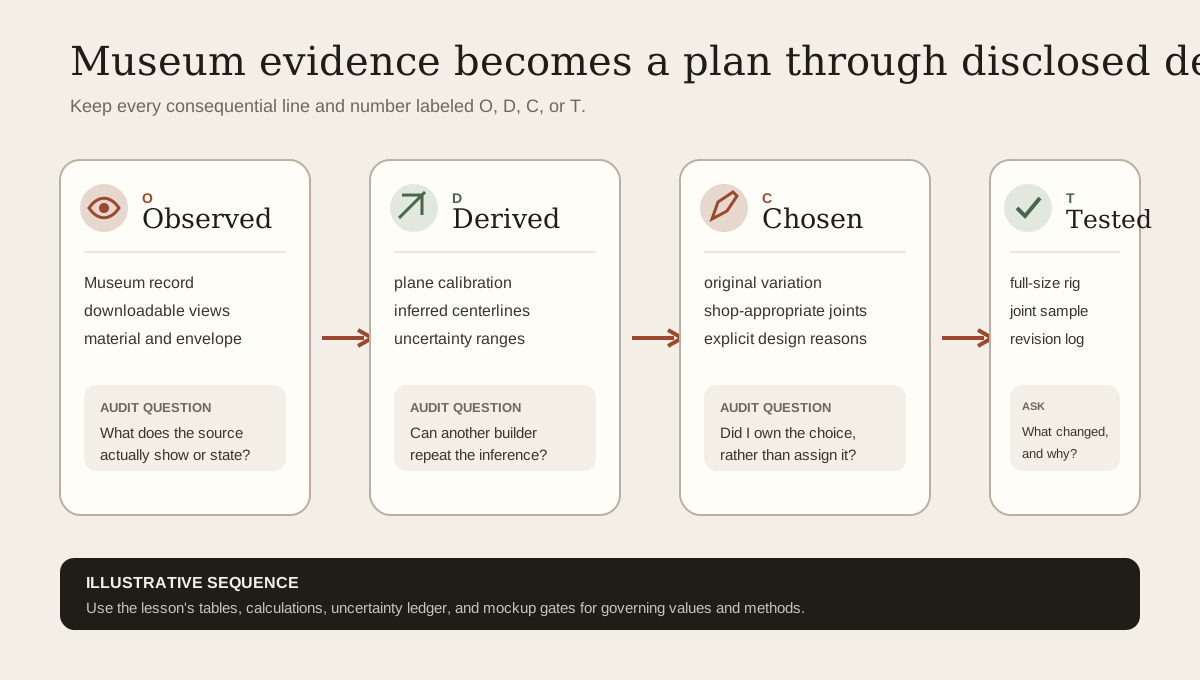
This lesson turns collection evidence into an honest inspiration plan. The method is Observed → Derived → Chosen → Tested, abbreviated ODCT. Every important line and number keeps one of those labels. The goal is not to make an uncertain replica look authoritative. It is to make an original variation whose evidence and decisions another builder can audit.
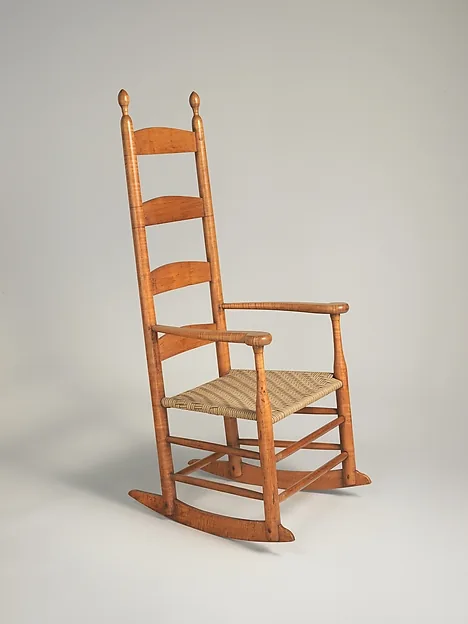
The Met’s Shaker side-chair record supplies four public-domain views, maple as the material, an object number, and an overall envelope of 26 by 17 1/4 by 12 1/4 inches 1. The Met’s Campeche chair offers thirteen public-domain views and an overall envelope, while its companion article examines mortise-and-tenon, half-lap, sliding-dovetail, wedged-stretcher, and leather-sling construction 2 3. Those are unusually rich evidence sets. Neither is automatically a shop plan.
Citation and permission are separate gates
Citation answers: What evidence did I use, and where did it come from? Permission answers: What may I copy, modify, publish, or redistribute? Passing one gate does not pass the other.
The Met marks the cited object images Public Domain. The Smithsonian model is downloadable and marked CC0, so its digital geometry can be copied and modified subject to the source’s stated terms 4. By contrast, a scholarly article being free to read does not by itself grant permission to republish its text or figures. Cite the article’s construction findings, paraphrase them, and check its rights statement before reusing an illustration.
Keep a rights line beside every source:
| Source item | Evidence use | Rights status | What enters your plan packet |
|---|---|---|---|
| Public-domain museum photograph | silhouette, visible joints, wear, proportions | stated Public Domain | credited image or your annotated crop |
| CC0 scan | inspectable surface geometry and additional viewpoints | stated CC0 | measurements with scale checks and scan caveats |
| Free scholarly PDF | historical and construction interpretation | free access; license not assumed | your paraphrase and citation, not copied figures |
| Your drawing and mockup photos | chosen geometry and test evidence | your original work | may be licensed by you |
Do not write “museum plan” on a file derived from an object record. Write “inspiration study after [object, museum, accession number].”
ODCT: four labels that do not drift
Use these labels in drawing layers, spreadsheet rows, and notebook margins:
| Label | Meaning | Example | Rule |
|---|---|---|---|
| O — Observed | Directly stated or plainly visible evidence | “Museum record lists maple”; “three horizontal slats are visible” | Record the source and view |
| D — Derived | A calculation or inference from observations | estimated slat span from a calibrated front photograph | Show inputs, method, and uncertainty |
| C — Chosen | Your design decision | seat height selected for your fitting rig | Never attribute it to the historical maker |
| T — Tested | Result from a physical or digital check | full-size mockup moved the crest 3/4 inch forward | Record setup, result, and revision |
An inference does not become observed because it looks convincing. A chosen value does not become historical because it survives a mockup. Testing validates your variation against its brief; it does not prove that you recovered an original maker’s intention.
Quick check
A chosen value never gets attributed to the historical maker, even if it survives a mockup.
Worked photo-plane calibration
Photographs are perspective projections. Scale is defensible only within a plane that is approximately parallel to the image sensor. Never use one global pixels-to-inches factor across the front and back of a chair.
Use the Shaker side-chair record as a worked exercise. The museum reports an overall width of 17.25 inches. In an unresampled analysis copy of a nearly frontal view, suppose the two visible extrema corresponding to that width span 862 pixels. Before calculating, verify that those extrema plausibly occupy the same shallow depth plane as the target. If they do not, reject the anchor.
The image scale for that plane is:
Suppose the visible shoulder-to-shoulder span of a back slat in the same plane measures 654 pixels:
Now account for uncertainty rather than rounding the estimate into false precision:
| Uncertainty | Governing value | Effect on the 13.09-inch estimate |
|---|---|---|
| repeated endpoint selection | ±4 px | ±0.08 in |
| residual perspective and plane mismatch | ±3% | ±0.39 in |
| conservative working interval | add the two allowances | ±0.47 in |
Record the result as D: 13.1 inches, working interval 12.6–13.6 inches. It is not a cut-list dimension. Make a full-size visual mockup across that interval, then choose a value for your design. Once selected, the drawing should say C, not O or D.
Calibration fails when the camera is oblique, the museum dimension describes an envelope formed by points at different depths, the image has been cropped and rescaled inconsistently, or the target disappears behind another member. A 3D scan can supply another view, but scan meshes may include texture noise, repaired surfaces, deformation, and an uncertain unit scale. Verify the model against a published dimension before measuring it.
Quick check
Calibrate each plane separately and verify the anchor features lie in that plane.
Keep an uncertainty ledger
Every derived or consequential chosen value gets a ledger row. Use ranges while evidence is weak; collapse a range only when a stated decision or test supports it.
| ID | Candidate value | Class | Evidence and uncertainty | Consequence | Resolution |
|---|---|---|---|---|---|
| D-01 | slat span 12.6–13.6 in | Derived | calibrated front plane; ±0.47 in | changes post spacing | test three cardboard slats |
| D-02 | rear-post lean 4°–7° | Derived | two side views disagree | changes back contact and footprint | full-size side mockup |
| C-01 | seat height 17 1/4 in | Chosen | fitting rig for intended user | sets rail and foot geometry | freeze after ergonomic gate |
| C-02 | woven-tape seat | Chosen | repairable and shop-appropriate | creates sustained rail tension | weave corner and rail sample |
| T-01 | crest moved 3/4 in forward | Tested | locked full-size rig; recorded user | improved shoulder contact | revise elevation to version B |
“Looks about right” is not a resolution. Name the next test, the person responsible, and the drawing revision that receives the answer.
Make an original variation with a morphology matrix
A morphology matrix separates a chair into systems so you can choose a coherent combination instead of tracing one silhouette. It is a design tool, not a copyright safe harbor.
| System | Observed possibilities | Chosen variation |
|---|---|---|
| structural family | Shaker post-and-rung frame; Campeche crossed reclining frame | post-and-rail frame with replaceable seat |
| posture | compact upright; deep recline | dining-upright with modest back lean |
| back support | horizontal slats; continuous leather sling | three unequal slats shaped from straight stock |
| seat | woven infill; leather membrane | woven tape on accessible rails |
| member language | turned rounds; broad curved members | faceted posts with round rungs |
| visual rhythm | regular ladder; sweeping mirrored curves | tight lower rhythm, wider upper spacing |
Write one sentence explaining each choice. Then identify the load-path consequences. A woven seat tensions its rails. Wider upper slat spacing changes where the back is supported. Faceted posts need joint reference surfaces. If a visual choice has no construction answer, it is not ready for a plan.
Quick check
Choose among observed possibilities for each system instead of tracing one silhouette.
Full-size mockup gates
Move forward only when each gate leaves evidence:
- Evidence gate: source manifest, rights ledger, annotated views, and ODCT labels exist. Conflicting views remain visible.
- Drawing gate: full-size front and side centerlines agree on floor, seat, joint, and crest stations. Derived ranges are shown as bands, not single magic lines.
- Geometry gate: cardboard profiles and story sticks establish stance and negative space. They are not seating.
- Ergonomic gate: use a screwed or bolted fitting rig. Don’t sit on a decorative mockup held by clamps, tape, or friction. Record the intended user, posture, contact points, and revisions.
- Joint gate: make full-size samples of the most consequential joint and seat corner using the planned stock, tools, and fibers.
- Prototype gate: build version 1 as a documented prototype. A guarded test plan or competent review must govern any structural loading. Do not infer a service rating from resemblance to a museum chair.
At every gate, photograph a ruler or labeled story stick in the same plane as the feature being documented. Preserve failed mockups long enough to write what they disproved.
The deliverable: an honest inspiration-plan packet
Your final packet is complete when it contains:
- a source manifest with museum, object title, accession number, URL, access date, and rights statement;
- an evidence board with every claim tagged O, D, C, or T;
- the calibration worksheet, including rejected anchors and uncertainty arithmetic;
- the uncertainty ledger and morphology matrix;
- dimensioned front, side, and top drawings of your chosen variation, with revision and control dimension;
- full-size mockup photographs and test records;
- a cut list generated only after chosen geometry is frozen;
- joint and seat-corner sample drawings;
- a title such as “Original side-chair study inspired by Shaker frame logic and museum evidence; not a replica or museum-authorized plan”; and
- a license covering only your original text and drawings, with third-party source material listed separately.
The strongest plan is not the one that hides uncertainty. It is the one that makes every transition—from museum fact to estimate, from estimate to design choice, and from choice to tested revision—plain enough for the next builder to challenge and improve.
Lesson complete
Nice work.
Sources for this lesson
- 1Side Chair, Shaker, 1840-1860. The Metropolitan Museum of Art. verifiedPublic Domain object record with four downloadable views, material, accession number 66.10.5, and overall dimensions. Those dimensions do not constitute a shop plan. Cited at: object details, dimensions, and image status.
- 2Campeche Chair. The Metropolitan Museum of Art. verifiedPublic Domain object record with thirteen downloadable views, materials, accession number 2000.451, and overall dimensions; useful for observation and reverse-engineering study, not a controlling plan. Cited at: object details and views.
- 3A Campeche Chair in The Metropolitan Museum of Art. The Metropolitan Museum Journal. 2003. verifiedScholarly construction analysis covering mortise-and-tenon, half-lap, sliding-dovetail, wedged-stretcher, and leather-sling details. Free access does not establish a Creative Commons license for the article or its figures. Cited at: construction analysis.
- 4Side Chair 3D Model. Cooper Hewitt, Smithsonian Design Museum. verifiedDownloadable Smithsonian Open Access 3D model marked CC0. Treat scan geometry as collection documentation and verify scale and construction before deriving any fabrication dimensions. Cited at: download and CC0 status.