Axes and Hatchets: Choosing and Sharpening
What makes a carving axe different from a felling axe, how to choose weight and handle length, how to sharpen without ruining the edge shape, and the chopping-block habits - stop cuts, the lower half only, the hand kept high - that keep axe work safe.
- 5 min
- 4 steps
- 4 questions
- Lesson 63 of 160
In this lesson
- Carving axe or felling axe
- Sharpening
- On the block
- What to take from this
Picking up where you left off.
Carving axe or felling axe
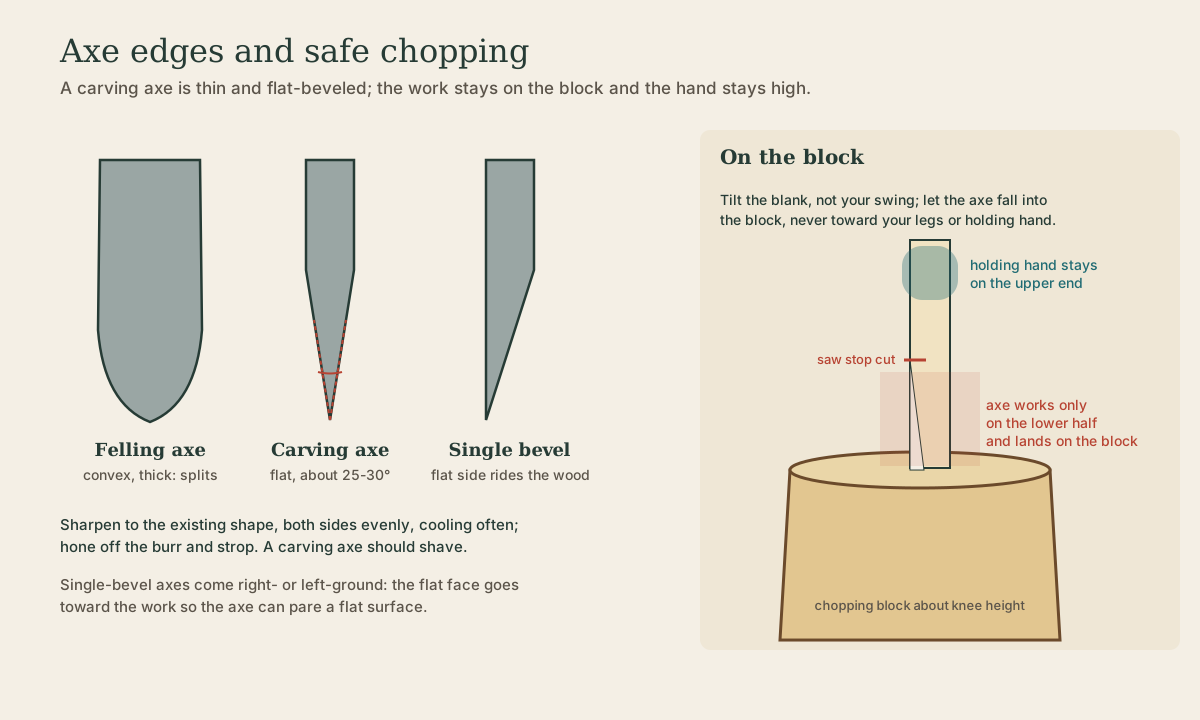
A felling or splitting axe has a heavy head and a fat, convex edge that throws chips and resists hardwood. A carving axe (hatchet) has a thin, flat bevel for paring and controlled slicing 1. Gränsfors puts it simply: thin, straight edges for carving; rounded edges for chopping in the forest 1.
What to look for:
- Weight: roughly 0.5-1 kg (1-2 lb) for the head. Heavier removes wood faster with less effort; lighter gives control for long sessions.
- Handle: 30-40 cm (12-16 in). Long enough to swing, short enough to choke up for fine work.
- A long, curved edge with a “beard” (the edge drops below the handle), so you can grip right behind the head and pare.
- Bevel: double bevel for general work; single bevel for flat hewing. Single-bevel axes come right- or left-ground; for a right-handed carver, the flat face goes toward the work 1.
- Sharp out of the box, or at least correctly shaped.
Quick check
Felling axes need a fat, convex edge to throw chips and resist hardwood; carving axes need a thin, flat edge for control.
Sharpening
Gränsfors Bruk’s guidance 1:
- Keep the original edge shape. Lay the whole bevel on the stone or file; don’t change the angle.
- Work both sides evenly and along the whole edge.
- Cool often. Overheating draws the temper - if the steel turns straw or blue, that part is soft. Power grinding is where axes get ruined; files and hand stones are safer.
- Hone with coarse then fine whetstones, moving in small circles, until the feather edge (burr) is gone from both sides.
- Strop on leather.
Target angle for a carving axe: about 25-30 degrees 1. A good carving axe will shave arm hair and leave a shiny, faceted surface on green birch. If it crushes fibers instead of slicing, it’s dull. Touch up with a fine stone before every session; regrind only when chipped.
Keep the edge covered with a sheath whenever it’s not in your hand.
Quick check
Thin enough to slice cleanly, not so thin it chips.
Quick check
Blue or straw colors at the edge mean the hardness is gone; grind slowly, by hand if possible.
On the block
Most axe work in sloyd happens with the blank standing on a chopping block at about knee height 2:
- Hold the blank by its upper end; the axe works only the lower half, and every cut finishes into the block. Then flip the blank end for end and do the other half.
- Stop cuts: make a saw cut across the grain where you want a shoulder (where a spoon’s bowl meets its handle), then axe down to it. The chip pops off at the saw cut instead of splitting along the handle.
- Tilt the blank, not your swing. Change the angle of the work to change the angle of the cut.
- Choke up behind the head for fine paring; slide back toward the end of the handle for heavier cuts.
- Let the axe’s weight do the work; short, controlled strokes beat big swings.
- Never cut toward your legs or holding hand, never axe on your lap, and don’t carve tired.
Barn the Spoon describes how the axe should feel in the hand, and how much of a spoon can be shaped with it before switching to the knife - more than beginners expect 3.
Playback is optional. If the player is unavailable, open the video at its source.
Quick check
If the axe slips or cuts through, it hits the block, not you. Turn the blank end for end to work the other half.
What to take from this
A carving axe is light (0.5-1 kg head), short-handled, and thin with a flat 25-30-degree bevel; felling axes are fat and convex. Sharpen to the existing shape, evenly on both sides, cooling often, and hone off the burr. On the block, hold the top, axe the lower half into the block, use saw stop cuts at shoulders, and tilt the work rather than the swing.
Lesson complete
Nice work.
Sources for this lesson
- 1Regrinding and sharpening your axe. Gränsfors Bruk. 2026. verifiedKeep the original edge shape, grind both sides evenly, cool often, hone off the feather edge; 25-30 degrees for carving axes.
- 2Wille Sundqvist. Swedish Carving Techniques. Taunton Press (reissued by Abrams). 1990. verifiedAxe and knife grips, sharpening, and household woodenware such as butter paddles, spoons, ladles, and dough bowls.
- 3Barn the Spoon. Spoon: A Guide to Spoon Carving and the New Wood Culture. Scribner. 2017. verifiedAxe and knife technique, sharpening, and spoon design from a London spoon carver.