Drawers: Half-Blind Dovetails, Bottoms, and Runners
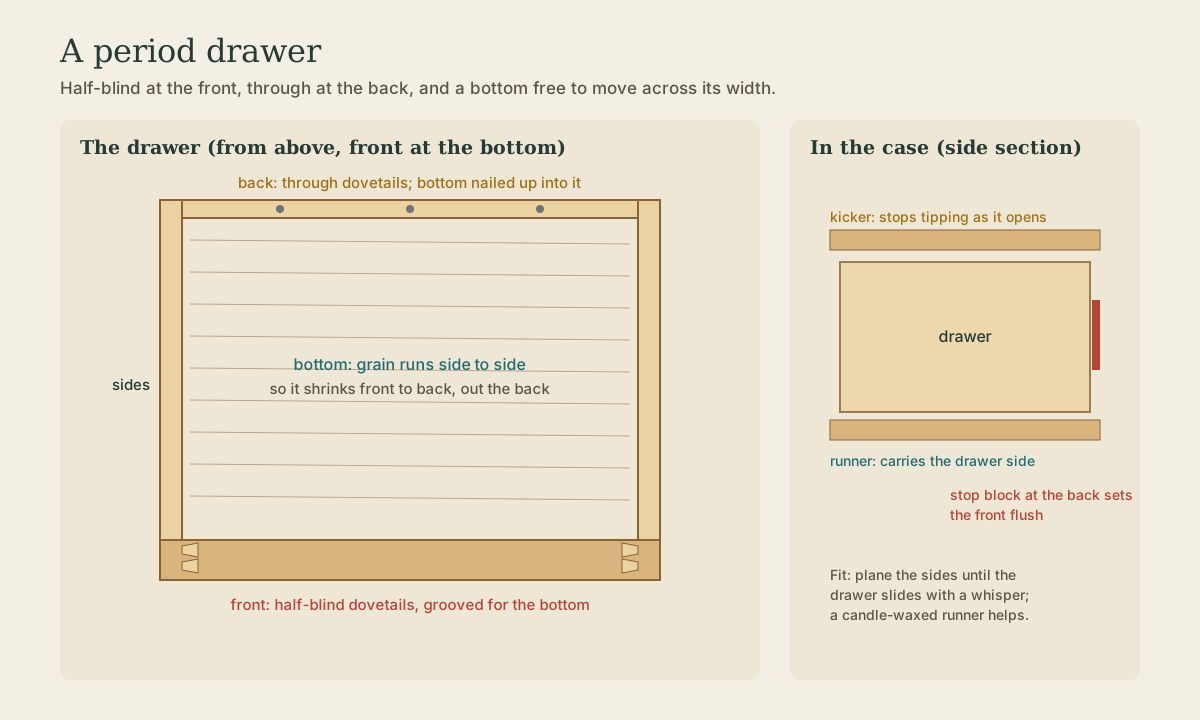
How a period drawer is built and fitted: half-blind dovetails at the front, through dovetails at the back, a bottom with its grain side to side that slides in under the back, runners, kickers, and stops in the case, and planing the drawer to a whisper fit.
- 4 min
- 6 steps
- 3 questions
- Lesson 57 of 160
In this lesson
- The box
- The bottom
- In the case
- Fitting
- Try it
- What to take from this
Picking up where you left off.
The box
A period drawer is a simple dovetailed box, but each joint is chosen for its job:
- Front: thick, joined to the sides with half-blind dovetails so nothing shows from the front and the pull of opening the drawer locks the tails against the pins.
- Sides: thinner, often a secondary wood like pine or poplar, grooved near the bottom edge for the bottom.
- Back: joined with through dovetails, and narrower than the sides; its lower edge sits on top of the bottom so the bottom can slide in underneath.
Dovetails on old drawers are typically few and widely spaced, with narrow pins (see Dovetails in Woodworking Foundations for cutting them). Gauge lines and saw overcuts left on the inside of the front are normal hand-work marks.
Quick check
The back sits on top of the bottom, which is then nailed up into it.
The bottom
- Grain side to side: the bottom’s grain runs across the drawer, parallel to the front. It shrinks and swells front to back, extending under the back rather than pushing the sides apart or splitting.
- Beveled edges: thick boards were beveled (or raised) along three edges to fit thin grooves in the front and sides. Hidden faces were often left fore-planed, since only show surfaces got the smoothing plane 1.
- Fastening: slide the bottom in from the back and nail it up into the back edge. No glue in the grooves, so it can move.
- Old repairs: if the grain runs front to back, or the bottom is glued in, it’s usually a later repair or a later piece.
Quick check
The bottom is nailed into the back, not glued into its grooves.
In the case
- Runners: strips along the case sides (or the drawer blades’ edges) that carry the drawer’s sides.
- Kickers: strips above each drawer’s sides that keep it from tipping down as it’s pulled out.
- Stops: small blocks glued at the back of the case (or at the front blade) so the drawer front stops flush.
- Dust boards: thin panels between drawers in better work, keeping dust and pilfering hands out.
- Graduated drawers: in chests of drawers, the drawers usually get taller toward the bottom, which looks right and puts heavy things low.
Quick check
The runner carries the drawer; the kicker stops it tipping.
Fitting
- Make the drawer a hair oversize and fit it after assembly.
- Plane the sides and edges with a sharp, fine-set plane, supporting the drawer on a board clamped in the vise or on a holdfasted batten.
- Test often. The goal is a drawer that slides with a whisper and pushes air when closed, without binding when humid.
- Rub paraffin or candle wax on the runners and the drawer’s bottom edges.
Fit in the season the piece will live in. A drawer fitted tight in a dry winter may stick in a humid Wisconsin August, so leave a little more clearance in winter.
Playback is optional. If the player is unavailable, open the video at its source.
Try it
Build one drawer for an existing opening: pine sides and back, a 3/4-in. hardwood front, half-blind dovetails at the front, through dovetails at the back, a beveled pine bottom with the grain running side to side, nailed into the back. Plane it to fit and wax the runners.
What to take from this
A period drawer has half-blind dovetails at the front, through dovetails at a narrower back, and a bottom with its grain side to side that slides in under the back and is nailed there, free to move. The case carries it on runners, kickers stop it tipping, and stops set the front flush. Plane it to a whisper fit for the season it will live in.
Lesson complete
Nice work.
Sources for this lesson
- 1Joseph Moxon, Christopher Schwarz. The Art of Joinery (2nd ed.). Lost Art Press. 2013. verifiedMoxon's 1678/1703 Mechanick Exercises joinery section with commentary. Fore plane with cambered iron set rank (shilling-thick shavings, about 0.04 in.), jointer set to a hair, smoothing plane set very fine; traversing; holdfast and planing stop; use the coarsest tool as long as possible.