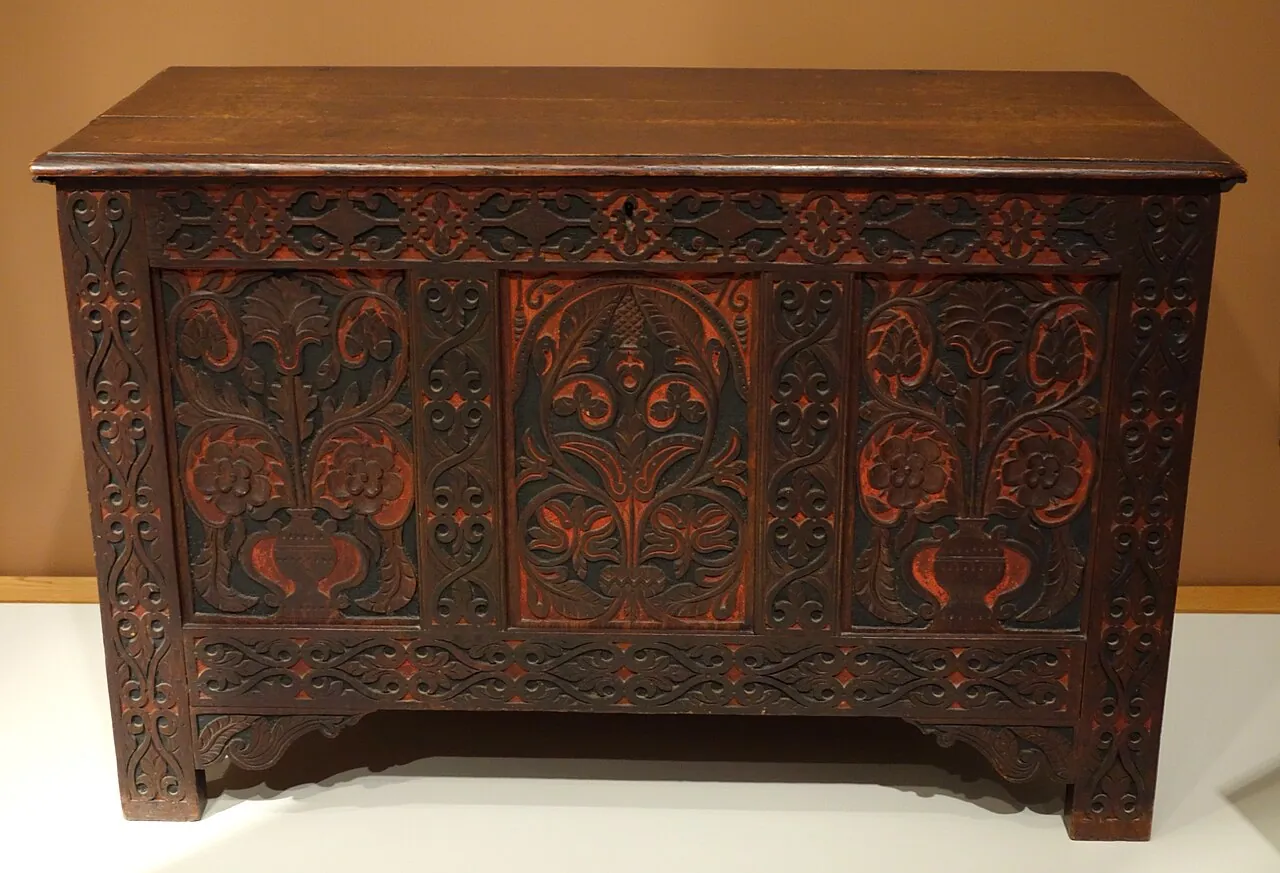
Carved Oak: Strapwork, Lunettes, and the Carved Box
Low-relief carving on 17th-century oak: the Thomas Dennis shop in Ipswich and its Exeter roots, laying out patterns with compass and gauge, setting in with gouges, lowering the background, and building a carved box.
- 4 min
- 6 steps
- 3 questions
- Lesson 54 of 160
In this lesson
- A shop and a style
- Layout
- Carving the pattern
- The carved box
- Try it
- What to take from this
Picking up where you left off.
A shop and a style
Much 17th-century New England joined furniture was carved: chest panels, rails, and box fronts covered in shallow relief patterns. The most elaborate came from the shop of Thomas Dennis (c. 1638-1706), a joiner in Ipswich, Massachusetts, from about 1667 until his death 1. His carving combines strapwork, curled scrolls, and flower-and-vine patterns, in a Jacobean style that joiners who emigrated from Exeter, England brought with them 1. All known New England strapwork carving comes from the Dennis shop 1.

Peter Follansbee has studied and reproduced these carvings for decades, and his Joiner’s Work covers carved decoration and carved boxes in detail 2.
Quick check
All known New England strapwork carving comes from the Dennis shop.
Layout
The patterns look free but are built from geometry:
- Gauge lines set the borders and the depth of each band.
- Dividers step off equal spaces along a rail for repeating units.
- A compass strikes the arcs: half-circle lunettes along a rail, interlaced arcs, and circles within squares.
- A square sets the verticals that divide panels.
Layout is scratched with an awl or the compass point, not drawn, so it stays visible as you work. Lay out on a planed, riven board; radial oak carves cleanly and its ray fleck shows through the background.
Quick check
Lunettes, arcs, and strap patterns come from a few divisions of the panel.
Carving the pattern
The carving is shallow, often about 1/8 in. deep:
- Set in: choose a gouge whose curve matches each arc and strike it straight down along the lines with a mallet, outlining the design. Straight lines get a flat chisel.
- Lower the background: with a flat or shallow gouge, cut toward the set-in lines and lift out the waste, leaving the pattern standing.
- Refine: clean up the walls, add veins and gouge cuts to the leaves and scrolls.
- Punch (optional): stamp the background with a punch to give it a uniform texture and hide tool marks.
Work with sharp tools and a few repeated cuts. The tool marks are part of the look; sanding them away is wrong for this work.
Playback is optional. If the player is unavailable, open the video at its source.
Quick check
Then the background is lowered up to those cuts.
The carved box
The carved box is the gateway project: a front and back of riven oak, often with carving on the front, ends rabbeted or butted and fastened with nails and wooden pins, and a pine or oak lid and bottom 2. The lid is hinged at the back, often on wooden pintles or small iron staples. Inside there may be a small till along one end.
A good sequence:
- Rive and plane the front, back, and ends.
- Lay out and carve the front while the oak is fresh.
- Cut rabbets and grooves, then nail and pin the case.
- Fit the bottom and lid; hang the lid; finish with linseed oil or paint.
Try it
Plane a riven oak board about 7 x 24 in. Lay out a row of lunettes with dividers and compass, set them in with two or three gouges, lower the background 1/8 in., and punch it. Then make it the front of a carved box.
What to take from this
17th-century New England oak was carved in low relief, most elaborately in Thomas Dennis’s Ipswich shop, in a style brought from Exeter. Lay out patterns with gauge, dividers, compass, and square; set in with matching gouges; lower and punch the background about 1/8 in.; and keep the tool marks. A carved box built from riven oak, nails, and pins is the place to start.
Lesson complete
Nice work.
Sources for this lesson
- 1Peter Follansbee. Strapwork Carvings from Thomas Dennis. Follansbee's Substack. verifiedThomas Dennis (c. 1638-1706), joiner of Ipswich, Massachusetts; strapwork, scrolls, and foliate carving in a style brought from Exeter, England.
- 2Peter Follansbee. Joiner's Work. Lost Art Press. 2019. verifiedNew England oak joinery from about 1620-1630 to the late 17th century, when joiners' riven oak work gave way to cabinetmakers' sawn maple, pine, and later mahogany; frame-and-panel, carving, carved boxes, joined chests; 1633 Plymouth probate inventories of tools.