Coarse, Medium, Fine
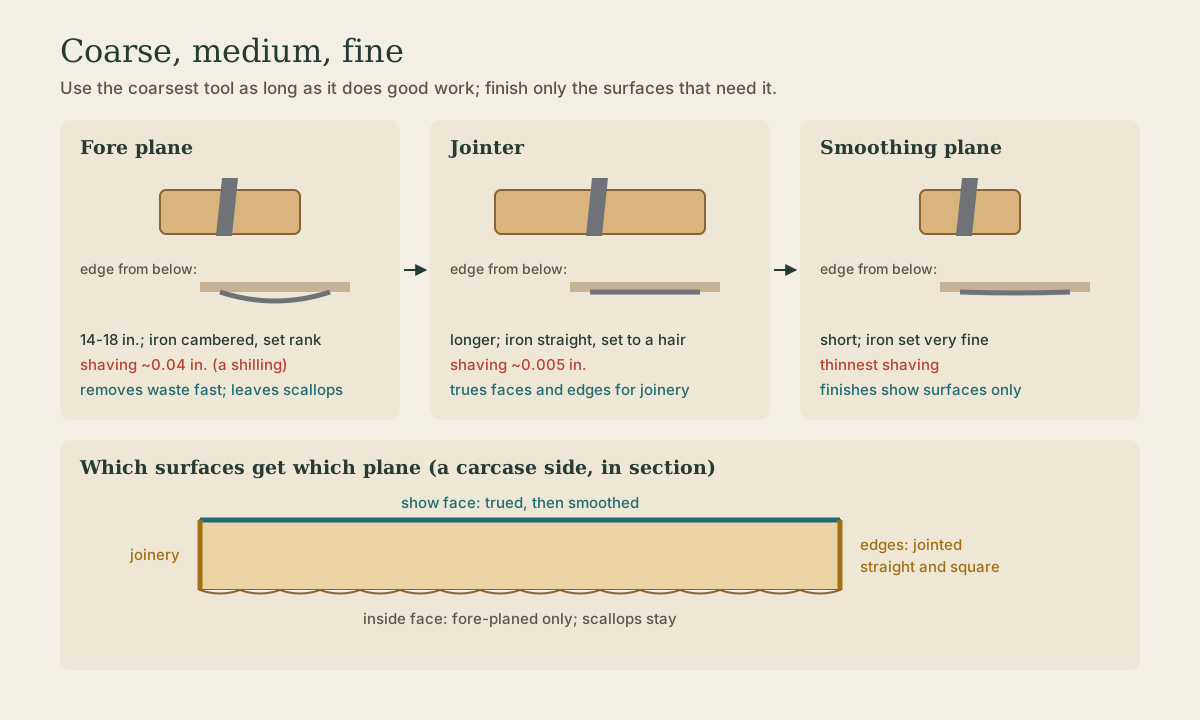
How a 17th-century joiner turned rough boards into furniture quickly: Moxon's fore plane with a cambered iron set rank, the jointer and smoothing plane, traversing across the grain, and the rule of finishing only the surfaces that need it.
- 5 min
- 7 steps
- 3 questions
- Lesson 49 of 160
In this lesson
- Use the coarsest tool that works
- The fore plane
- Traversing
- The jointer and the smoothing plane
- Finish only what shows
- Try it
- What to take from this
Picking up where you left off.
Use the coarsest tool that works
Joseph Moxon’s Mechanick Exercises (1678) is the earliest English book to describe joiners’ tools, and its plane descriptions still hold 1. His key idea came from his section on smithing: a coarse file takes off the hammer’s irregularities, and you don’t file more than you need. In joinery, the fore plane is the coarse file 1.
Christopher Schwarz’s commentary puts it plainly: one stroke with a fore plane saves many strokes with a jointer, and many woodworkers grab a smoothing plane when they should be grabbing the fore 1.
The fore plane
- Called fore because it comes before the jointer or smoothing plane 1.
- Iron cambered: ground to a convex arch, not straight. Set rank, a straight iron that sat even slightly lower at one corner would dig gutters; a cambered iron leaves only shallow hollows (“dawks”) 1.
- Set rank: on soft, even wood, a shaving about the thickness of an old shilling, roughly 0.04 in.; on hard, curly, or knotty wood, about an old groat, roughly 0.024 in. The rule: as rank as you can make good work with, for speed’s sake 1.
- Modern equivalent: a plane 14-18 in. long with an iron ground to about an 8-in. radius and the mouth opened for thick shavings. Stanley sold its No. 6 as a “fore,” but a No. 5 jack does the job 1.
Adjusting a wooden plane: rap the heel to back the iron off, rap the iron to advance it, and tap the wedge after each adjustment to lock it 1.
Quick check
A straight iron set even slightly crooked digs in at one corner; a cambered one only leaves shallow dawks.
Quick check
For hard or knotty wood, an old groat, about 0.024 in. The rule: as rank as you can make good work with, for speed.
Traversing
On a wide board that is cupped or twisted, Moxon planes across the grain, which joiners called traversing 1. Working across the fibers, the fore plane takes a big bite with little tearout. Plane the high edges of the cupped face down to the middle, flip the board, and take the middle down on the other face.
Schwarz finds traversing works best on the cupped face, where the sole rides two high edges. On a bowed face, plane a hollow down the middle with the grain first, then traverse 1. The surface it leaves is rough (“wooly”), but it gets the board flat fast.
The jointer and the smoothing plane
- Jointer: longer than the fore, with a perfectly straight sole. It shoots edges straight and square for glued joints and trues broad surfaces like tabletops, working across and diagonally as well as along the grain 1. Set it so the edge shows as a hair-thin black line when you sight down the sole; Schwarz gets shavings of about 0.004-0.006 in. that way 1.
- Smoothing plane: iron set very fine, to remove the irregularities the fore plane left. Moxon goes straight from fore to smoother, skipping the jointer when a surface doesn’t need to be dead flat 1.
Playback is optional. If the player is unavailable, open the video at its source.
Finish only what shows
Schwarz’s sequence after reading Moxon 1:
- Fore plane, set rank, to get the board fairly flat and close to thickness.
- Fore plane, set fine, to clean up.
- Jointer only on faces and edges that must be true for joinery, such as an edge to be glued or the inside of a carcase side.
- Smoothing plane only on surfaces the owner will see.
Joshua Klein of Mortise & Tenon Magazine makes the same point about tables: the biggest inefficiency in furniture making isn’t hand tools versus machines but ill-considered workflow, and the work starts from carefully chosen reference faces 2. Turn over an old chest of drawers and you’ll often find drawer bottoms and backs still scalloped by the fore plane. That isn’t sloppiness; it’s how the shop could afford to make the piece.
Quick check
Hidden faces were left fore-planed; old drawer bottoms and case backs still show the scallops.
Try it
Take a rough or cupped pine board, grind a spare iron to a curve, and set it rank. Traverse the cupped face flat, true one face and one edge with a jointer or jack, gauge the thickness from that face, and fore-plane the other face down to the line. Smooth only the face that will show.
What to take from this
Moxon’s fore plane, with a cambered iron set rank, takes shavings up to about 0.04 in. and traverses cupped boards flat. The jointer, set to a hair, trues only the surfaces joinery needs; the smoothing plane finishes only what shows. Use the coarsest tool that does good work, and plan the workflow from reference faces.
Lesson complete
Nice work.
Sources for this lesson
- 1Joseph Moxon, Christopher Schwarz. The Art of Joinery (2nd ed.). Lost Art Press. 2013. verifiedMoxon's 1678/1703 Mechanick Exercises joinery section with commentary. Fore plane with cambered iron set rank (shilling-thick shavings, about 0.04 in.), jointer set to a hair, smoothing plane set very fine; traversing; holdfast and planing stop; use the coarsest tool as long as possible.
- 2Joshua A. Klein. Issue Four: The Artisan's Guide to Pre-industrial Table Construction. Mortise & Tenon Magazine. 2018. verifiedReference faces, rough stock prep, drawbore mortise and tenon, tapering legs, assembly, tops, breadboard ends, leveling feet; inefficiency comes from ill-considered workflow.