Bent Wood and Nails
How green saplings bend and why they break: compression versus tension in a bend, the t/R rule from the Wood Handbook, pre-bending the thick end, boiling and forms for hickory, letting bends dry in place, and nailing green stock without splitting it.
- 5 min
- 5 steps
- 3 questions
- Lesson 84 of 160
In this lesson
- Why bends break
- Bending green saplings
- Nailing green stock
- Try it
- What to take from this
Picking up where you left off.
Why bends break
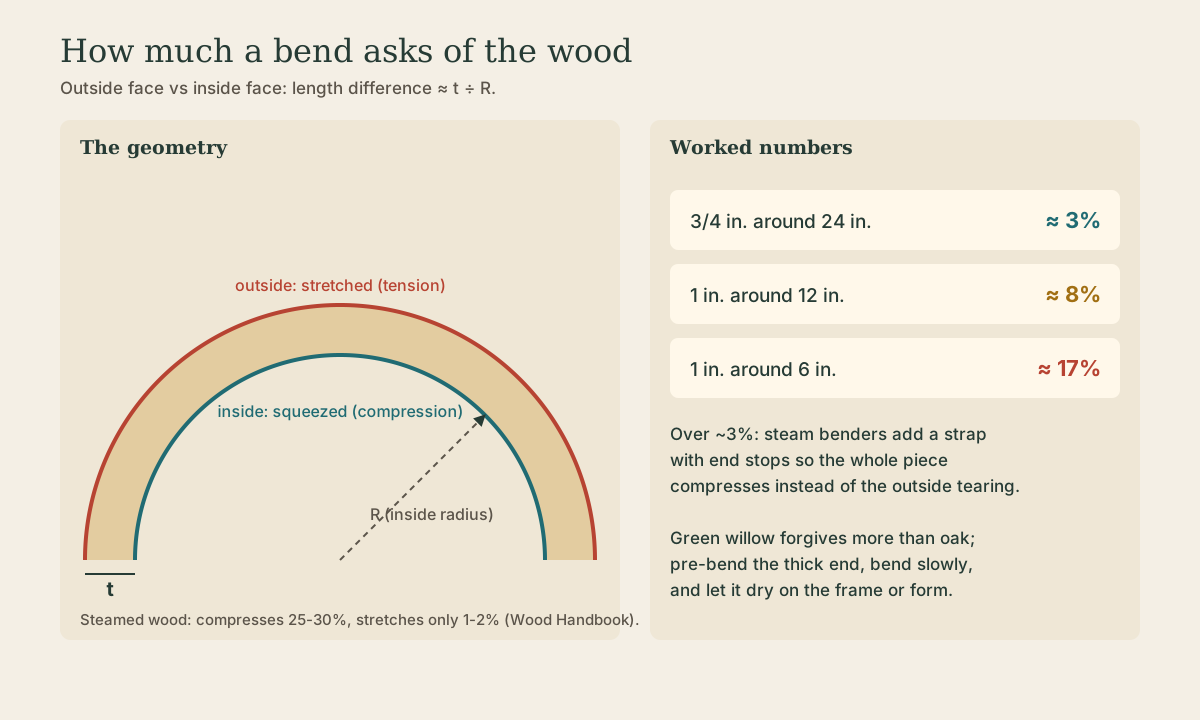
When a stick bends, the inside of the curve gets shorter and the outside gets longer. Wood is very uneven about this. Softened by steam or boiling water, it can be compressed 25 to 30% along the grain, but stretched only 1 to 2% 1. So a sharp bend has to happen almost entirely by squashing the inside face. When the outside is asked to stretch further than it can, it splinters.
How much a bend asks is simple geometry. For a stick of thickness t bent around an inside radius R, the outside face must be about t/R longer than the inside. The Wood Handbook’s rule for steam bending: if the outer and inner faces differ by much more than 3%, use a metal strap with end stops on the outside, so the strap takes the tension and the whole piece is pushed into compression 1.
- 3/4-in. rod around a 24-in. radius: about 3%.
- 1-in. rod around a 12-in. radius: about 8%.
- 1-in. rod around a 6-in. radius: about 17%.
Two more rules from the same chapter: choose stock without cross grain, knots, or checks in the bend, and hardwoods generally bend better than softwoods; oak, elm, hickory, ash, birch, and maple are the usual bending woods 1.
Quick check
So a severe bend has to happen mostly by compressing the inside face.
Quick check
t/R = 1/12, about 8%. Steam benders add a strap with end stops above about 3%.
Bending green saplings
Rustic bends are gentler than a steam-bent chair back, and green willow forgives a lot. It bends easily, stays where it’s put, and keeps its bark as it dries 2. The technique:
- Use it fresh. Cut willow loses its flexibility as it dries; build soon after cutting 2.
- Pre-bend the thick end by hand or over a bench edge. Otherwise the thin tip takes all the curve and the arch comes out lopsided 2.
- Bend slowly, working along the rod with both hands, a little at a time.
- Fasten as you go: nail one end, ease the curve over, and nail the other.
For tighter bends in stiffer wood, do what Old Hickory did: soften the saplings in boiling water, clamp them to a pattern, and let them dry; dried on the form, they keep the shape 3. The Wood Handbook gives steaming or boiling times of about 1-1/4 hours per inch of thickness for dry stock, and about half that for wood at 20-25% moisture 1.
Let it set. A bend must cool and dry while held in shape. Taken off the form too early it springs back, and even a set bend loosens a little if it gets wet again 1. In a nailed willow chair, the frame itself holds the bends while they dry.
Quick check
Work the stiff butt over your knee or a bench edge so the curve is even.
Nailing green stock
Nails are the joinery of bent willow work, and they work because the frame is triangulated and the bends are held by many fastenings.
- Galvanized nails resist rust in outdoor furniture and green, wet wood. Musgrove Willows uses framing nails of 2-1/2 to 4 in. for the frame and finishing nails of 1 and 1-5/8 in. for arms, seat, and back 4.
- Pre-drill for every nail near an end or in small stock, slightly smaller than the nail 2. Rustic Carpentry made the same point with a bradawl 5.
- Clinch nails that come through: bend the point over across the grain and set it back into the wood.
- Angle the nails slightly toward each other at a joint so the pieces can’t pull straight off.
Try it
Cut a dozen 3/4-in. willow rods 5 ft long. Bend two around a 12-in. radius (a bucket works as a form) without pre-bending, and two after pre-bending the butts. Nail each pair to a scrap board as a hoop and compare the curves after a week.
What to take from this
Bent wood compresses easily on the inside and barely stretches on the outside, so a bend’s severity is about t/R; above roughly 3%, steam benders strap the outside. Use clear, straight-grained stock. Bend willow green, pre-bend the thick end, go slowly, and nail as you go. For stiffer wood, boil and clamp to a form, and let the bend dry in place. Use galvanized nails, pre-drill, clinch, and angle them.
Lesson complete
Nice work.
Sources for this lesson
- 1Wood Handbook, Chapter 19: Specialty Treatments. USDA Forest Service, Forest Products Laboratory. 2021. verifiedPublic U.S. government chapter covering plasticizing and bending wood, stock selection, the bending operation, and fixing the bend.
- 2Jonathan Benson. Rustic Chair. Popular Woodworking. 2023. verifiedChild's chair of willow and Osage-orange saplings about 1 in. thick; use cut stock right away; willow bends easily, holds its bend, and keeps its bark; pre-bend the thick end; galvanized nails in pre-drilled holes; seat 12 in. high, 15 by 15 in.; seat frame sloped 5 to 10 degrees; seat and back sticks about 3/4 in. apart.
- 3Harry L. Rinker. Rinker on Collectibles, Column 1383: Old Hickory. Rinker Enterprises. 2013. verifiedBilly Richardson sold hickory sapling chairs at the Martinsville, Indiana, Saturday market; in 1892 he and others took over an abandoned church for production; Old Hickory Chair Company, named for Andrew Jackson, incorporated 1898; 1901 catalog of hoop chairs, rockers, settees, tables, and log cabins; saplings boiled and clamped to patterns; Old Faithful Inn and Grove Park Inn; Patton family from 1908; Old Hickory Furniture Company from 1921; closed 1978, revived in Shelbyville 1982.
- 4Mitch Ison. How to Build a Bent Willow Chair. Low Impact (Musgrove Willows). 2021. verifiedRear legs and back-rest supports twice the front-leg length; other members halfway between; king 18/36/27 in., medium 14/28/21, miniature 10/20/15; galvanized framing nails 2-1/2 to 4 in. and finishing nails; build order sides, front and rear beams, headrest, stretcher, braces, seat beams, arms, hoops, infill; 1 part turpentine to 2 parts linseed oil yearly.
- 5Paul N. Hasluck. Rustic Carpentry. Cassell and Company (Project Gutenberg edition). 1907. verifiedPublic-domain workshop manual. Cut sticks in mid-winter when the sap is at rest so the bark stays on; cut in spring when the sap is rising for peeled work; store six to twelve months according to size; bore for nails with a bradawl to avoid splits; hazel, cherry, yew, birch, larch, fir, and prunings; V-notched mitres, mortise and tenon, nails, dowels, screws; two or three coats of hard outside varnish.