Round Tenons and Shrink Fits
Joining round stock that won't loosen: nailed joints versus round mortise-and-tenon joints, using a tenon cutter, the shrink fit of a dry tenon in a wetter post, a worked example of why tenons must be sized dry, wedging across the grain, and laying out mortises that don't collide.
- 6 min
- 8 steps
- 3 questions
- Lesson 83 of 160
In this lesson
- Nails or tenons
- Cutting round tenons
- Why the tenon must be dry
- The shrink fit
- Wedges, glue, and nails
- Laying out the mortises
- Try it
- What to take from this
Picking up where you left off.
Nails or tenons
Most rustic furniture is nailed. It’s fast, it works with irregular stock, and the old makers did plenty of it. Rustic Carpentry only insists that you bore for the nails with a bradawl, because nothing looks worse than splits 1. For willow and other small stock, nails are the right answer; Bent Wood and Nails covers them.
For bigger frames, especially chairs that get rocked back on two legs, nailed joints work loose. The stronger joint is the round mortise and tenon: a cylinder turned on the end of one pole, fitted into a hole bored in another. Old Hickory, the Park Service builders, and the post-and-rung chairmakers all relied on it.
Cutting round tenons
You can whittle a round tenon with a knife and check it in a test hole, but a tenon cutter is faster and repeatable. It’s a hollow body with a blade, like a giant pencil sharpener, that turns the end of a pole to a set diameter and leaves a rounded shoulder. Using one well 2:
- Clamp the pole firmly; you bring the cutter to the work.
- Chamfer the end of the pole so it starts into the cutter.
- Drive it with a hand drill or brace, never a drill press, which would take big side loads on the spindle.
- Keep it in line using the built-in level vial and your eye from the side.
- Size it on scrap first. The blade adjusts for depth of cut; thin brass shims can enlarge the tenon slightly.
Bore the mortises with a sharp Forstner or auger bit of the same nominal size, and test every cutter setting in a hole bored in scrap before cutting good parts.
Playback is optional. If the player is unavailable, open the video at its source.
Quick check
The workpiece is clamped and the cutter is brought to it, aligned by eye and the built-in level.
Why the tenon must be dry
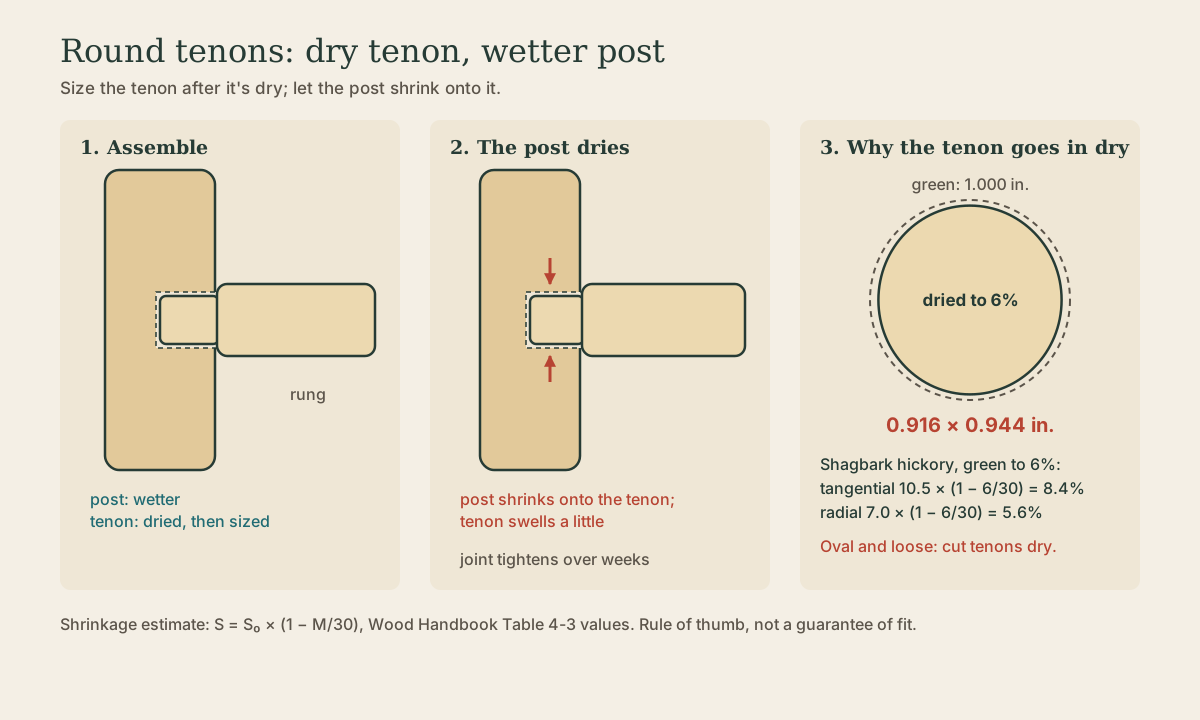
Round wood shrinks unevenly as it dries: about twice as much tangentially, around the growth rings, as radially, across them 3. So a round tenon cut green doesn’t just get smaller, it goes oval.
Take a shagbark hickory tenon cut green to exactly 1.000 in. Its total shrinkage from green to oven-dry is about 10.5% tangential and 7.0% radial 3. Below the fiber saturation point (about 30%), shrinkage is roughly proportional to the moisture lost, so drying to 6% gives:
- tangential: 10.5 × (1 − 6/30) = 8.4%, so the tenon is 0.916 in. one way;
- radial: 7.0 × (1 − 6/30) = 5.6%, so 0.944 in. the other.
That tenon is now oval and nearly 1/16 in. loose in a 1-in. hole. Dry the tenon first, then cut it to size.
Quick check
Tangential shrinkage 10.5 x (1 - 6/30) = 8.4%; radial 7.0 x 0.8 = 5.6%. Cut tenons after drying.
The shrink fit
Turn that problem around and it becomes the strongest trick in round-wood joinery: a dry tenon in a wetter post. Post-and-rung chairmakers dry the rung tenons hard, often in a warm box, and bore mortises in posts that still hold more moisture 4. After assembly the post dries and shrinks around the tenon, while the tenon picks up a little moisture and swells. Over a few weeks the joint locks.
To do it with rustic stock:
- Pick poles for posts that are seasoned but not bone-dry.
- Cut tenons slightly oversize, then dry them: a few days near the woodstove or in a box with a light bulb.
- Size the tenons dry, to a snug push fit in a test hole.
- Bore the mortises and assemble promptly, before the dry tenons pick up moisture.
A moisture meter, or weighing a sample piece until it stops losing weight, tells you where the wood is 5.
Wedges, glue, and nails
- Through tenons can be wedged. Saw a kerf in the end of the tenon and orient it across the grain of the post, so the wedge spreads the tenon without acting like a splitting wedge on the post. Use a dry hardwood wedge.
- Glue is optional in a good shrink fit; hide glue or yellow glue adds insurance.
- A pin or nail through the post and tenon, pre-drilled, keeps a joint from pulling apart while it seasons.
Quick check
A wedge driven along the post’s grain acts like a splitting wedge on the post.
Laying out the mortises
Two rungs entering a post at the same height will meet inside it and weaken it badly. Stagger the heights of rungs that meet at a post, keep mortises from running into each other, and leave plenty of wood between the bottom of a mortise and the far side of the post.
Try it
Make a test ladder: two 1-1/2-in. posts and three 1-in. rungs from the poles you cut. Dry the rungs near the stove for a week, cut and size the tenons dry, bore the posts, and assemble. Wedge one joint, glue one, and leave one plain. Check them all after a month.
What to take from this
Nail small stock (pre-drilled); use round mortise-and-tenon joints for frames that take racking. Run a tenon cutter in a hand drill or brace, chamfer the stock, and test the size on scrap. Round wood shrinks about twice as much tangentially as radially, so a green hickory tenon dries oval and loose: dry the tenon, then size it. A dry tenon in a wetter post becomes a shrink fit. Wedge across the post’s grain, and stagger mortises so they don’t collide.
Lesson complete
Nice work.
Sources for this lesson
- 1Paul N. Hasluck. Rustic Carpentry. Cassell and Company (Project Gutenberg edition). 1907. verifiedPublic-domain workshop manual. Cut sticks in mid-winter when the sap is at rest so the bark stays on; cut in spring when the sap is rising for peeled work; store six to twelve months according to size; bore for nails with a bradawl to avoid splits; hazel, cherry, yew, birch, larch, fir, and prunings; V-notched mitres, mortise and tenon, nails, dowels, screws; two or three coats of hard outside varnish.
- 2Jeffrey Fleisher. Veritas Power Tenon Cutter Tool Review. Highland Woodworking. 2016. verifiedHand drill or brace only, never a drill press; built-in level vial for alignment; coarse and fine blade adjustment; 0.010 in. brass shims enlarge the tenon about 0.020 in.; bevel the end of the stock so it starts; cuts with little resistance and radiused shoulders.
- 3Samuel V. Glass, Samuel L. Zelinka. Moisture Relations and Physical Properties of Wood (Wood Handbook, Chapter 4). USDA Forest Service, Forest Products Laboratory, FPL-GTR-282. 2021. verifiedFree and bound water, fiber saturation (~30%), EMC table (Table 4-2), green moisture by species (Table 4-1), shrinkage by species (Table 4-3), and the shrinkage equation.
- 4Jennie Alexander. Make a Chair from a Tree: Third Edition. Lost Art Press. 2021. verifiedPublisher contents and excerpts for post-and-rung construction, moisture management, bending, assembly, and hickory-bark seating.
- 5Measuring Wood Moisture (FS-1074). University of Maryland Extension. verifiedFirewood should be split, stacked, covered, and dried roughly 6 to 12 months, until internal moisture reaches about 20 percent.