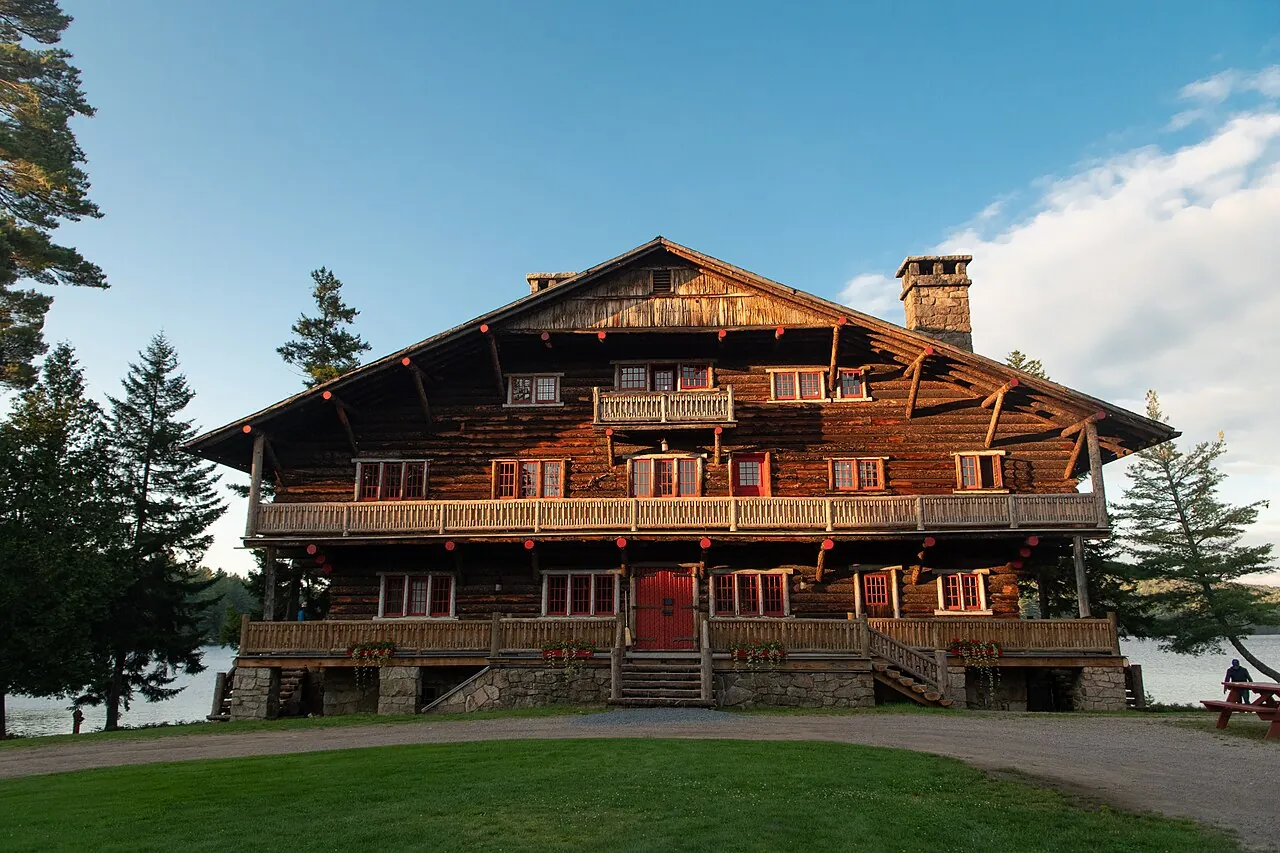
Adirondack Camps and Twig Work
Where American rustic furniture comes from: guides' stick furniture, Durant's Camp Pine Knot and the Great Camps, mosaic twig work and bark-on decoration, the shift to peeled poles, the woods they used, and the 1930s warning against overdone rusticity.
- 5 min
- 6 steps
- 3 questions
- Lesson 79 of 160
In this lesson
- From guides to Great Camps
- The woods
- Twig work and bark
- Simplicity over novelty
- Try it
- What to take from this
Picking up where you left off.
From guides to Great Camps
Rustic furniture in the Adirondacks started as plain stuff. Before the 1870s, guides knocked together stick chairs, tables, and bunks for the sportsmen who hired them, from whatever grew near camp 1.
.jpg)
That changed with William West Durant, heir to huge Adirondack landholdings. In 1877 he began Camp Pine Knot on Raquette Lake, inspired by the bark-covered shanty of the guide Alvah Dunning 1. Pine Knot had chalet-like log buildings, sapling railings, bark exteriors, big fireplaces, and furniture covered in mosaic twig work and stick-against-bark stars and diamonds 1. It set the pattern for the Great Camps, the private compounds wealthy families built on Adirondack lakes in the following decades.
The style then simplified. At Durant’s later camps, Uncas and Sagamore, and at camps like Kamp Kill Kare, peeled-pole construction replaced much of the labor-heavy twig work 1. That’s the line most rustic furniture still follows: either bark-on and decorative, or peeled, simpler, and more structural.
Quick check
Durant later turned that backwoods vocabulary into an aspirational style at Camp Pine Knot, begun in 1877.
The woods
The Adirondack makers used what grew there, and each wood had a job 1:
- Yellow birch: strong and handsome, prized for frames.
- White birch bark: peeled in sheets and nailed on as panels, the signature of the style.
- Northern white cedar: light and rot-resistant, good for anything outdoors.
- Spruce bark: tough enough for exterior siding.
In Wisconsin the same list mostly applies: yellow and paper birch, white cedar, and spruce all grow in the north, with willow, hickory, and ironwood farther south.
Twig work and bark
Mosaic twig work is the most elaborate rustic technique. Straight twigs are split lengthwise and nailed or glued flat-side down to a board, following a pattern laid out first: diamonds, sunbursts, herringbones. Contrasting barks make the pattern. It takes patience more than special tools: a fine saw, a knife, small brads, and a lot of matched twigs.
Bark panels are the other decoration: white birch bark nailed over a drawer front or a cabinet side, often bordered with split twigs. Bark from a downed or already-felled tree avoids girdling a live one. Stripping bark from a standing birch kills or scars it.
Playback is optional. If the player is unavailable, open the video at its source.
For bark-on work of any kind, the bark has to stay put. The 1907 English manual Rustic Carpentry gives the rule: cut sticks in mid-winter, when the sap is at rest; cut in spring and the bark comes away 2. That timing comes back in When to Cut.
Quick check
Contrasting barks make the pattern; the split face gives a flat gluing and nailing surface.
Simplicity over novelty
By the 1930s the National Park Service was furnishing lodges and shelters across the country, and its architectural consultant Albert Good had firm opinions. His Park and Recreation Structures (1938) makes simplicity the keynote of park furniture and asks designers to draw on local traditions: Shaker, Amish, and Moravian pieces in the East, mountain handcraft in the Ozarks and Smokies, Spanish and Pueblo work in the Southwest 3.
He names cedar and hickory as good rustic woods, with peeled cedar’s red inner bark giving a mottled surface, and calls bark-on hickory the peak of allowable rusticity 3. He’s openly scornful of contorted, multi-forked logs posing as hat trees 3. That’s still good advice: one strong curve or a good crotch can make a piece, and a heap of oddities ruins it.
Quick check
Good held up simplicity and local tradition, and called bark-on hickory the limit of allowable rusticity.
Try it
Make a small mosaic twig panel, about 6 by 8 in., on a scrap of pine. Draw a diamond-in-a-square pattern, collect straight twigs of two contrasting barks (red osier dogwood and gray willow or birch work), split them with a knife, and nail them down with 5/8-in. brads, pre-drilling any twig that wants to split. Use it as a box lid.
What to take from this
Adirondack rustic began as guides’ stick furniture, became a style with Durant’s Camp Pine Knot in 1877, and shifted from bark-on twig work toward peeled poles at the later Great Camps. The makers used yellow birch, white birch bark, white cedar, and spruce bark. Mosaic twig work is split twigs nailed flat in a laid-out pattern. Cut bark-on stock in mid-winter. The Park Service’s 1938 rule still holds: keep it simple and local, and leave the contorted oddities in the woods.
Lesson complete
Nice work.
Sources for this lesson
- 1Niki Kourofsky. The Roots of Rustic Style. Adirondack Life. 2022. verifiedGuides' utilitarian stick furniture before the 1870s; William West Durant's Camp Pine Knot (begun 1877) on Raquette Lake, inspired by guide Alvah Dunning's bark shanty; mosaic twig work, bark exteriors, sapling railings; Uncas and Sagamore moved toward peeled-pole construction; yellow birch, white birch bark, white cedar, spruce bark; modern makers.
- 2Paul N. Hasluck. Rustic Carpentry. Cassell and Company (Project Gutenberg edition). 1907. verifiedPublic-domain workshop manual. Cut sticks in mid-winter when the sap is at rest so the bark stays on; cut in spring when the sap is rising for peeled work; store six to twelve months according to size; bore for nails with a bradawl to avoid splits; hazel, cherry, yew, birch, larch, fir, and prunings; V-notched mitres, mortise and tenon, nails, dowels, screws; two or three coats of hard outside varnish.
- 3Albert H. Good. Park and Recreation Structures, Part III: Furniture and Furnishings. National Park Service. 1938. verifiedPublic-domain U.S. government publication with eight plates of rustic furniture precedents. It is a historical design source, not a current accessibility or seating-load standard.