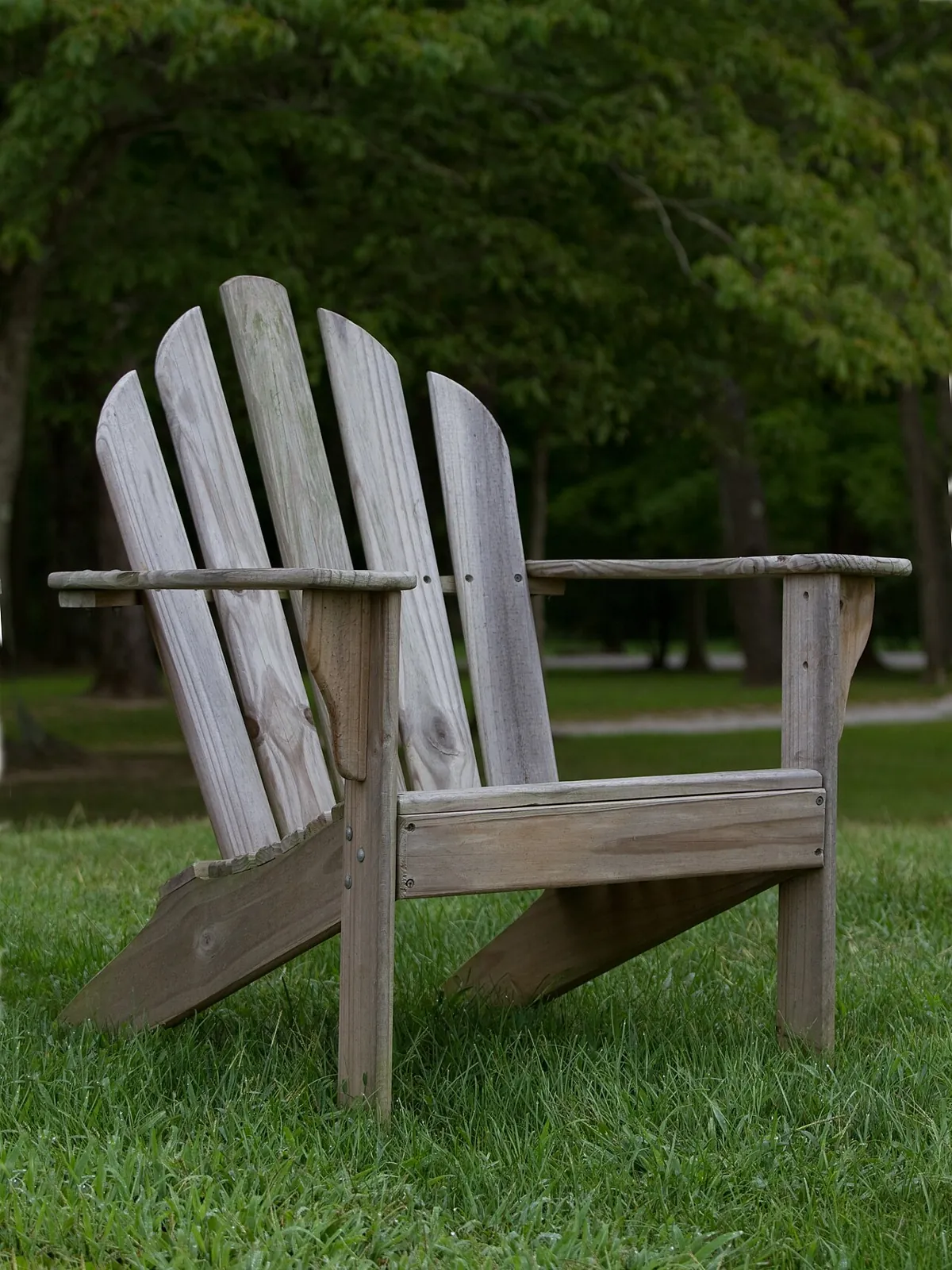
The Westport Plank Chair
How the Adirondack chair began: Thomas Lee's chair at Westport on Lake Champlain, Harry Bunnell's 1905 patent for a chair of a few wide boards, the wilderness-cure market it served, and how the plank chair turned into today's slatted Adirondack chair.
- 4 min
- 5 steps
- 3 questions
- Lesson 81 of 160
In this lesson
- Lee and Bunnell
- What the patent describes
- From planks to slats
- Try it
- What to take from this
Picking up where you left off.
Lee and Bunnell
The Adirondack chair, the slant-backed, wide-armed lawn chair, started as the Westport plank chair. The story usually told is that Thomas Lee, summering at Westport on Lake Champlain around 1903, wanted a comfortable outdoor chair that would sit steady on sloping ground and built prototypes until one worked. His friend Harry C. Bunnell, a local carpenter, borrowed one as a model, began making them to sell, and patented the design 1.

The patent record is exact: Bunnell filed on April 1, 1904, and US Patent 794,777 was granted on July 18, 1905, for a “bungalow” chair for porches, lawns, and camps 2.
The market mattered. Westport chairs were made from about 1904 for, among others, tuberculosis patients taking the wilderness cure in Adirondack sanatoriums and cottages, who spent hours a day sitting outdoors 1. Bunnell’s patent describes converting the chair into an invalid’s chair, with a hinged seat over a compartment 2.
Quick check
Thomas Lee designed it; Bunnell built and patented it, filing April 1, 1904.
Quick check
The patent even describes converting it into an invalid’s chair.
What the patent describes
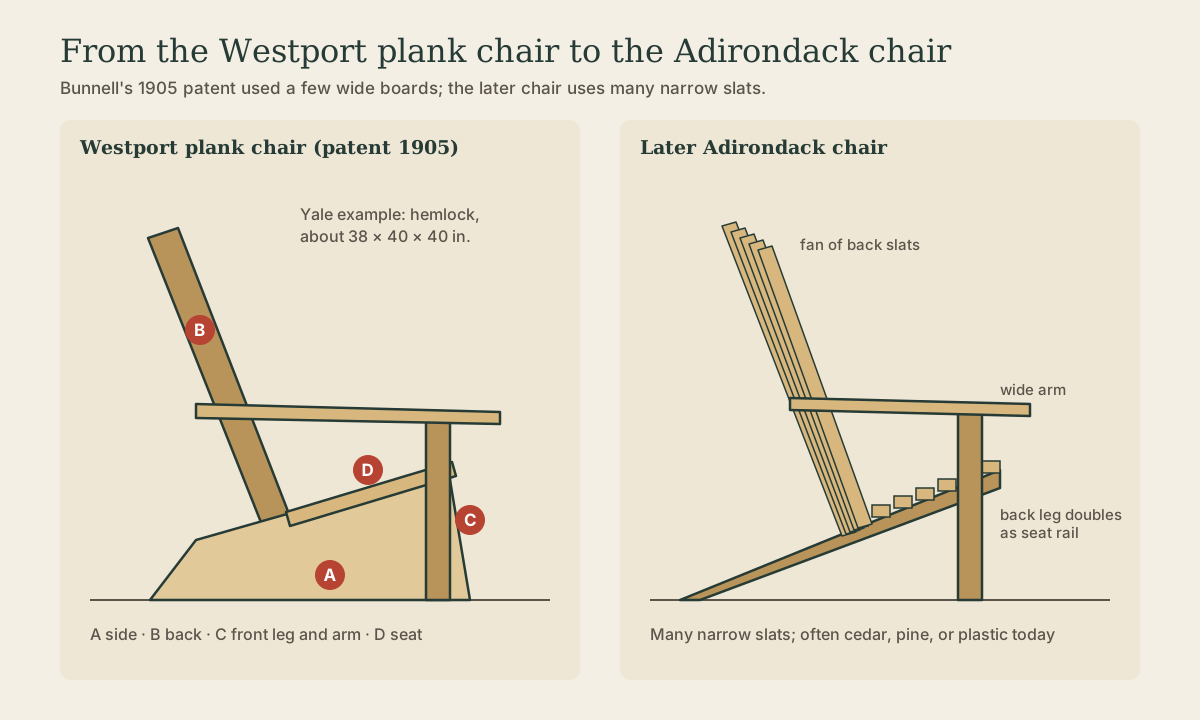
The chair is made from a few wide, solid boards 2:
- Sides (A): two parallel solid pieces with an irregular diamond outline: a straight base on the ground, an angled front edge, and a sloping top edge.
- Back (B): a single solid board running up and back between the sides.
- Seat (D): resting on the forward top edges of the sides, so it slopes down toward the back.
- Front legs (C): carrying broad, flat arms.
- Extras: a hinged foot-rest, removable cushions, and a compartment under the seat.
The Westport chair at the Yale University Art Gallery is hemlock, about 38 in. high, 40 in. wide, and 40 in. deep 1. It’s a big chair: low, deep, and broad.
From planks to slats
Wide, clear boards like the Westport chair’s are expensive and hard to find. Later makers rebuilt the idea from narrow stock: long back legs that double as sloping seat rails, a seat of slats, a fanned back of slats, and the same broad arms. That’s the chair now called Adirondack, sold in cedar, pine, and molded plastic.
What carried over is the geometry: a seat that slopes down toward the back, a reclined back, and arms wide enough for a plate or a cup. What was lost is the plank chair’s simplicity. With only a handful of parts, it’s one of the easiest serious chairs to build.
Quick check
Slats can come from ordinary narrow lumber; wide, clear boards are costly.
Try it
Draw the Westport chair’s side piece full size on a sheet of cardboard: a straight base about 36 in. long, an angled front edge, and a top edge sloping down toward the back. Prop a board on it as a seat and a wider board as a back, sit on it carefully, and adjust the slope until it feels right. This becomes the pattern for the build lesson.
What to take from this
The Adirondack chair began as the Westport plank chair: designed by Thomas Lee around 1903, built and patented by Harry Bunnell (US 794,777, filed 1904, granted 1905), and sold partly to the wilderness-cure market. It’s a few wide boards: two diamond-outlined sides, one back board, a seat sloping toward the back, and front legs with broad arms. The Yale example is hemlock, about 38 by 40 by 40 in. The later slatted chair kept the geometry and swapped wide planks for narrow stock.
Lesson complete
Nice work.
Sources for this lesson
- 1Harry C. Bunnell. Westport Chair (Yale University Art Gallery 2002.77.1). Yale University Art Gallery, via SAPFM Museum Furniture Collection. 1905. verifiedHemlock, about 38.4 x 39.5 x 40 in.; designed by Thomas Lee and made by Bunnell, who patented it; made in Westport on Lake Champlain from about 1904; sold to the convalescent market of the wilderness cure.
- 2Harry C. Bunnell. Chair (US Patent 794,777). United States Patent Office. 1905. verifiedFiled April 1, 1904, granted July 18, 1905, Westport, New York. A bungalow chair for porches, lawns, and camps: solid side pieces of irregular diamond outline, a single wide back board, a seat on the forward upper edges of the sides, front legs carrying arms, a hinged seat over a compartment, convertible to an invalid's chair.