Tools and Materials
A small kit does most upholstery: tack hammer or stapler, webbing stretcher, ripping tools, needles and twine, shears, and a regulator. Plus the materials - tacks by ounce size, webbing, springs, twines, burlap, stuffings, and covers.
- 4 min
- 4 steps
- 3 questions
- Lesson 147 of 160
In this lesson
- Tools
- Materials
- Setting up
- What to take from this
Picking up where you left off.
Tools
A basic kit 1:

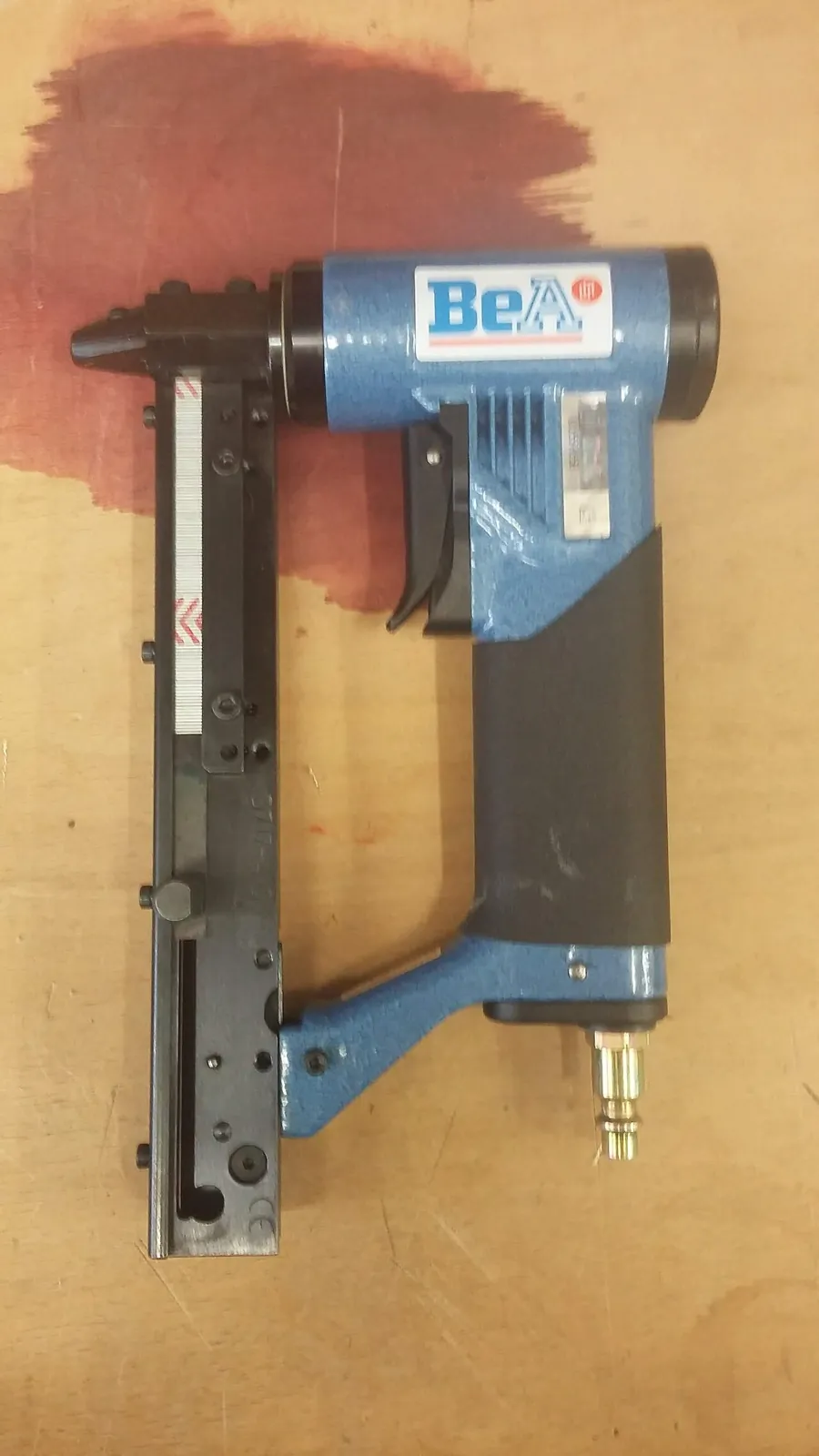
- Tack hammer: light, often magnetic on one face to pick up and start tacks. Or a staple gun (pneumatic or electric) - modern upholstery largely uses staples instead of tacks 2.
- Webbing stretcher: a padded block with teeth that levers webbing tight across the frame. The Montana bulletin even gives plans for making one from a block of wood and filed nails 1.
- Ripping chisel and mallet, tack puller, and staple lifter for stripping old work.
- Needles: a long straight mattress needle (double-pointed) for stitching through stuffing, a curved needle for sewing on the surface, and a large-eyed needle 1.
- Regulator: a long, pointed steel tool for moving stuffing under the cover and dressing corners.
- Shears: heavy, sharp, for fabric and webbing.
- Pliers, a knife, chalk, and a tape measure.
- Sewing machine: a heavy-duty or walking-foot machine for welting and cushions.
Quick check
Its teeth grip the webbing; its padded end braces against the frame as you push the handle down.
Materials
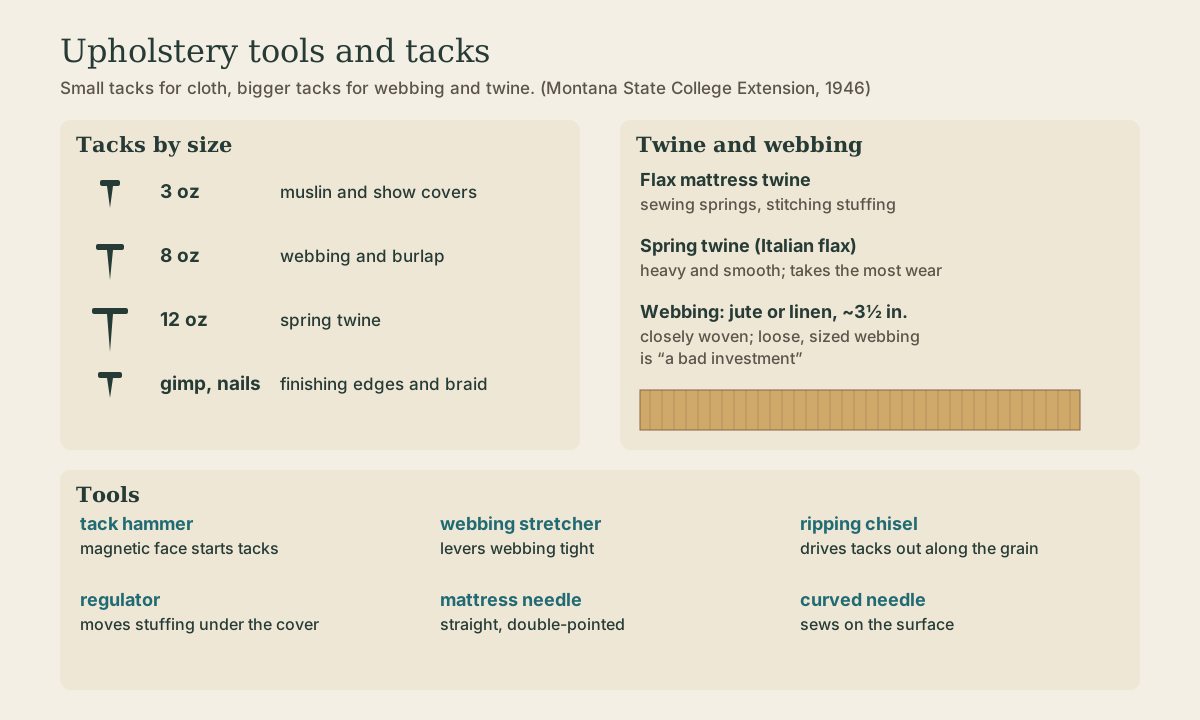
Tacks are sized in “ounces” 1:
| Size | Use |
|---|---|
| 3-ounce (small) | Muslin and show covers |
| 8-ounce (medium) | Webbing and burlap |
| 12-ounce (large) | Spring twine |
| Gimp tacks, decorative nails | Finishing edges, gimp, braid |
Webbing: jute or linen webbing, about 3 1/2 inches wide in traditional work. Quality matters: closely woven webbing lasts; loosely woven, sized webbing that only looks good is “a bad investment” 1. Modern elastic (rubber) webbing is used in thin seats and backs.
Springs: coil springs in various heights and gauges. A good spring, pressed down with your palm, shouldn’t bend sideways, and should push back strongly 1. Sinuous (zigzag) springs are used in modern seats.
Twines 1: - Flax mattress twine: medium weight, very strong, for sewing springs and stitching stuffing. - Spring twine (Italian flax): heavy, strong, and smooth, for tying springs. It takes the most wear in the whole piece.
Burlap (hessian): tightly woven jute cloth to cover springs; scrim, a finer open weave, for stitched edges.
Stuffings 1 2: - Curled horsehair: the best traditional stuffing - springy, durable, reusable after washing. - Coir (coconut fiber) and upholstery moss: cheaper alternatives. - Cotton batting and Dacron (polyester) wrap for the smoothing layer. - Polyurethane foam in modern work. - Excelsior (wood shavings) mats quickly and shouldn’t be used for padding 1.
Covers: muslin for the inner cover; the show fabric or leather; welt cord or gimp to finish edges; cambric for the dust cover.
Quick check
Tack size is given in ‘ounces’; heavier loads get bigger tacks, and covers get small ones.
Quick check
Spring twine rubs on the wires every time someone sits. Lighter flax mattress twine is used for sewing springs to webbing and stitching stuffing.
Setting up
Work at a comfortable height: upholsterers use trestles (padded sawhorses) with raised edges so the piece can sit upside-down or on its back without sliding. Good light, a vacuum for old stuffing dust, and a dust mask for stripping old pieces (old stuffing is dusty and can hold mold and pests) make the work far more pleasant.
What to take from this
The core kit is a tack hammer or staple gun, webbing stretcher, ripping tools, mattress and curved needles, a regulator, shears, and a sewing machine for welting. Tacks come in ounce sizes: 3 for covers, 8 for webbing and burlap, 12 for spring twine. Use close-woven webbing, springs that don’t buckle, smooth strong spring twine, burlap and scrim, horsehair or coir with cotton, or foam in modern work.
Lesson complete
Nice work.
Sources for this lesson
- 1Margaret Huston Tuller. Simple Upholstery Methods (Bulletin 198, revised). Montana Extension Service, Montana State College. 1946. verifiedA sprung footstool step by step - webbing stretcher, 3-, 8-, and 12-ounce tacks, 3 1/2-inch webbing interlaced, springs sewn at intersections, 8-way tying with clove hitches, burlap, edge roll, hair and cotton padding, muslin, cover, welt, cambric; plus retying 'broken springs' and renewing webbing.
- 2Upholstery. Wikipedia. verifiedTraditional upholstery builds up springs, lashings, animal hair, coir, hessian, scrim, bridle ties, and stitching by hand; modern work uses polyurethane foam, serpentine springs, staples, and machine sewing.