Dehumidification Kilns, Equalizing, and Conditioning
The small-shop workhorse - a dehumidification kiln that condenses water out and reuses the heat, up to 150 °F and 6 percent - and the end-of-run steps that make a charge uniform and stress-free.
- 5 min
- 5 steps
- 3 questions
- Lesson 17 of 160
In this lesson
- How it works
- Running one
- Equalizing
- Conditioning
- What to take from this
Picking up where you left off.
How it works
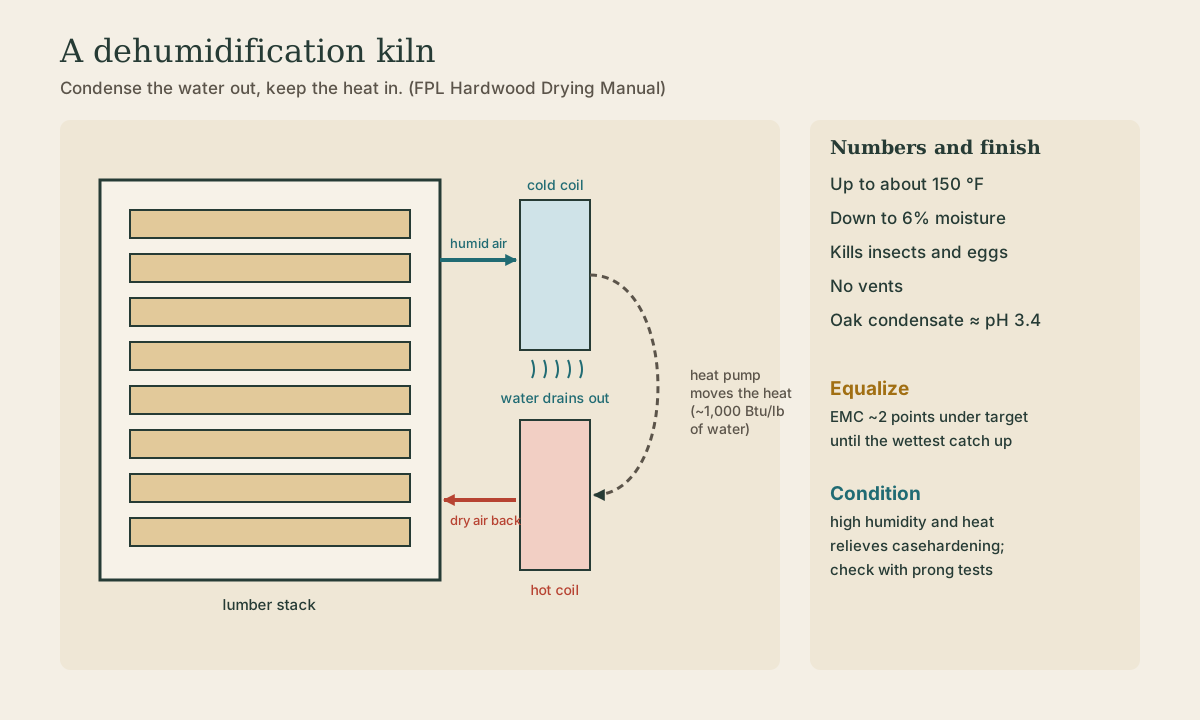
A dehumidification (DH) kiln is a closed, insulated box with fans, a heat pump, and usually a small auxiliary heater. Warm, humid air from the lumber is drawn across a cold evaporator coil. Water vapor condenses into liquid and drains out. Condensing releases heat, about 1,000 Btu per pound of water, which the heat pump moves to a hot condenser coil that rewarms the dried air before it goes back through the lumber 1. Instead of venting heat away with the moisture, as steam kilns do, a DH kiln recycles most of it, which makes it efficient on electricity alone.
The FPL hardwood manual’s summary: electric DH kilns dry lumber at temperatures up to about 150 °F, can reach final moisture contents as low as 6 percent, kill insects and their eggs, and produce lumber as good as a well-run steam kiln. They suit smaller operations, roughly under 2 million board feet a year, and are a common step up from a solar kiln.
Two practical notes from the manual: condensate from drying oak is acidic, around pH 3.4, so plumb and dispose of it accordingly and check state rules for larger operations; and DH kilns have no vents, so schedules are run by controlling the compressor, fans, and heater.
Quick check
Humid kiln air passes over a cold evaporator coil; water condenses and drains away, and the heat released by condensing (about 1,000 Btu per pound) is used to reheat the air.
Quick check
Check state rules for larger operations.
Running one
DH kilns follow the same logic as any moisture-content schedule: humid and mild while wet, harsher as the wood dries. For refractory woods like oak, the early stages are slow; DH kilns are often loaded with air-dried lumber at 20 to 25 percent, which skips the riskiest wet stage entirely and greatly shortens kiln time. Small DH units for a hobby shop handle a few hundred to a couple thousand board feet in an insulated room or box.
Track progress with kiln samples weighed daily, and keep each sample’s drying rate under the safe rate for the species.
Equalizing
At the end of any kiln run, some boards are drier than others: thin, flatsawn, and sapwood boards dry ahead of thick heartwood. Equalizing fixes that. When the driest samples reach about 2 percentage points below the target average, the kiln is set to an EMC about 2 points below target and held there. The driest boards stop drying (they’re already at that EMC), while the wettest keep going until they reach it 1. The FPL manual suggests equalizing at 170 °F dry-bulb, raising the wet-bulb to hit the right EMC, for schedules that end at 160 °F or below 1.
The result is a charge where every board is close to the target, instead of a spread that will move unpredictably once you build with it.
Conditioning
Even a perfectly equalized charge is usually casehardened: the shell set large under tension early in drying, and now it’s in compression with the core in tension. Conditioning relieves it by putting moisture back into the surface quickly. The kiln is run at a very high humidity, close to saturation, at a temperature at or above the equalizing temperature. For a 7 percent target, the FPL manual’s example conditions at about 11 percent EMC: 180 °F dry-bulb and 170 °F wet-bulb 1. The shell takes up moisture and swells slightly, which relieves the stress.
Conditioning needs heat to work. The manual notes that longitudinal stresses tend to stay unrelieved when conditioning temperature is under about 160 °F, when the conditioning EMC is too low, or when it’s too short. DH and solar kilns that can’t reach those temperatures and humidities condition less effectively. After conditioning, let the lumber cool and prong test it a few hours later; prongs that still pinch in need more conditioning, prongs that flare out were over-conditioned.
What to take from this
A dehumidification kiln condenses water out of the kiln air and reuses the heat, drying to 6 percent at up to 150 °F with lumber quality equal to a steam kiln. Finish every kiln charge by equalizing, holding an EMC about two points under target until the wettest boards catch up, and then conditioning at high humidity and temperature to relieve casehardening. Check with prong tests after the lumber cools.
Practice
Equalizing holds an EMC just below the target so wet boards keep drying and dry boards don’t. The result is a uniform charge.
Lesson complete
Nice work.
Sources for this lesson
- 1Joseph Denig, Eugene M. Wengert, William T. Simpson. Drying Hardwood Lumber. USDA Forest Service, Forest Products Laboratory, FPL-GTR-118. 2000. verifiedPredrying, kiln schedules, safe daily drying rates (Table 8.6), stress testing and conditioning, dehumidification kilns, the semi-greenhouse solar kiln, and storage. Cited at: Dehumidification Drying; Equalizing; Equalizing With Steam; Conditioning with Steam.
Further reading
- Richard Bergman. Drying and Control of Moisture Content and Dimensional Changes (Wood Handbook, Chapter 13). USDA Forest Service, Forest Products Laboratory, FPL-GTR-282. 2021. verifiedOven-dry and meter methods, outdoor EMC by city incl. Madison (Table 13-1), recommended MC (Table 13-2), kiln schedules (Table 13-3), drying defects, and dimensional change coefficients (Table 13-5).