Kiln Samples and Safe Drying Rates
How operators know where a charge is - 30-inch kiln samples weighed through the run - and the FPL's safe daily moisture-loss limits that keep oak, maple, cherry, and walnut from checking.
- 5 min
- 5 steps
- 3 questions
- Lesson 15 of 160
In this lesson
- Why samples
- Making kiln samples
- The arithmetic
- Safe drying rates
- What to take from this
Picking up where you left off.
Why samples
A moisture-content schedule needs to know the moisture content of the charge as it dries. Meters can’t read reliably above fiber saturation, and a kiln is full of wet wood. So operators use kiln samples: short, representative boards whose weight is tracked through the run 1.
Making kiln samples
From the FPL hardwood manual:
- Choose boards that represent both the wettest, slowest-drying wood (thick, heartwood, quartersawn) and the driest, fastest (thin, flatsawn, sapwood). Clear, sound wood, no knots, bark, or decay.
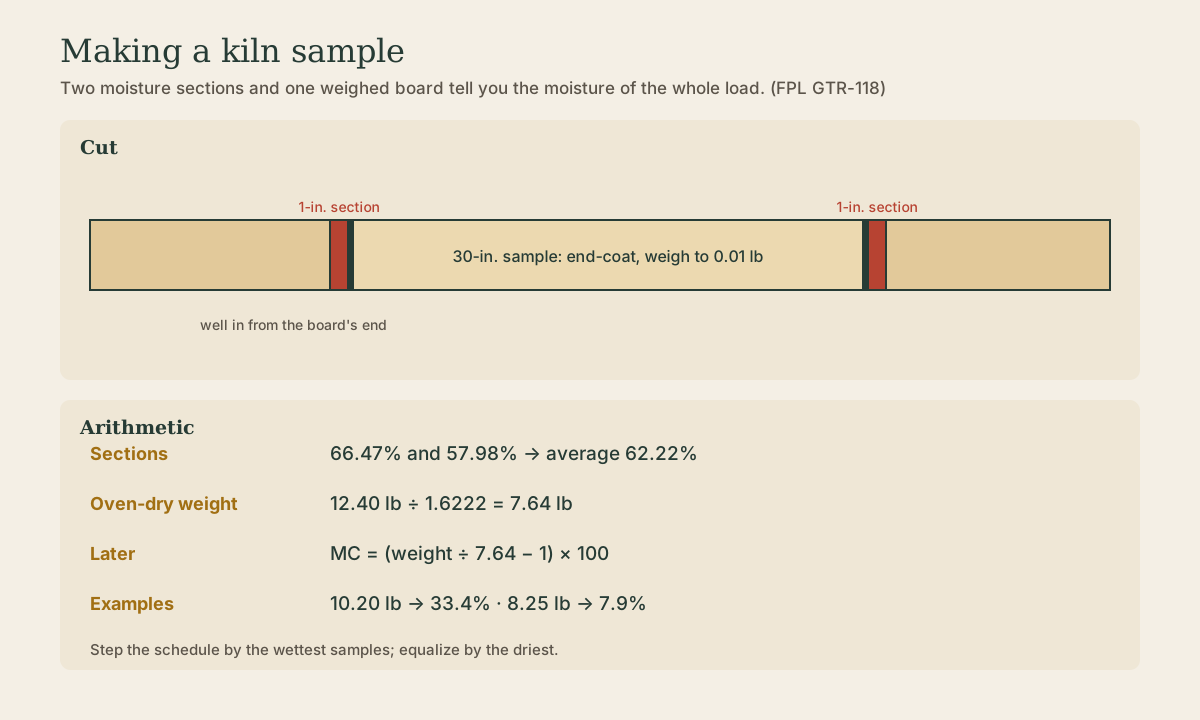
- Cut a sample about 30 inches long, well in from the board’s end, and cut a moisture section about 1 inch long along the grain from each end of the sample.
- Weigh the moisture sections immediately, very precisely, then oven-dry them to find their moisture content.
- End-coat the sample right away (asphalt roofing compound works) and weigh it to 0.01 lb. Write the weight and date on it.
- Put the sample back in the load, in a pocket where it gets the same air as the lumber.
The arithmetic
From each moisture section, MC = (original weight ÷ oven-dry weight − 1) × 100. The FPL manual’s example: sections at 98.55 g and 86.92 g green, 59.20 g and 55.02 g oven-dry, give 66.47 and 57.98 percent, which average 62.22 percent 1.
Assume the sample’s MC at cutting equals that average. Then its estimated oven-dry weight is:
oven-dry weight = weight when cut ÷ (1 + MC/100)
A sample weighing 12.40 lb at 62.22 percent has an oven-dry weight of 12.40 ÷ 1.6222 = 7.64 lb. From then on, every time you weigh it:
current MC = (current weight ÷ oven-dry weight − 1) × 100
At 10.20 lb it’s at 33.4 percent; at 8.25 lb, 7.9 percent. Weigh samples daily, at the same time. Change schedule steps based on the wettest samples, so the slowest wood isn’t damaged by conditions it isn’t ready for; equalize based on the driest.
The same method works for air drying and solar kilns: a single end-coated sample board, weighed every week or two, tells you more than any number of guesses.
Quick check
Oven-dry weight = 12.40 ÷ (1 + 0.622) = 7.64 lb.
Safe drying rates
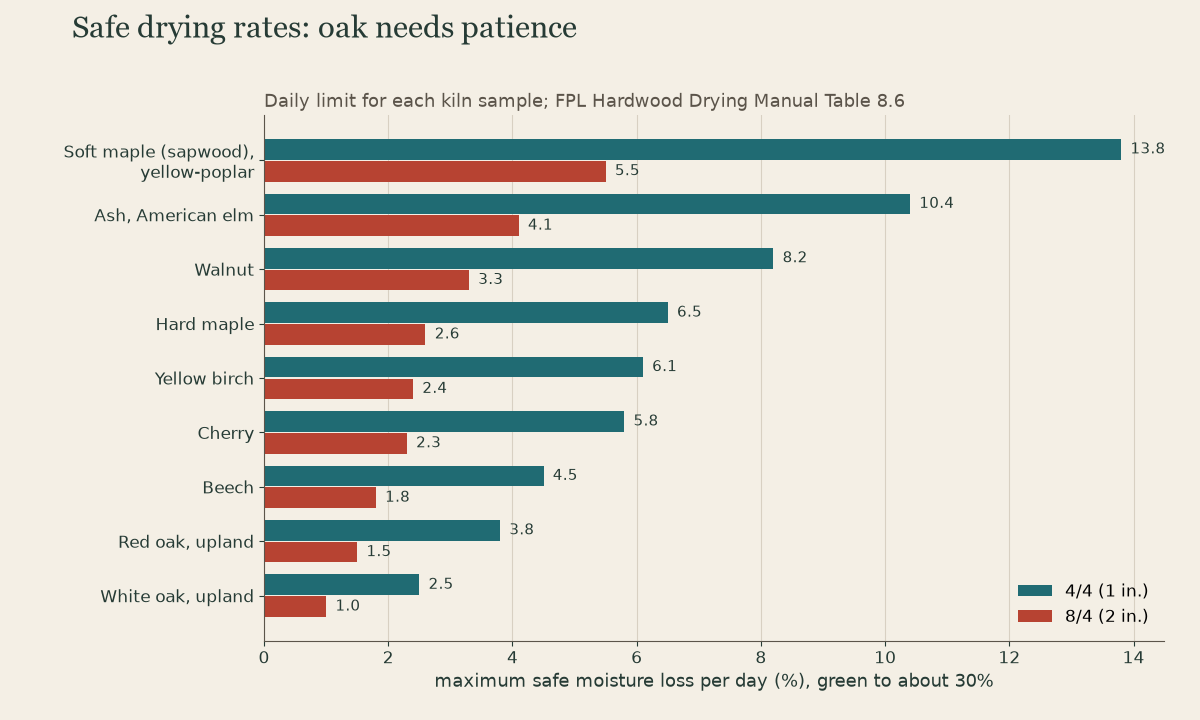
Weighing daily gives you not just moisture content but drying rate: percent moisture lost per day. For every species and thickness there’s a rate that, if not exceeded, produces sound lumber. The FPL’s table 1:
| Species | 4/4 | 8/4 |
|---|---|---|
| Soft maple (sapwood), yellow-poplar | 13.8 | 5.5 |
| Ash, American elm | 10.4 | 4.1 |
| Walnut | 8.2 | 3.3 |
| Hard maple | 6.5 | 2.6 |
| Yellow birch | 6.1 | 2.4 |
| Cherry | 5.8 | 2.3 |
| Beech | 4.5 | 1.8 |
| Red oak, upland | 3.8 | 1.5 |
| White oak, upland | 2.5 | 1.0 |
Percent moisture-content loss per day.
Three rules from the manual for using it:
- These are daily limits for each sample, not averages. Losing 8 percent today and 2 tomorrow is not “5 per day”; the 8 percent day already did the damage.
- They apply to the wet stages (I and II), from green down to about 30 percent, when surface checks and internal checks form. Below that, wood can dry faster safely.
- Going far below the safe rate isn’t free either: it raises stain risk and cost.
Notice how much the numbers vary. White oak 8/4 should lose only 1 percent a day; soft maple 4/4 can lose nearly 14. That’s why oak takes weeks in a kiln and why soft maple must be dried fast to stay white. And why air-drying red oak in a dry, windy Wisconsin May can exceed its safe rate on an exposed pile: an open yard has no humidity control at all.
What to take from this
Kiln samples, 30 inches long with 1-inch moisture sections cut from each end, let you estimate oven-dry weight and track moisture content by weighing: oven-dry = weight ÷ (1 + MC), then MC = (weight ÷ oven-dry − 1) × 100. Weigh daily, step the schedule by the wettest samples, and keep each sample’s daily loss under the FPL safe rate, from 13.8 percent for soft maple to 2.5 for 4/4 white oak.
Practice
Red oak is refractory. 4/4 upland red oak should lose no more than 3.8 percent moisture per day in the early stages; 8/4, only 1.5.
Practice
Conditions change based on the wettest samples, which represent the wood most at risk of damage from harsher conditions.
Lesson complete
Nice work.
Sources for this lesson
- 1Joseph Denig, Eugene M. Wengert, William T. Simpson. Drying Hardwood Lumber. USDA Forest Service, Forest Products Laboratory, FPL-GTR-118. 2000. verifiedPredrying, kiln schedules, safe daily drying rates (Table 8.6), stress testing and conditioning, dehumidification kilns, the semi-greenhouse solar kiln, and storage. Cited at: Kiln Samples; Calculation of Moisture Content and Ovendry Weight; Table 8.6.
Further reading
- Richard Bergman. Drying and Control of Moisture Content and Dimensional Changes (Wood Handbook, Chapter 13). USDA Forest Service, Forest Products Laboratory, FPL-GTR-282. 2021. verifiedOven-dry and meter methods, outdoor EMC by city incl. Madison (Table 13-1), recommended MC (Table 13-2), kiln schedules (Table 13-3), drying defects, and dimensional change coefficients (Table 13-5).