Solar Kilns
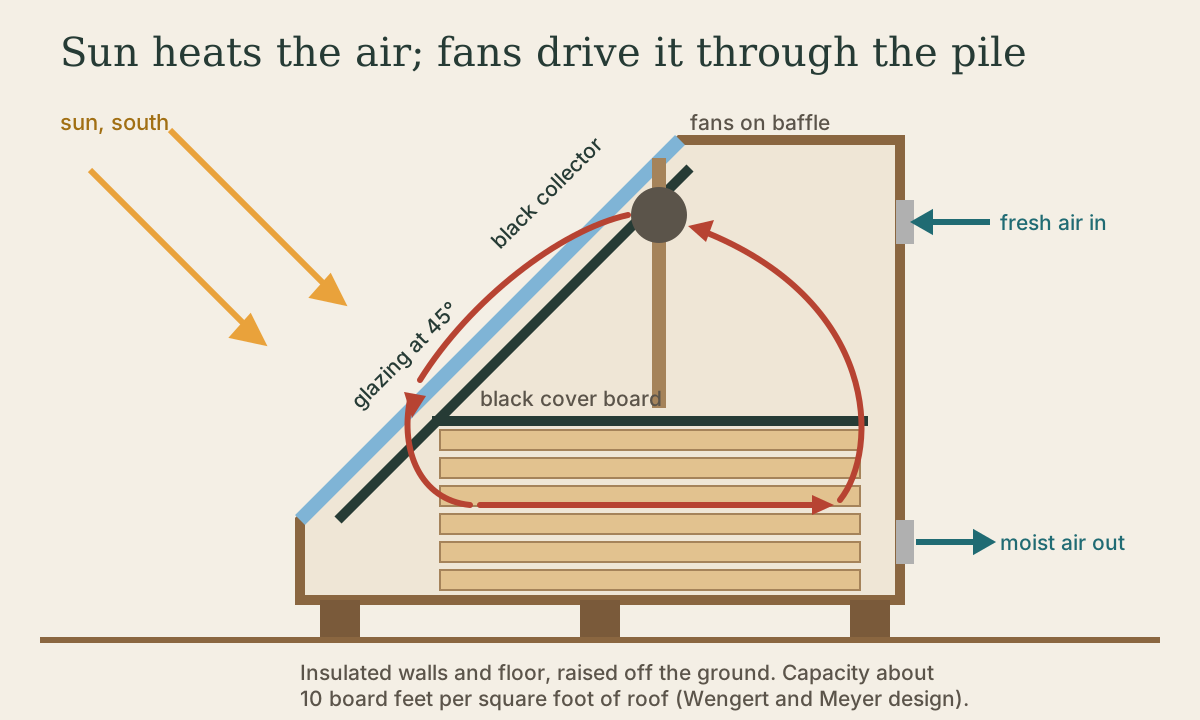
The semi-greenhouse solar kiln developed by Gene Wengert - sized at 10 board feet per square foot of roof, tilted 45 degrees for Wisconsin - dries 4/4 hardwood to 6 to 8 percent in about six weeks of good weather.
- 5 min
- 7 steps
- 3 questions
- Lesson 16 of 160
In this lesson
- The idea
- What it can do
- Size and angle
- Construction notes
- Loading and running it
- The Wisconsin season
- What to take from this
Open alongside this lesson
-
Design and Operation of a Solar-Heated Dry Kiln (opens in a new tab)
Virginia Tech's current version of the same design, with construction drawings and operating notes.
Picking up where you left off.
The idea
A solar kiln is a small insulated drying chamber with a glazed roof. Sunlight heats a black collector surface under the glazing; fans push that warm air through a stickered stack of lumber; vents swap some humid air for drier outside air. It costs little to build, almost nothing to run, and it dries furniture lumber to 6 to 8 percent, something air drying in Wisconsin can’t do.
The design most people build was developed by Gene Wengert, starting at the Forest Products Laboratory and Virginia Tech and continuing at the University of Wisconsin–Madison. The FPL hardwood manual describes it and notes it has been built more than 300 times nationwide; Virginia Tech still publishes plans for its current version 1 2.
What it can do
- Most 4/4 hardwoods dry from green to 6 percent in about six weeks of good weather in the FPL experience.
- The manual’s reference kiln dries 450 board feet of 4/4 in six weeks or less, or 600 board feet of 8/4 in about 15 weeks.
- Virginia Tech’s current version holds 750 to 1,000 board feet and dries a load in about a month of moderately sunny weather in Blacksburg.
Solar kilns are best where drying time isn’t critical. The FPL manual suggests that operations needing more than about 50,000 board feet a year of kiln-dried lumber are better served by a dehumidification kiln.
Size and angle
Two design rules from the FPL manual 1:
- Capacity: a maximum of about 10 board feet per square foot of roof, measured perpendicular to the noon sun. A roof 8 by 8 feet, 64 square feet, handles about 640 board feet.
- Roof angle: equal to the latitude for best year-round performance. Wisconsin spans 42.5 to 47 degrees north, so 45 degrees is ideal. Steepening to about 55 degrees improves winter performance, when the sun is low.
The glazed roof faces south.
Quick check
The FPL rule is a maximum of about 10 board feet per square foot of roof, measured perpendicular to the noon sun.
Construction notes
From the FPL manual’s construction description:
- Floor: 2×6 joists on hangers, 16 to 24 inches on center, covered top and bottom with 5/8-inch exterior plywood and insulated with batts or rigid foam. Avoid foil-faced insulation, which traps moisture, and blown-in insulation. Seal the top with aluminum or oil-based paint, then paint it flat black.
- Walls: 2×4 or 2×6 studs with 3/4-inch plywood, insulated, interior painted like the floor. Frame doors in the side walls as large as the end of the lumber pile.
- Vents: four 1-foot-square openings in the back (north) wall, two high and two low, screened against birds and rodents, with simple doors.
- Baffle and fans: a 3/4-inch plywood baffle from the roof to within 6 inches of the lumber pile, with two fans mounted as high as possible. The inside can exceed 150 °F, so use metal fans without plastic parts. Fans blow toward the front of the kiln, away from the top vents. Close the gap between baffle and pile with plastic or canvas so air goes through the lumber, not over it.
- Foundation: cinder blocks, ties, or concrete; never wood on the ground.
- Exterior: dark stain; avoid vapor-tight coatings that trap moisture in the insulation.
- Glazing: one or two layers of translucent fiberglass, plastic film, or glass; two layers dry faster. Fiberglass is cheap and tough. Seal with non-hardening silicone and fasten with treated 1×4 strips.
Loading and running it
- Sticker the lumber on the kiln floor (never directly on it), stickers perpendicular to the lumber.
- Fill the kiln to its design capacity. A light load dries too fast and can check or honeycomb.
- Keep the top of the stack within 6 inches of the baffle and leave about a foot between the pile and the front and back walls.
- End coat any uncoated ends and cover the top of the stack with black-painted plywood.
- Track moisture with sample boards weighed every few days, using the kiln-sample arithmetic from the previous lesson.
A solar kiln has a natural rhythm that helps quality: hot and drying hard by day, cooling at night when humidity in the kiln rises and the surface of the lumber regains a little moisture. That nightly recovery tends to relieve surface stress, one reason well-run solar kilns produce lumber low in checking and casehardening.
The Wisconsin season
Solar drying follows the sun. From April to September a well-built kiln in Wisconsin dries steadily; in midwinter, with short days and low sun, drying slows a lot, and a steep roof helps. Many Wisconsin woodworkers air dry lumber to around 20 percent over spring and summer, then finish it in the solar kiln, which also gets hot enough to heat-sterilize the lumber when the sun is strong if you hold the core at 140 °F.
What to take from this
The Wengert semi-greenhouse solar kiln is a cheap, proven way to dry furniture lumber: about 10 board feet per square foot of south-facing roof, tilted 45 degrees for Wisconsin, insulated, with baffle-mounted metal fans and back-wall vents. Fill it to capacity, track sample boards, and expect about six weeks for 4/4 in good weather.
Practice
Roof angle should equal latitude; Wisconsin spans about 42.5 to 47 degrees, so 45 is ideal, and 55 helps in winter when the sun is low.
Practice
A solar kiln’s heat is sized to its load. A light load gets too much heat per board foot and dries too fast.
Lesson complete
Nice work.
Sources for this lesson
- 1Joseph Denig, Eugene M. Wengert, William T. Simpson. Drying Hardwood Lumber. USDA Forest Service, Forest Products Laboratory, FPL-GTR-118. 2000. verifiedPredrying, kiln schedules, safe daily drying rates (Table 8.6), stress testing and conditioning, dehumidification kilns, the semi-greenhouse solar kiln, and storage. Cited at: Solar Drying; Construction of Solar Kiln.
- 2Brian Bond. Design and Operation of a Solar-Heated Dry Kiln. Virginia Cooperative Extension, Publication 420-030. verifiedCurrent version of the Virginia Tech solar kiln (750 to 1,000 board feet, about a month per load in sunny weather) with downloadable plans.