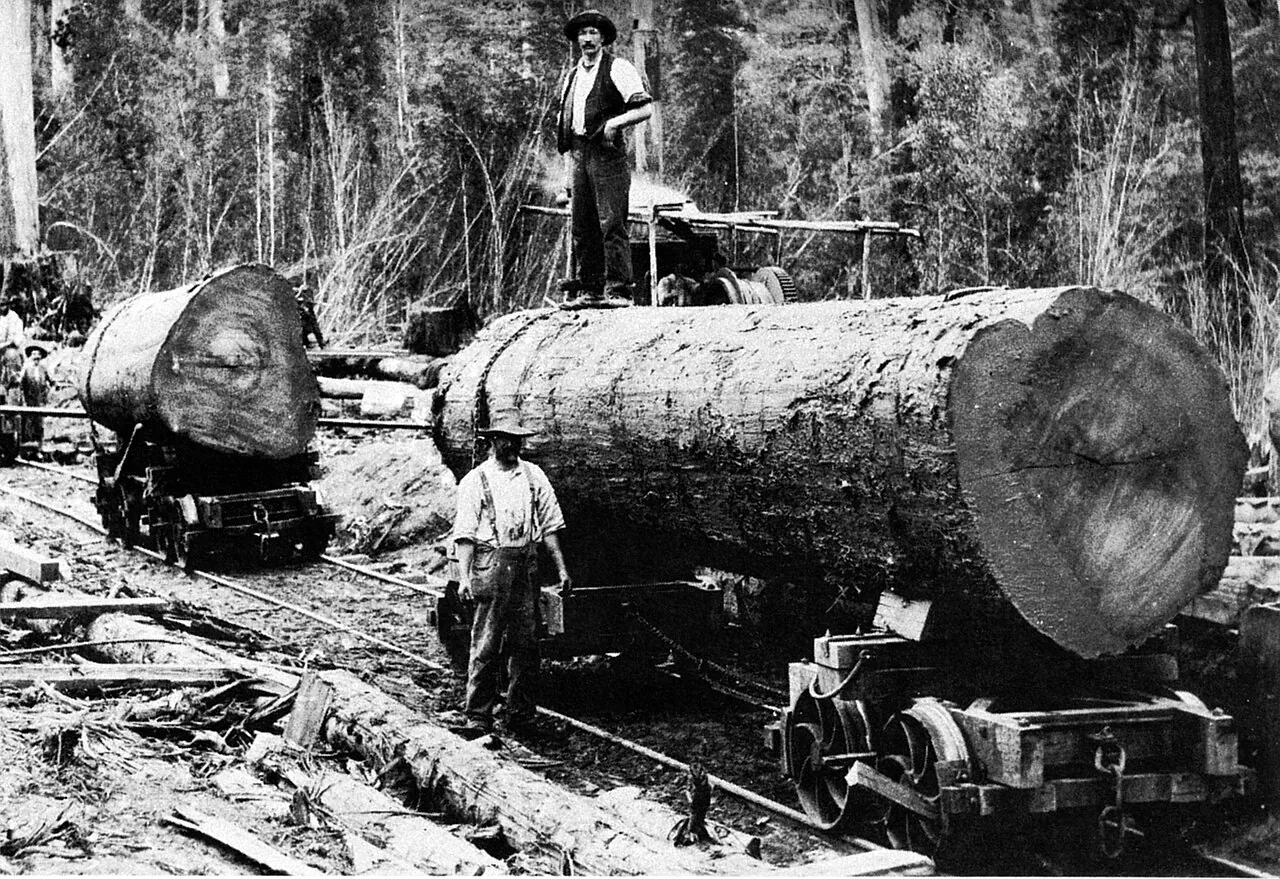
Felling and Log Care
Drying quality starts with the log - cut at the right time, coat the ends at once, keep logs off the ground, and saw them before warm weather lets stain, bacteria, and insects in.
- 5 min
- 5 steps
- 3 questions
- Lesson 6 of 160
In this lesson
- The log decides a lot
- When to cut
- Coat the ends the day you cut
- Keep logs off the ground and out of the sun
- What to take from this
Picking up where you left off.
The log decides a lot
Most drying problems that show up months later were started before the first board was cut. The Forest Products Laboratory’s hardwood drying manual puts it plainly: logs should be taken from the woods and sawn into lumber as soon as possible, particularly in warm weather, and the impact of long log storage on drying quality “cannot be overstated” 1.
.jpg)
Three things go wrong in a log that sits:
- The ends dry and check. Water leaves end grain many times faster than through bark or faces. Checks that start in the log run into the boards.
- Fungi move in. In warm weather, blue-stain fungi colonize the sapwood within days to weeks, especially in maple, birch, ash, and pine sapwood. Stain doesn’t weaken wood, but it ruins it for clear finishes.
- Insects and bacteria arrive. Ambrosia beetles bore pinholes into fresh logs. Under wet, low-oxygen conditions bacteria weaken the wood and set it up for checking, honeycomb, and grayish enzymatic stains during drying.
When to cut
The water content of a living tree changes surprisingly little through the year; “winter wood is drier” is mostly a myth. What changes is deterioration. In cold weather stain fungi, bacteria, and insects are nearly inactive, so a log felled in December keeps reasonably well until spring sawing. A log felled in July can start staining within a week. If you control the timing, fell in late fall or winter, and saw before the weather warms.
Spring cutting has one practical drawback beyond decay: when sap is running, bark slips off easily, which is great for peeling poles and terrible if you want bark left on for a live-edge slab.
Oaks have a special rule in Wisconsin. Oak wilt, a fungal disease that kills red oaks quickly and weakens white oaks, spreads through fresh wounds in spring and early summer. The Wisconsin DNR advises not cutting, pruning, or wounding oaks from April through July, and to be very cautious, through October 1 2. If you must fell an oak in that window, know that the stump and any damaged neighbors are at risk, and wounds should be painted within minutes. Felling oaks in winter avoids the issue entirely.
Coat the ends the day you cut
End coating seals end grain so the ends dry at about the same rate as the rest of the log. Commercial wax emulsions (brushed or sprayed) are the standard; latex paint or roofing cement work in a pinch. Apply it as soon as possible after bucking.
The payoff is measurable. In a 12-week summer study in Wisconsin, wax end coating cut blue stain in hard maple logs by as much as 9 inches per log end and reduced splitting in red oak by about 6 inches per end, at a coating cost under $3 per thousand board feet. The longer the logs sat, the bigger the benefit 1.
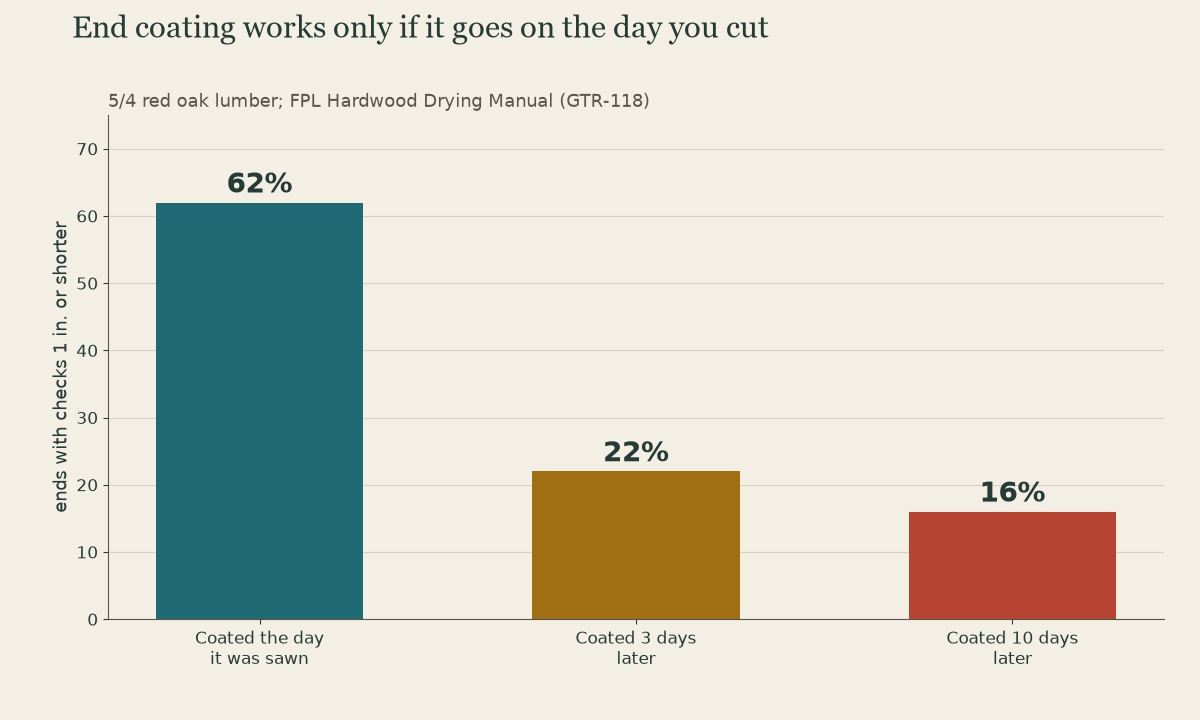
Timing matters just as much for lumber. In a test on 5/4 red oak, coating applied the day the boards were sawn left 62 percent of ends with checks no longer than an inch. Delaying the coating by just three days dropped that to 22 percent; after ten days, 16 percent. Coating applied after checks start doesn’t stop them deepening 1.
Quick check
Linares-Hernandez and Wengert (1997) found coating reduced blue stain in hard maple by up to 9 inches per end and splitting in red oak by about 6 inches, at a coating cost under $3 per thousand board feet.
Keep logs off the ground and out of the sun
If logs must wait:
- Get them off the ground on skids or poles, out of soil contact and standing water.
- Shade them. Direct sun on a log end can open checks in hours.
- Leave them long. Buck to length at the mill, not in the woods, so you can trim off a checked or stained end.
- Rotate the pile. First in, first sawn.
Large mills keep log decks under continuous water spray, which stops fungi and checking but not bacterial activity, so even sprayed logs must be sawn in reasonable time.
For green woodworking, the goal flips: you want wood to stay wet. Keep logs in long lengths, bark on, ends coated, in shade; split out only what you need. Short bolts can be stored submerged or wrapped in plastic for a few weeks in cool weather, but expect mold and stain if they sit warm.
What to take from this
Saw logs soon, especially in warm weather, because stain fungi, insects, and bacteria start working immediately. Fell in late fall or winter when you can, and never wound Wisconsin oaks April through July. Coat log and board ends the same day they’re cut; three days’ delay throws away two-thirds of the benefit. Keep waiting logs off the ground, shaded, long, and rotated.
Practice
Fresh wounds in spring and early summer let the oak wilt fungus in. Wisconsin DNR advises no cutting or pruning of oaks April through July.
Practice
The water content of the wood changes little by season, but deterioration nearly stops in the cold. Logs cut in winter can wait for spring sawing far better than summer logs can wait at all.
Lesson complete
Nice work.
Sources for this lesson
- 1Joseph Denig, Eugene M. Wengert, William T. Simpson. Drying Hardwood Lumber. USDA Forest Service, Forest Products Laboratory, FPL-GTR-118. 2000. verifiedPredrying, kiln schedules, safe daily drying rates (Table 8.6), stress testing and conditioning, dehumidification kilns, the semi-greenhouse solar kiln, and storage. Cited at: Protection of Logs; Prevention of End Checks.
- 2Spring Brings Opportunities To Protect Oak Trees. Wisconsin DNR Forestry News. 2025. verifiedDon't prune, cut, or wound oaks April through July (to be cautious, through October 1) because of oak wilt.
Further reading
- Forest Products Laboratory. Air Drying of Lumber. USDA Forest Service, Forest Products Laboratory, FPL-GTR-117. 1999. verifiedRevision of Rietz and Page (1971). Yard layout, piling and stickering, air-drying times by species and region, and days to dry 1-in. red oak at Madison, WI by stacking month (Table 9).