Sawing for Drying
How you open a log - flatsawn, quartersawn, or rift; around the pith; and at what thickness - largely decides how its boards dry and how much they warp.
- 5 min
- 6 steps
- 3 questions
- Lesson 7 of 160
In this lesson
- Three ways to slice a log
- Patterns and their warp
- Saw thick enough
- Thickness and drying time
- Width and length
- What to take from this
Picking up where you left off.
Three ways to slice a log
The angle at which a board’s face crosses the growth rings changes how it shrinks, dries, and looks:

- Flatsawn (plainsawn): the face is roughly tangent to the rings, which show as cathedral arches. Fastest to saw, widest boards, least waste. Shrinks most in width, cups, and is the most prone to surface checking. Dries faster than quartersawn, because moisture moves more easily radially, which here is through the board’s thickness 1.
- Quartersawn: the rings run nearly perpendicular to the face, so width shrinks radially, about half as much. Stays flat, rarely surface checks, and shows ray fleck in oak and sycamore. Slower to dry, more waste, narrower boards.
- Rift sawn: rings at roughly 30 to 60 degrees to the face. Straight grain on every face, which is why it’s favored for legs. Movement in between.
Most boards from a log sawn “through and through” are a mix: flatsawn in the middle of the width and nearly quartersawn at the edges of the center boards.
Patterns and their warp
The FPL hardwood drying manual summarizes how sawing affects warp 2:
- Lumber sawn parallel to the bark is less likely to bow or twist than lumber sawn at an angle to it. On a tapered log, that means sawing to follow the taper on the good face, not straight through the core.
- Flatsawn lumber cups more than quartersawn.
- Boards with growth rings off-center on the end are more prone to crook (sidebend) than boards whose rings are mirror images on both edges.
- Wood near the pith often has high lengthwise shrinkage and will bow or crook.
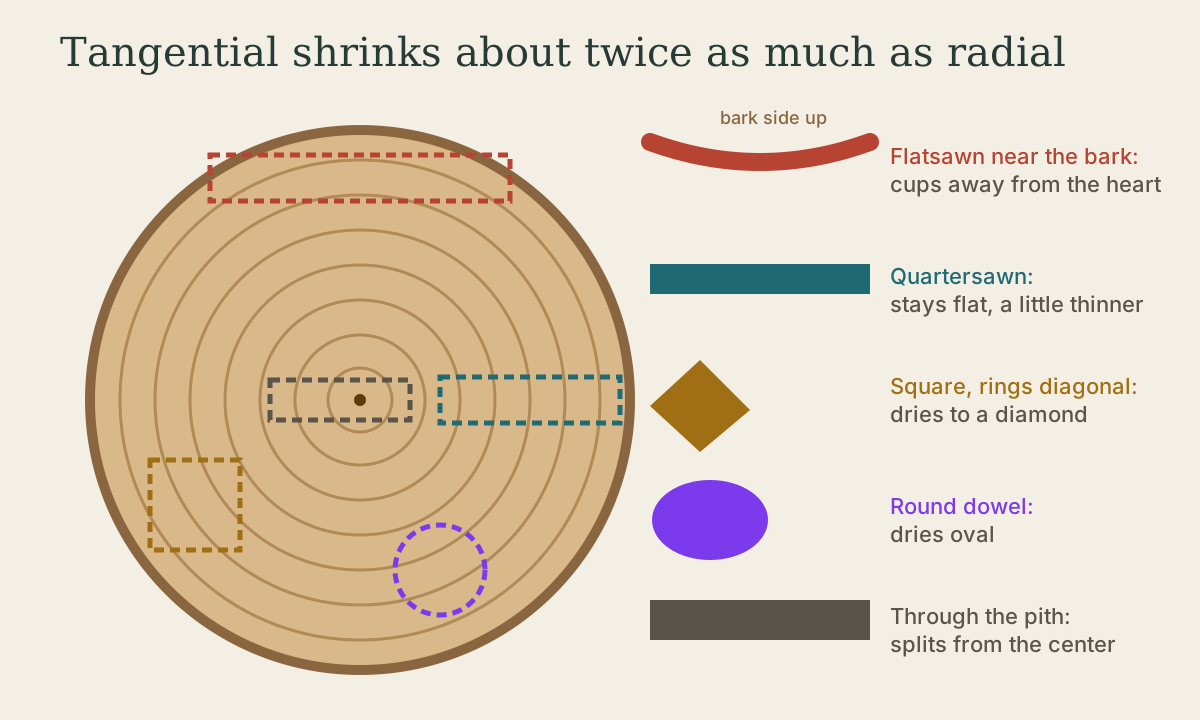
So box the heart: saw so the pith and the juvenile wood around it end up in one center cant or a low-value board, rather than running through the middle of good boards. A board containing the pith will almost certainly split down the middle as it dries.
Reaction wood follows the same logic. If the tree leaned, the side of the log that was under tension (hardwoods) or compression (softwoods) holds wood with high longitudinal shrinkage. Boards from that zone bow; keep them short or use them for small parts.
Quick check
The FPL manual notes that lumber with off-center rings is more prone to sidebend (crook) than lumber whose rings are mirror images on each edge.
Saw thick enough
Green boards have to be oversize to allow for shrinkage and planing. From the FPL manual: presurfaced 4/4 lumber is typically 1.03 inches thick, at least 0.09 inch is needed for planing allowance before that, so rough green 4/4 should be no thinner than about 1.12 inches 2. Practical green targets:
| Final dressed thickness | Saw green at |
|---|---|
| 3/4 in. (from 4/4) | 1 1/8 in. |
| 1 1/16 in. (from 5/4) | 1 3/8 in. |
| 1 3/4 in. (from 8/4) | 2 1/8 to 2 1/4 in. |
Saw consistently. A board that’s thick on one end and thin on the other can’t be held flat by stickers, and one thick board in a layer lets its thinner neighbors warp freely. Uniform thickness matters more than hitting a number exactly.
Thickness and drying time
Drying time grows faster than thickness. The FPL air-drying guide notes that 2-inch lumber may take about three times as long to dry as 1-inch lumber of the same species 3. Its regional table makes the point for the Mid-North: 1-inch red oak takes roughly 60 to 165 days to reach 20 to 25 percent, while 2-inch oak in central regions takes 190 to 250. Thick stock also checks and honeycombs more easily, and some species, such as oak, are hard to dry in thick sizes at all. Saw 8/4 and thicker only where you need it, and expect to wait.
Width and length
Wide flatsawn boards cup more in absolute terms. If you’re sawing for a project, consider ripping very wide flatsawn boards in half green, or sawing them quartered. Saw long: you can always crosscut later, and longer boards let you trim off checked or stained ends.
What to take from this
Flatsawn dries faster but cups and checks more; quartersawn stays flat and stable but dries slower. Saw parallel to the bark, keep the pith and reaction wood out of good boards, and saw thick enough, about 1 1/8 inches green for finished 3/4 stock, and evenly. Expect 8/4 to take roughly three times as long as 4/4.
Practice
Green lumber needs allowance for drying shrinkage plus planing. The FPL manual recommends rough 4/4 no thinner than about 1.12 inches.
Practice
Moisture has twice as far to travel and the gradient is gentler. The FPL air-drying guide puts 2-inch lumber at about three times the drying time of 1-inch.
Lesson complete
Nice work.
Sources for this lesson
- 1Richard Bergman. Drying and Control of Moisture Content and Dimensional Changes (Wood Handbook, Chapter 13). USDA Forest Service, Forest Products Laboratory, FPL-GTR-282. 2021. verifiedOven-dry and meter methods, outdoor EMC by city incl. Madison (Table 13-1), recommended MC (Table 13-2), kiln schedules (Table 13-3), drying defects, and dimensional change coefficients (Table 13-5). Cited at: Drying Mechanism.
- 2Joseph Denig, Eugene M. Wengert, William T. Simpson. Drying Hardwood Lumber. USDA Forest Service, Forest Products Laboratory, FPL-GTR-118. 2000. verifiedPredrying, kiln schedules, safe daily drying rates (Table 8.6), stress testing and conditioning, dehumidification kilns, the semi-greenhouse solar kiln, and storage. Cited at: Sawing Procedures; Presurfacing.
- 3Forest Products Laboratory. Air Drying of Lumber. USDA Forest Service, Forest Products Laboratory, FPL-GTR-117. 1999. verifiedRevision of Rietz and Page (1971). Yard layout, piling and stickering, air-drying times by species and region, and days to dry 1-in. red oak at Madison, WI by stacking month (Table 9). Cited at: Thickness.