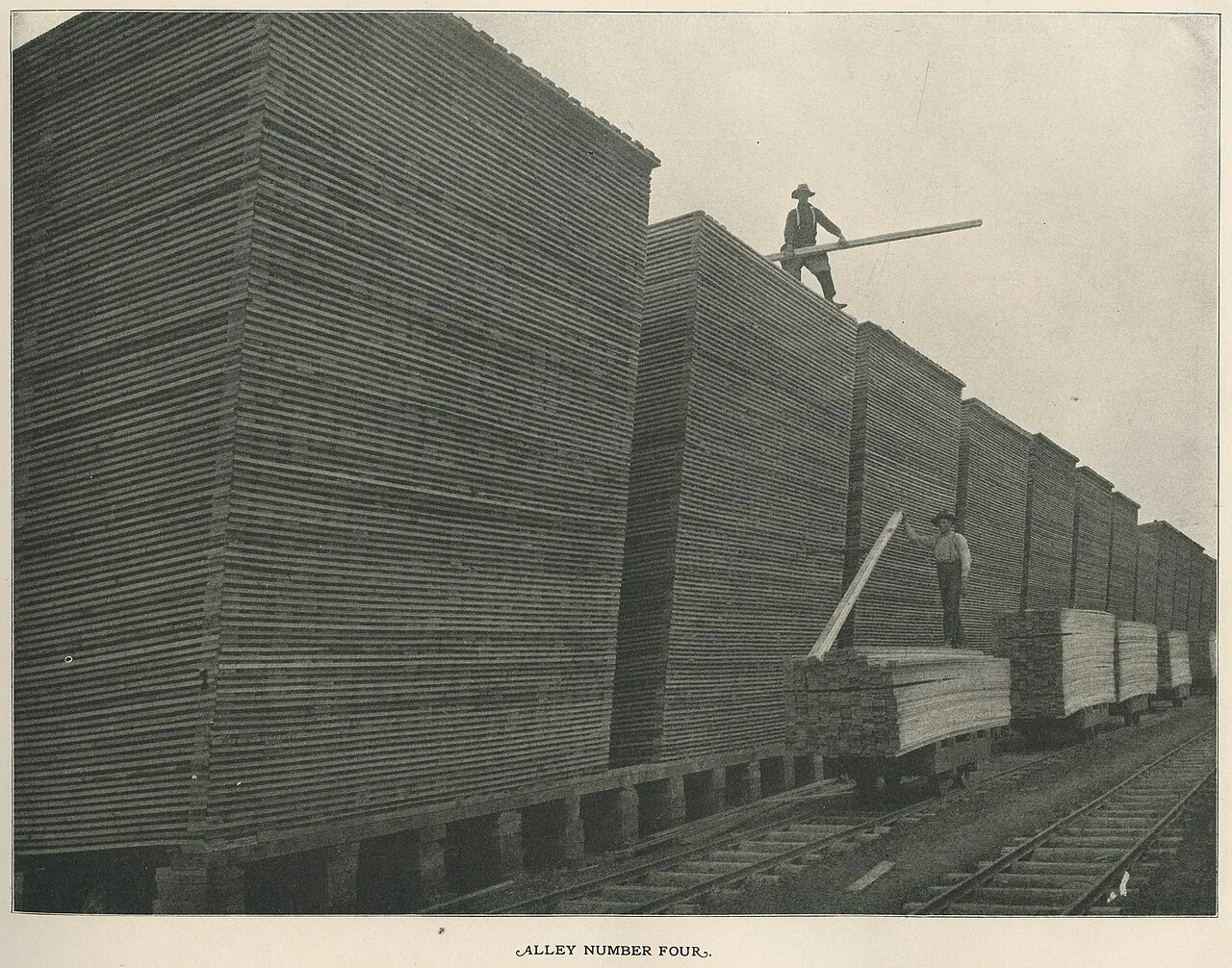
Stickering and Stacking
A sticker stack is a machine for moving air past every board while holding them flat - dry, uniform stickers in plumb columns over solid supports, ends coated, top roofed and weighted.
- 5 min
- 8 steps
- 3 questions
- Lesson 8 of 160
In this lesson
- What a stack has to do
- The foundation
- Stickers
- Laying the boards
- End coating
- Roof and weight
- Special cases
- What to take from this
Picking up where you left off.
What a stack has to do
Stickering means laying boards in layers separated by thin strips, the stickers, so air can flow across both faces of every board. A good stack does two jobs at once: it exposes all the wood to moving air, and it restrains the boards so they dry flat. Poor stacking is the commonest cause of warp in air-dried lumber, and it’s almost free to get right 1.
.jpg)
The foundation
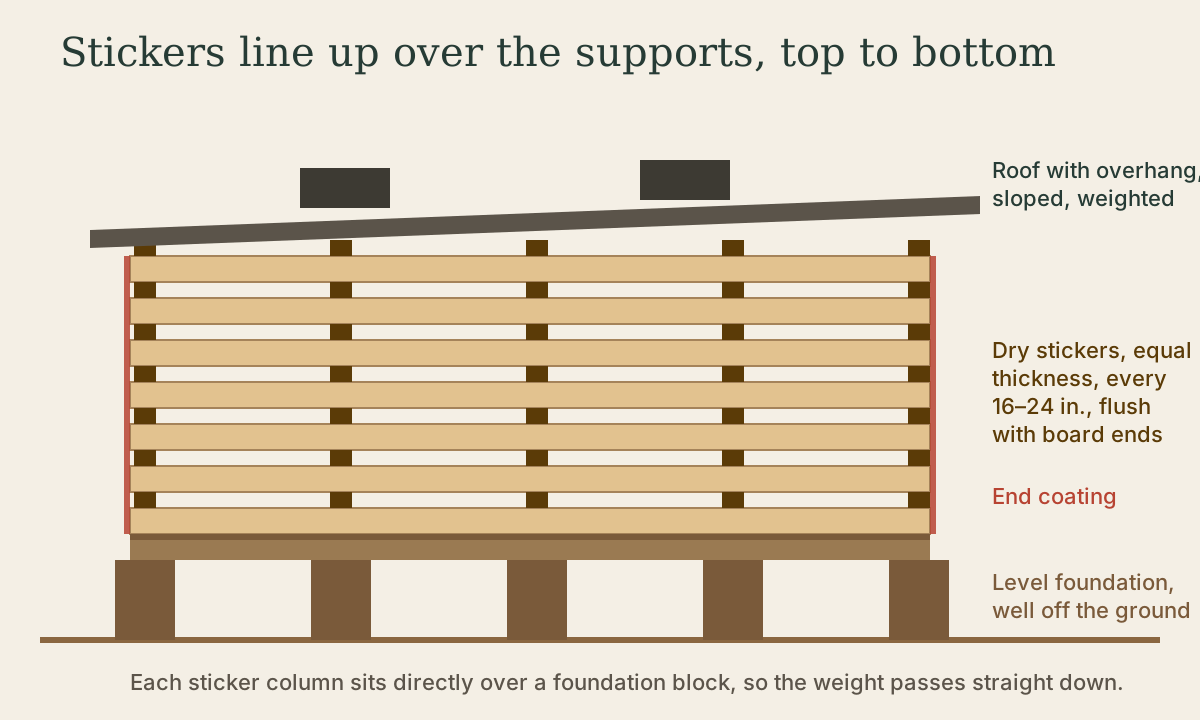
Everything rests on the foundation, so it has to be level, solid, and high:
- Raise the pile 18 to 24 inches off the ground so the wind can sweep the cool, moist air out from under it, and so the bottom boards stay out of ground moisture and splash 1. Low piles on damp ground give wet, stained bottom layers.
- Make the supports level and in plane. A sagging foundation warps every board above it and can tip the pile 1.
- Space the supports so each one lines up under a column of stickers.
- Don’t lay solid timbers flat on the ground in a way that blocks air under the pile; the FPL guide specifically warns against foundations that let air move in only one direction.
Concrete blocks with treated 4×4 or 6×6 bearers work well for a small yard. Keep weeds cut back; they hold humid air around the bottom of the pile.
Stickers
The FPL air-drying guide’s recommendations 1:
- Size: for hardwoods, stickers are usually ripped from 1-inch lumber, rough or dressed to about 3/4 inch thick, and 1 to 2 inches wide, most often 1 1/4. Softwood stickers are often wider.
- Uniform thickness. All stickers in a pile must be the same thickness, or the boards over the thick ones get pushed up and warp. Surface the stock before ripping stickers.
- Dry, straight-grained, strong. Oak, beech, and hickory make durable hardwood stickers. Use heartwood and keep stickers stored dry: sapwood or wet stickers can infect green lumber with stain and decay fungi. Green edgings make poor stickers.
- Spacing: 16 to 24 inches is common for hardwood, with five to nine stickers on a 16-foot board. The FPL hardwood manual says 24 inches is usually fine for stock thicker than 6/4, but recommends 12 inches for lower-grade 4/4 to 6/4 and for warp-prone species, plus an extra sticker 12 inches from each end when lengths are mixed 2.
- Alignment. Stack stickers in plumb vertical columns directly over the foundation supports. If they wander, the weight above can’t pass straight down through the stickers and instead bends the boards between them, and they dry bent.
- Flush at the ends. Put a sticker right at each end of the pile, flush with the board ends, so the ends are held flat and shaded. Overhanging board ends cup, check, and split.
Quick check
Aligned stickers pass the weight straight down by compression. Misaligned ones make each board a little beam under load, and it sets in that bent shape as it dries.
Laying the boards
- Sort by thickness first; never mix thicknesses in a layer.
- Lay boards edge to edge in packages about 4 feet wide, a common standard. In wider hand-built piles, leave narrow gaps between boards or a vertical “chimney” in the middle so air can rise through.
- Put long boards on the outside and shorter ones inside, and alternate the butt ends of random-length boards so each layer is supported at both ends. A board end with no sticker under it will droop.
- Keep a package around 4 feet high so it’s stable and the boards on the bottom aren’t over-stressed.
End coating
If the boards weren’t end coated at sawing, coat them now, before they check. Most hardwood operations otherwise trim 3 to 10 inches off every board end to remove checks, a loss of 6 to 20 percent of a 100-inch board 2.
Roof and weight
Cover the pile with a roof that overhangs the ends and sides, sloped to shed water, and sitting a little above the top layer on its own stickers so air moves under it. Rain soaking the top layers rewets them, and summer sun on unprotected top boards causes severe checking and warp. Plywood, metal roofing, or old lumber all work.
Then add weight on top: concrete blocks, scrap timbers, or ratchet straps. The weight holds the top layers flat; they have nothing above them to restrain them otherwise. Weight on top reduces warp throughout the pile.
Special cases
- Light-colored woods like hard maple develop sticker stain, discolored stripes where the sticker touched, if early drying is slow. Use narrow, dry stickers, get the pile into fast-moving air or a predryer immediately, and consider grooved or profiled stickers that touch less wood.
- Oak and other check-prone woods need gentler early drying: closer piles, a shaded shed, or shade cloth on the sunny side in spring.
What to take from this
Raise the pile on a level, solid foundation; lay dry, uniform 3/4-inch heartwood stickers every 16 to 24 inches in plumb columns over the supports, with a sticker flush at every end; sort by thickness, coat the ends, roof it with overhang, and weight the top. That combination exposes every board to air while holding it flat.
Practice
The FPL guide recommends dry storage of stickers and heartwood stock, because sapwood or wet stickers can infect fresh lumber with stain and decay fungi.
Practice
The FPL guide notes 16 to 24 inches is common for hardwood, with five to nine stickers on a 16-foot board. Thinner stock and warp-prone species get the closer spacing.
Lesson complete
Nice work.
Sources for this lesson
- 1Forest Products Laboratory. Air Drying of Lumber. USDA Forest Service, Forest Products Laboratory, FPL-GTR-117. 1999. verifiedRevision of Rietz and Page (1971). Yard layout, piling and stickering, air-drying times by species and region, and days to dry 1-in. red oak at Madison, WI by stacking month (Table 9). Cited at: Piling Methods for Air Drying; Height and Type of Pile Foundation; Air-Drying Yard; Sticker Manufacture.
- 2Joseph Denig, Eugene M. Wengert, William T. Simpson. Drying Hardwood Lumber. USDA Forest Service, Forest Products Laboratory, FPL-GTR-118. 2000. verifiedPredrying, kiln schedules, safe daily drying rates (Table 8.6), stress testing and conditioning, dehumidification kilns, the semi-greenhouse solar kiln, and storage. Cited at: Stacking Lumber; Prevention of End Checks.