Using Moisture Meters Without Fooling Yourself
Pin meters read conductance between needles, pinless meters read the electric field under a pad; both are reliable only from about 6 to 30 percent, need species and temperature corrections, and mostly see the wood nearest the surface.
- 5 min
- 7 steps
- 3 questions
- Lesson 19 of 160
In this lesson
- Two kinds of meter
- What meters can and can’t read
- Pin meters: depth matters
- Pinless meters: the surface dominates
- Corrections
- A field routine
- What to take from this
Picking up where you left off.
Two kinds of meter
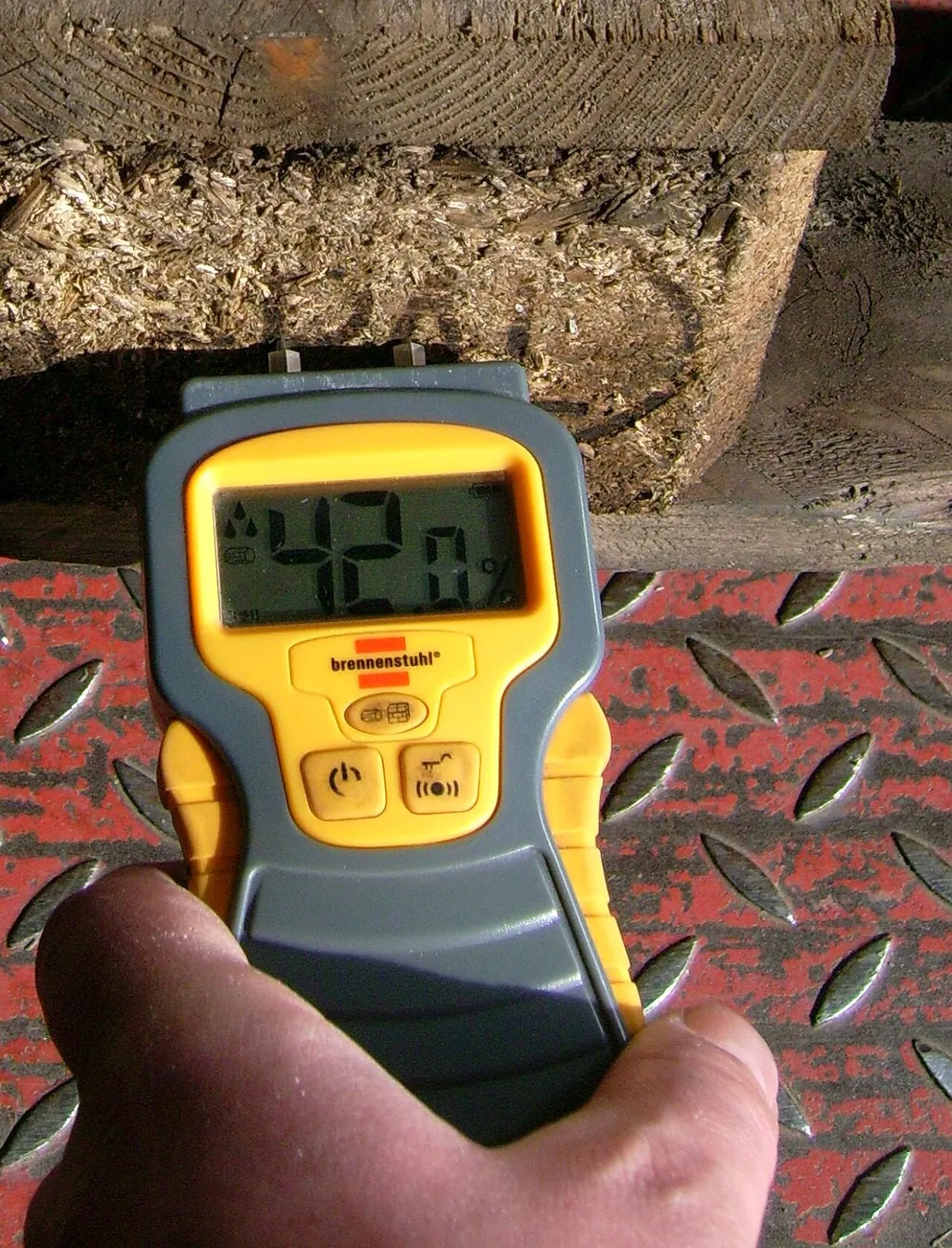
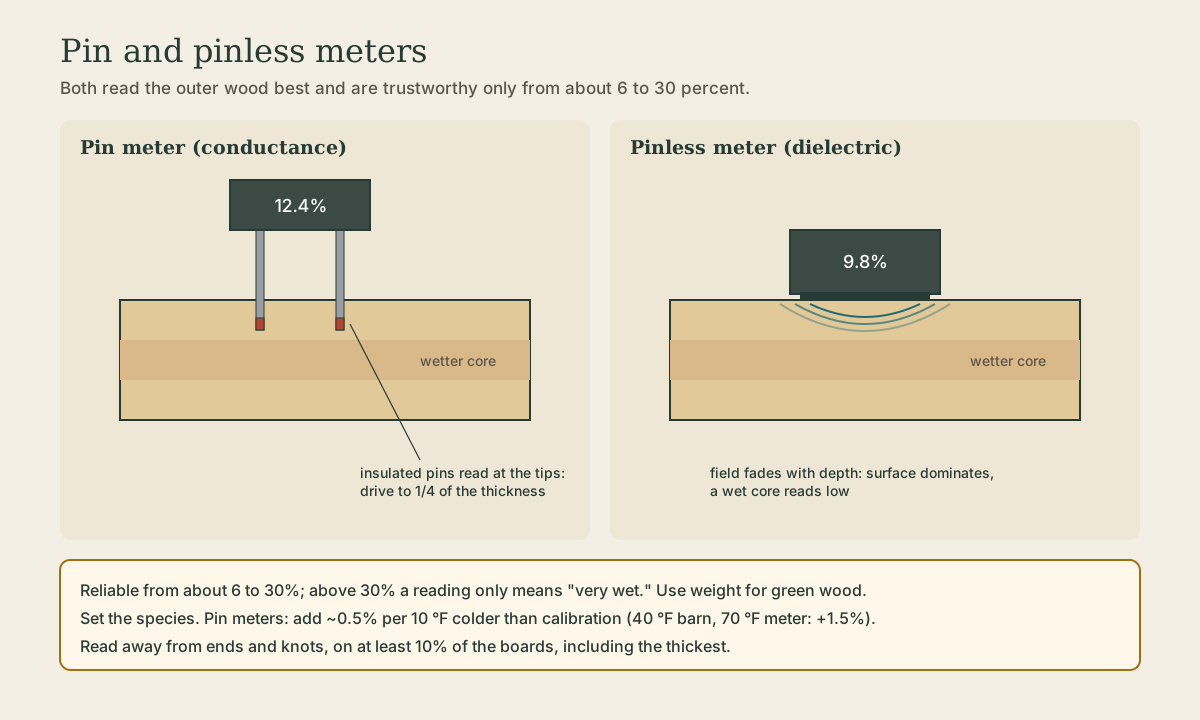
Pin meters (conductance or resistance type) drive two needle electrodes into the wood and measure how easily direct current passes between them. Wet wood conducts better than dry wood. Pinless meters (dielectric type, often called capacitance meters) press a flat pad against the surface and measure how the wood affects an electric field that penetrates a short distance into it 1.

Both are fast and repeatable. Both are also easy to misread. Their accuracy depends on understanding what part of the board they’re actually measuring and correcting for species and temperature.
What meters can and can’t read
From the Wood Handbook:
- Reliable range: about 6 to 30 percent for resistance (pin) meters, 4 to about 30 for commercial dielectric (pinless) meters. Precision drops near both ends.
- Above 30 percent, readings are only qualitative, even if the scale goes to 120. A meter can tell you a board is very wet; it can’t tell you how wet.
- Properly used on a quantity of lumber dried evenly below fiber saturation, the average of corrected readings should come within about 1 percent of the true average.
So meters are for checking dry and nearly dry wood: deciding whether air-dried stock is ready to come indoors, whether a kiln charge is done, whether shop stock is at 6 to 9 percent. For green wood and early drying, use weight.
Quick check
The Wood Handbook says readings above 30 percent must be considered only qualitative. Use weight and the oven-dry method for wet wood.
Pin meters: depth matters
A pin meter reads the wettest wood touched by the uninsulated part of the pins. Ordinary bare pins therefore report the wettest point along their length. Insulated pins, coated except at the tips, read only the wood at the tips, which lets you probe a gradient 1.
- In drying lumber the core is wetter than the shell. Drive insulated pins to one-fifth to one-quarter of the thickness to approximate the average moisture of the whole piece.
- If readings rise as you drive the pins deeper, you have a normal drying gradient. Read at quarter depth, then at mid-thickness; a big difference means the board isn’t equalized.
- After rain or in humid storage, the surface can be wetter than the core. Bare pins then read the wet surface. Use insulated pins below the wet skin.
- Orient the pins as the meter manufacturer specifies; calibration assumes that orientation.
Pinless meters: the surface dominates
A pinless meter’s field weakens quickly with depth, so the outer layers dominate the reading. If the core is much wetter than the surface, the meter underestimates the board. Pinless meters are excellent for quick sorting of uniformly dry stock and leave no holes in finished surfaces, but they need full contact on a flat, smooth surface, and they need the right density setting: newer pinless meters correct for temperature internally but require a specific gravity adjustment, set by choosing the species 1.
Corrections
- Species. Meters are calibrated for one species group (often Douglas-fir). Apply the species correction from the manufacturer’s table or set the meter to the species.
- Temperature (pin meters). Add about 0.5 percent for every 10 °F the wood is colder than the meter’s calibration temperature, and subtract the same for every 10 °F it’s warmer. Reading boards at 40 °F in an unheated barn with a meter calibrated at 70 °F: add about 1.5 percent. Reading warm boards straight out of a kiln: subtract.
- Avoid ends, knots, and reaction wood; take readings at several points, on several boards.
A field routine
- Pick at least 10 percent of the boards, more for small batches, including the thickest and most heartwood-heavy.
- On each, take readings at least 2 feet from the ends, at quarter-thickness with insulated pins.
- Correct for species and temperature and average them.
- Check two or three boards at mid-thickness too, or cut an oven-dry section from one board to confirm the meter.
The Wood Handbook’s rule for interior wood: if the average is within 1 percent of the recommended value and every individual piece falls within the allowed range (6 to 10 percent for most of the U.S.), the lot is probably satisfactory 1.
What to take from this
Pin meters read conductance between needles and see the wettest wood their bare metal touches; pinless meters read mostly the surface layers. Both work reliably only from about 6 to 30 percent, need species and temperature corrections (pin meters: plus 0.5 percent per 10 °F colder), and should be read at quarter-thickness, away from ends, on several boards. Use weight and oven-dry sections for wet wood and to check the meter.
Practice
With a typical drying gradient, the reading at 1/5 to 1/4 of the thickness approximates the average for the whole piece.
Practice
For resistance meters, add about 0.5 percent per 10 °F below the calibration temperature. 30 °F colder means add about 1.5.
Lesson complete
Nice work.
Sources for this lesson
- 1Richard Bergman. Drying and Control of Moisture Content and Dimensional Changes (Wood Handbook, Chapter 13). USDA Forest Service, Forest Products Laboratory, FPL-GTR-282. 2021. verifiedOven-dry and meter methods, outdoor EMC by city incl. Madison (Table 13-1), recommended MC (Table 13-2), kiln schedules (Table 13-3), drying defects, and dimensional change coefficients (Table 13-5). Cited at: Electrical Method; Table 13-2.
Further reading
- Joseph Denig, Eugene M. Wengert, William T. Simpson. Drying Hardwood Lumber. USDA Forest Service, Forest Products Laboratory, FPL-GTR-118. 2000. verifiedPredrying, kiln schedules, safe daily drying rates (Table 8.6), stress testing and conditioning, dehumidification kilns, the semi-greenhouse solar kiln, and storage.