The Oven-Dry Method
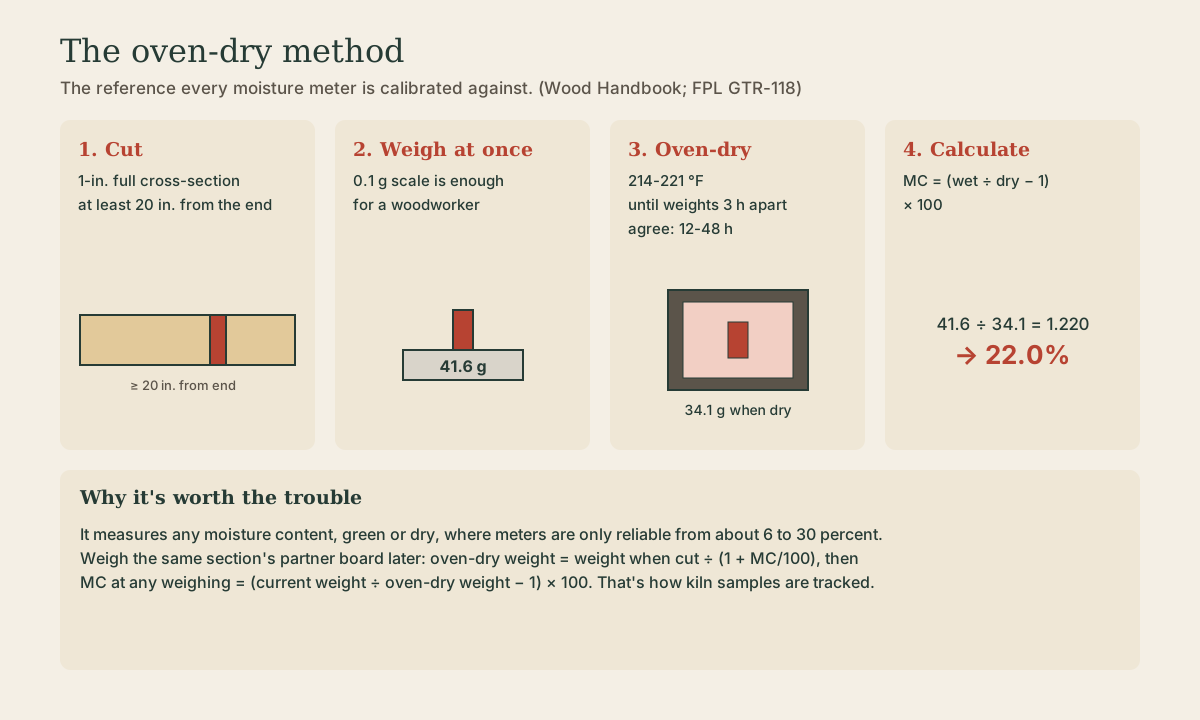
The reference method every meter is calibrated against - cut a 1-inch cross-section 20 inches from the end, weigh it, dry it at 214 to 221 °F until the weight stops changing, and do the arithmetic.
- 5 min
- 7 steps
- 3 questions
- Lesson 18 of 160
In this lesson
- Why it’s the standard
- Cutting the section
- Drying it
- The arithmetic
- Shell and core
- Turning one section into a tracking sample
- What to take from this
Picking up where you left off.
Why it’s the standard
Moisture meters are fast, but every one of them is calibrated against a slower, surer method: drying a piece of wood in an oven and weighing the water it lost. The oven-dry method has been the universally accepted measure of moisture content for over a century, and it’s the method kiln samples depend on 1. It works at any moisture content, including green wood far above the range of any meter.
Its limitations: it’s slow, it destroys the sample, and woods with volatile extractives (some cedars, some tropical species) read slightly high because those compounds evaporate along with the water.
Cutting the section
From the Wood Handbook:
- Take specimens from representative boards.
- Cut at least 20 inches from the end, because ends gain and lose moisture quickly.
- Avoid knots, bark, pitch pockets, and other irregularities.
- Cut a full cross-section, 1 inch long along the grain.
- Weigh it immediately. If you can’t, seal it in a plastic bag or wrap it tightly in foil until you can.
A kitchen scale reading to 0.1 gram is adequate for a woodworker’s purposes on a full-width section; the FPL manual asks for precision of 0.05 percent of the section’s weight for kiln work 2.
Quick check
Water moves fast through end grain, so the last foot or two of a board is usually drier (or wetter after rain) than the rest.
Drying it
Put the section in an oven at 214 to 221 °F (101 to 105 °C) and keep it there until there is no appreciable weight change between weighings 3 hours apart. A 1-inch lumber section reaches constant weight in 12 to 48 hours; smaller pieces faster 1.
A kitchen oven can do this if it holds temperature reliably at its lowest settings; an oven thermometer will tell you. Ventilate: drying wood smells, and resinous wood smokes if overheated.
Microwave option. For quick estimates, the FPL manual describes oven-drying moisture sections in a microwave at a low setting, about 250 to 300 watts: roughly 30 minutes or more for green sections, 10 to 15 for dry ones, then a minute or two more and reweigh until the weight holds steady. If a section starts to smell smoky, it’s charred and the result is worthless 2.
Weigh dried sections immediately after taking them out; bone-dry wood starts regaining moisture from the air within minutes.
The arithmetic
MC (%) = (weight when cut − oven-dry weight) ÷ oven-dry weight × 100
Or, equivalently and easier on a calculator:
MC (%) = (weight when cut ÷ oven-dry weight − 1) × 100
Example: a section weighs 41.6 g when cut and 34.1 g oven-dry.
(41.6 ÷ 34.1 − 1) × 100 = 22.0 percent
Shell and core
To see whether a board has a moisture gradient, cut the 1-inch section, then split or saw it into a shell (outer quarter of the thickness on each face) and a core (the middle half), and dry each separately. A shell at 8 percent and core at 14 tells you the board isn’t ready to mill, even if a pin meter reading at the surface looks perfect.
Turning one section into a tracking sample
The section’s moisture content also lets you estimate the oven-dry weight of the rest of a board, which you can then weigh over time, as in the kiln-sample lesson:
oven-dry weight of sample = sample weight ÷ (1 + MC/100)
Cut a 1-inch section from each end of a 2- to 3-foot sample board, average the two sections’ moisture content, end-coat and weigh the sample, and you can track that sample’s moisture content through months of air drying or weeks in a kiln with nothing but a scale.
What to take from this
The oven-dry method is the standard: cut a full 1-inch cross-section at least 20 inches from the end, weigh it at once, dry it at 214 to 221 °F until the weight holds steady (12 to 48 hours), and compute MC = (wet ÷ dry − 1) × 100. Split sections into shell and core to check for gradients, and use a section’s MC to estimate a sample board’s oven-dry weight for tracking.
Practice
(41.6 − 34.1) ÷ 34.1 × 100 = 22.0 percent. Always divide by the oven-dry weight.
Practice
The Wood Handbook says keep it in the oven until there’s no appreciable weight change at 3-hour intervals, typically 12 to 48 hours for a 1-inch section.
Lesson complete
Nice work.
Sources for this lesson
- 1Richard Bergman. Drying and Control of Moisture Content and Dimensional Changes (Wood Handbook, Chapter 13). USDA Forest Service, Forest Products Laboratory, FPL-GTR-282. 2021. verifiedOven-dry and meter methods, outdoor EMC by city incl. Madison (Table 13-1), recommended MC (Table 13-2), kiln schedules (Table 13-3), drying defects, and dimensional change coefficients (Table 13-5). Cited at: Oven-Drying Method.
- 2Joseph Denig, Eugene M. Wengert, William T. Simpson. Drying Hardwood Lumber. USDA Forest Service, Forest Products Laboratory, FPL-GTR-118. 2000. verifiedPredrying, kiln schedules, safe daily drying rates (Table 8.6), stress testing and conditioning, dehumidification kilns, the semi-greenhouse solar kiln, and storage. Cited at: Kiln Samples; Calculation of Moisture Content and Ovendry Weight.
Previous: Dehumidification Kilns, Equalizing, and Conditioning