Seasoning Firewood
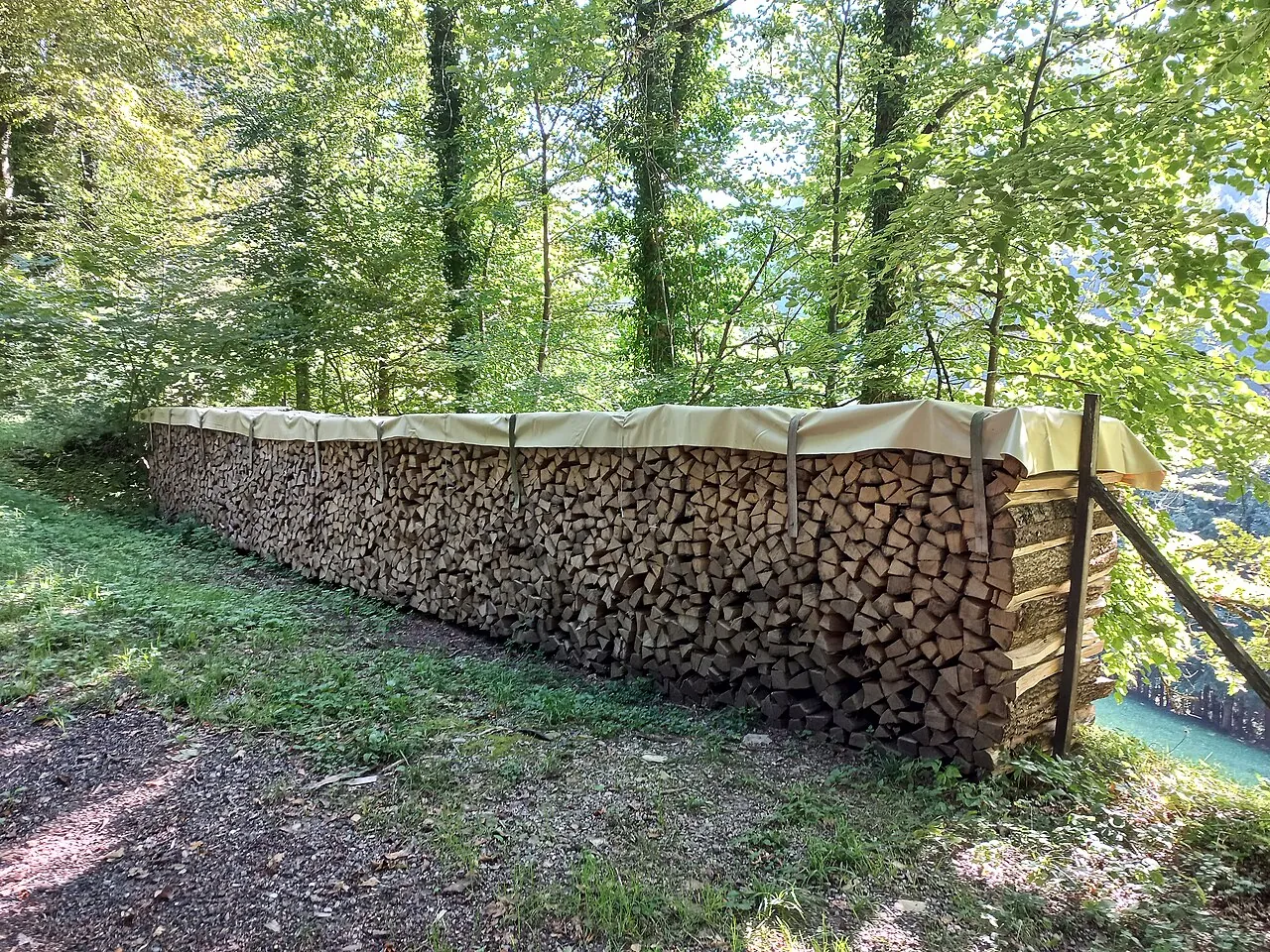
Firewood dries by the same rules as lumber - split it, stack it off the ground in the wind with the top covered and sides open, and give it six to twelve months to get under 20 percent.
- 4 min
- 6 steps
- 3 questions
- Lesson 23 of 160
In this lesson
- The target
- The method
- How long
- Indoors
- Dense wood, more heat per cord
- What to take from this
Picking up where you left off.
The target
Freshly cut firewood is green: often 40 to over 100 percent moisture on the dry basis used in this course. Wet wood wastes much of its energy boiling off water, burns cool and smoky, and builds creosote in chimneys. Burn wood under about 20 percent moisture 1. Seasoned wood is darker, lighter, often checked on the ends, and sounds hollow when two pieces are knocked together. A pin moisture meter on a freshly split face settles the question.

Quick check
EPA Burn Wise and extension guidance agree: wood burns best under 20 percent moisture.
The method
Firewood dries by the same physics as lumber, so the same rules apply:
- Split it. Bark is close to a vapor barrier, and a round log has little surface for its volume. Splitting exposes wood on several faces and shortens the distance water travels. Split soon after cutting; green wood also splits easier.
- Cut to length first. Water leaves through the ends far faster than through the sides, so 16-inch pieces dry much faster than long logs.
- Stack it off the ground on pallets, poles, or a rack, so it stays out of ground moisture and air moves underneath.
- Expose it to sun and wind. A single row oriented across the prevailing wind, in an open sunny spot, dries fastest.
- Cover only the top. A roof or a sheet over the top keeps rain and snow off; covering the sides traps moisture 1.
How long
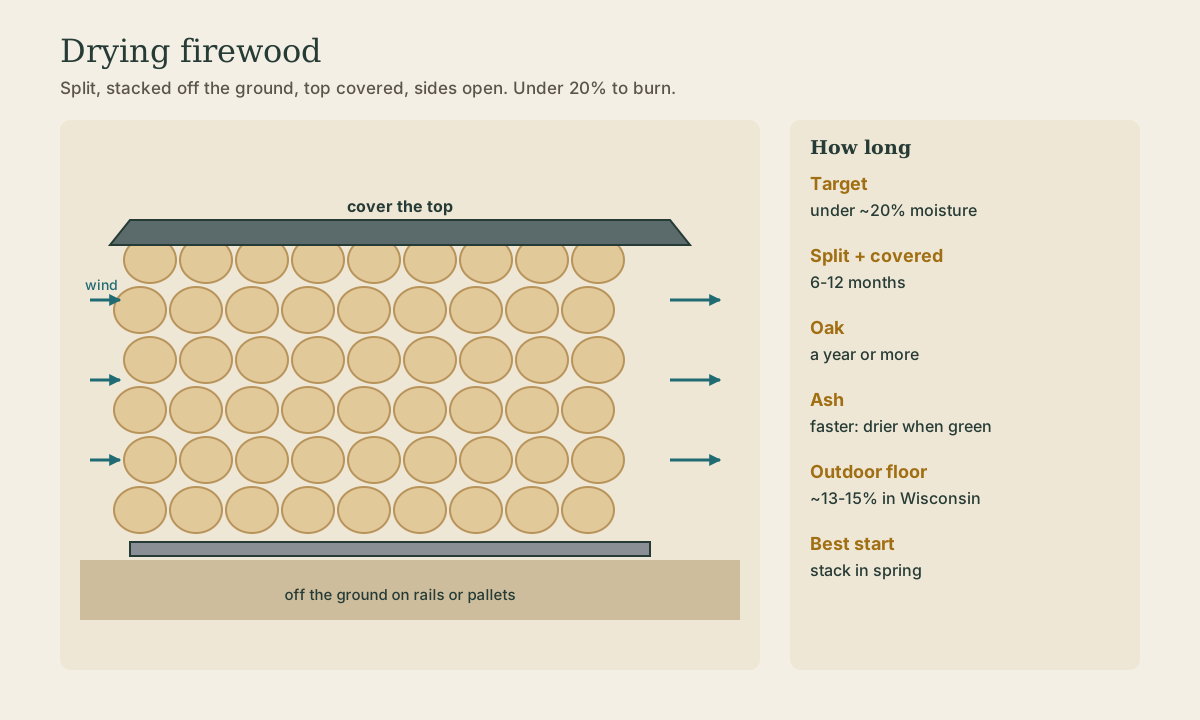
Extension guidance is about 6 to 12 months of drying for split, stacked, covered wood to reach 20 percent 2; EPA says season at least six months 1. Species and timing change that a lot:
- Lighter woods such as aspen, basswood, soft maple, and pine dry in one good summer.
- Ash is relatively dry when green (around 45 percent) and seasons fast.
- Oaks are dense and slow. Red and white oak often need a full year, sometimes longer, to get under 20 percent through the center of each split.
Drying is fastest at first and slows as the wood approaches the outdoor equilibrium, about 13 to 15 percent in Wisconsin 3. Wood split and stacked in spring benefits from the driest, windiest months; wood stacked in late fall gains little until the following spring, just like lumber.
Indoors
Bringing a few days’ supply indoors near the stove finishes the last of it: indoor winter air in Wisconsin sits at an EMC around 5 to 7 percent 4. Don’t store large amounts inside, which brings insects and mold into the house.
Dense wood, more heat per cord
Heat value tracks the dry weight of wood, so dense species like oak, hickory, sugar maple, and ash pack much more heat into each cord than aspen, basswood, or pine. Burn the light woods for shoulder seasons and kindling; save the dense ones, well seasoned, for January.
What to take from this
Cut firewood to length, split it, and stack it off the ground in sun and wind with the top covered and sides open. Give it 6 to 12 months, a year or more for oak, until it measures under 20 percent. Stack in spring for the fastest drying, and save dense, seasoned hardwood for the coldest weather.
Practice
Like a lumber pile, a firewood stack dries by air moving through it. The top cover keeps rain off; open sides let it breathe.
Practice
Bark is a vapor barrier and round logs have little surface for their volume. Splits expose wood on several faces and cut the drying distance.
Lesson complete
Nice work.
Sources for this lesson
- 1Best Wood-Burning Practices. U.S. EPA Burn Wise (archived program site). verifiedBurn wood under 20% moisture; season at least six months, off the ground, top covered and sides open.
- 2Measuring Wood Moisture (FS-1074). University of Maryland Extension. verifiedFirewood should be split, stacked, covered, and dried roughly 6 to 12 months, until internal moisture reaches about 20 percent.
- 3Richard Bergman. Drying and Control of Moisture Content and Dimensional Changes (Wood Handbook, Chapter 13). USDA Forest Service, Forest Products Laboratory, FPL-GTR-282. 2021. verifiedOven-dry and meter methods, outdoor EMC by city incl. Madison (Table 13-1), recommended MC (Table 13-2), kiln schedules (Table 13-3), drying defects, and dimensional change coefficients (Table 13-5). Cited at: Table 13-1.
- 4Samuel V. Glass, Samuel L. Zelinka. Moisture Relations and Physical Properties of Wood (Wood Handbook, Chapter 4). USDA Forest Service, Forest Products Laboratory, FPL-GTR-282. 2021. verifiedFree and bound water, fiber saturation (~30%), EMC table (Table 4-2), green moisture by species (Table 4-1), shrinkage by species (Table 4-3), and the shrinkage equation. Cited at: Table 4-2.