Turning Blanks and Green Bowls
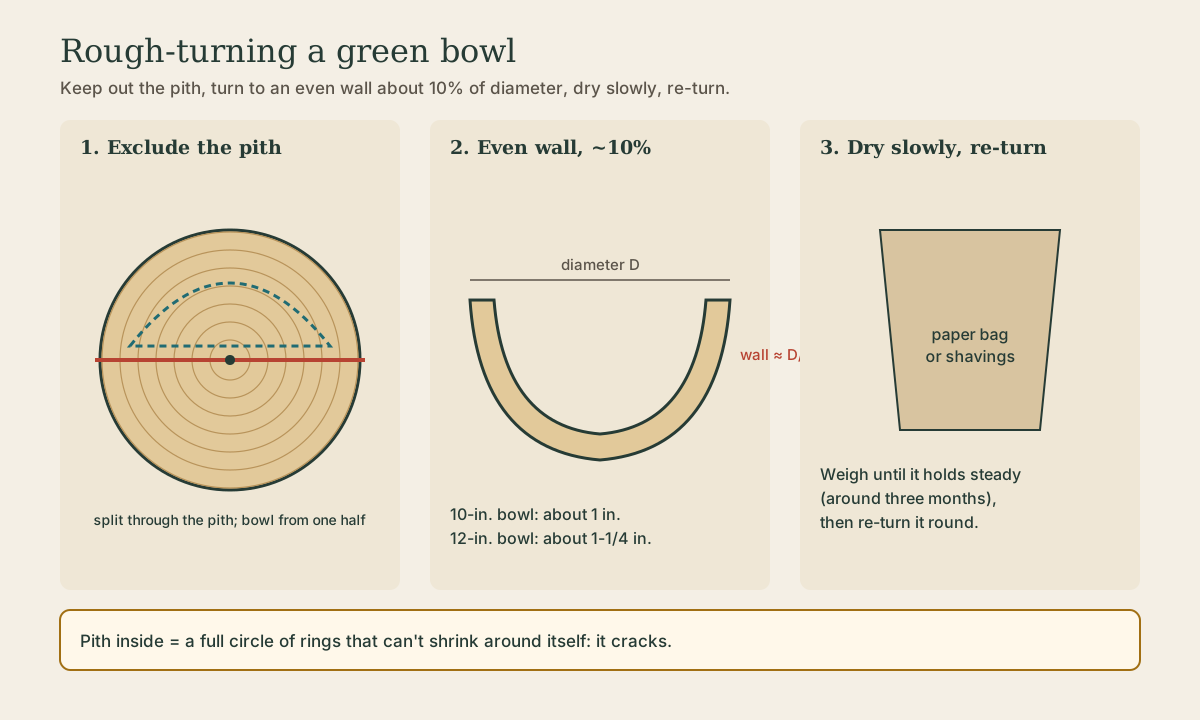
Bowls are dried by turning them first - rough out the green blank to a wall about 10 percent of the diameter, keep the pith out, slow the drying, and re-turn it round once it settles.
- 5 min
- 7 steps
- 3 questions
- Lesson 20 of 160
In this lesson
- Why bowls are dried this way
- Cut the blank around the pith
- Rough turn, then wait
- Re-turn
- Turning green to final thickness
- Faster methods, with caution
- What to take from this
Picking up where you left off.
Why bowls are dried this way
A bowl blank is a big chunk of wood, often 4 to 6 inches thick. Dried as a solid block it would take years and almost certainly crack, because its surface would shrink while its center stayed wet. Turners avoid that by turning the bowl first, while the wood is green and easy to cut, to a thickness that dries quickly and evenly, then letting it dry, and only then turning it to final shape. This is called twice turning.
Cut the blank around the pith
Start with a log section split or sawn through the center, so the pith is removed. A blank that contains the pith has a complete circle of growth rings around it. Because tangential shrinkage is about twice radial, that circle can’t shrink around itself without splitting open from the center 1. Sawing outside the log’s center eliminates complete rings and much of the stress 2.
The usual orientations:
- Face-grain bowls, the most common, are cut from a half-log with the bark side as the rim or the base. Their grain runs across the bowl.
- End-grain bowls and hollow forms are cut with the grain running up the axis. They need the pith removed or bored out, and they’re more prone to cracking.
Coat the end grain of blanks with wax emulsion the moment you cut them if you can’t turn them that day.
Rough turn, then wait
Turn the outside and inside, leaving the wall about 10 percent of the bowl’s diameter: about 1 inch for a 10-inch bowl, 1 1/4 for a 12-inch 2. A wall that thin dries much faster than a solid block and can flex as it shrinks instead of checking. Keep the wall even, including the base; a thick bottom dries last and cracks the bowl.
Then slow the drying, especially at first:
- Coat the end grain areas, the two spots on the rim and wall where the grain runs out, with wax emulsion.
- Put the bowl in a paper bag, or wrap it in newspaper, and set it somewhere cool and out of drafts. Some turners pack it in its own shavings. The bag holds humidity near the surface and evens out drying.
- Weigh it every week or two and write the weight on the bowl. When the weight stops dropping, it’s at equilibrium with the room.
Typical drying before re-turning is around three months; a full wax coating can add a month or two 2. A turner with a basement full of roughed-out bowls is working on a rolling schedule.
Quick check
The usual rule is a wall about 10 percent of the diameter: thin enough to dry and flex without checking, thick enough to re-turn round after it warps.
Re-turn
As it dries, the rough bowl warps oval, narrower in the tangential direction, the same way a dowel dries oval. Once its weight is stable, remount it, true the base and rim, and turn it to final wall thickness and shape. Because the wood is now at equilibrium, the finished bowl stays round.
Turning green to final thickness
The other approach is to turn a bowl to a thin, even, final wall while green, often 1/4 inch or less, and let it warp as it dries. The result is deliberately distorted, often attractively so. Thin even walls dry fast and rarely crack. This works well for natural-edge bowls and when the warp is part of the design.
Faster methods, with caution
Turners use several accelerated methods: soaking rough bowls in a dilute dish-soap solution for a day or more, burying them in desiccant, or microwaving them on defrost in short cycles and weighing between, until they’ve lost about a third of their weight. Each can work; microwaving in particular risks checking and is best kept for emergencies 2.
What to take from this
Cut bowl blanks to exclude the pith, coat end grain, and rough turn green to an even wall about 10 percent of the diameter. Slow the drying with a paper bag or shavings, weigh until the weight holds steady (around three months), then re-turn round. Or turn thin and even to final size green and let it warp on purpose.
Practice
Tangential shrinkage is about twice radial, so a full circle of rings around the pith pulls itself apart. Saw blanks to one side of the center.
Practice
Like a dowel, a round bowl shrinks more around the rings than across them, so it dries oval. That’s why it’s re-turned round once dry.
Lesson complete
Nice work.
Sources for this lesson
- 1Samuel V. Glass, Samuel L. Zelinka. Moisture Relations and Physical Properties of Wood (Wood Handbook, Chapter 4). USDA Forest Service, Forest Products Laboratory, FPL-GTR-282. 2021. verifiedFree and bound water, fiber saturation (~30%), EMC table (Table 4-2), green moisture by species (Table 4-1), shrinkage by species (Table 4-3), and the shrinkage equation. Cited at: Shrinkage.
- 2Options for Drying Green Bowl Blanks. Woodworker's Journal. verifiedRough turn to about 10 percent of diameter, cut blanks to exclude the pith, bag or seal, and re-turn after about three months.
Further reading
- Richard Raffan. Turning Wood with Richard Raffan. 3rd ed. The Taunton Press. verifiedAuthor's official bibliography and description of the book's turning, sharpening, tool-control, and safety coverage.