How Wet Is Green Wood?
Moisture content is measured against dry wood, so green wood can be more than 100 percent water; only the last 30 percent, held in the cell walls, makes wood shrink.
- 5 min
- 6 steps
- 3 questions
- Lesson 1 of 160
In this lesson
- Moisture content is measured against dry wood
- Green wood is very wet, and it varies
- Two kinds of water
- Fiber saturation: the line that matters
- Why furniture wood isn’t bone dry
- What to take from this
Picking up where you left off.
Moisture content is measured against dry wood
Wood people describe wetness as moisture content (MC): the weight of water in a piece divided by the weight of the same piece with all water removed, times 100 1.
MC (%) = (weight now − oven-dry weight) ÷ oven-dry weight × 100
The denominator is the bone-dry wood, not the wet piece. That is why green wood can be “over 100 percent”: a board holding more water by weight than wood is simply above 100. A board at 50 percent holds half its dry weight in water. Engineers sometimes use a wet-basis number for fuels such as firewood and chips, but every lumber table, meter, and kiln schedule uses the dry basis.
Quick check
MC = (15 − 10) / 10 × 100 = 50%. Moisture content is always figured against the oven-dry weight, not the wet weight.
Green wood is very wet, and it varies
“Green” just means freshly cut, not yet dried. How wet that is depends on the species and on whether it’s heartwood or sapwood. The Wood Handbook’s averages for some trees you’ll find in Wisconsin 2:
| Species | Heartwood MC | Sapwood MC |
|---|---|---|
| Sugar maple | 65% | 72% |
| Northern red oak | 80% | 69% |
| White oak | 64% | 78% |
| White ash | 46% | 44% |
| Black cherry | 58% | — |
| Black walnut | 90% | 73% |
| Basswood | 81% | 133% |
| Aspen | 95% | 113% |
| Eastern hemlock | 97% | 119% |
| Red pine | 32% | 134% |
| Tamarack | 49% | — |
Two patterns matter for drying. First, in most softwoods the sapwood is far wetter than the heartwood: red pine sapwood is about four times as wet. Second, light woods like aspen and basswood can carry more water than dense woods, because they have more empty space inside. White ash is unusually dry when green, which is one reason it is the classic wood for green-bent and green-split parts that season quickly.
A cubic foot of green red oak weighs roughly 60 to 65 pounds. Dried to furniture moisture, that same wood is about 44 pounds. Most of the difference is water you’ll be moving out of the wood, by air, by kiln, or by time.
Two kinds of water
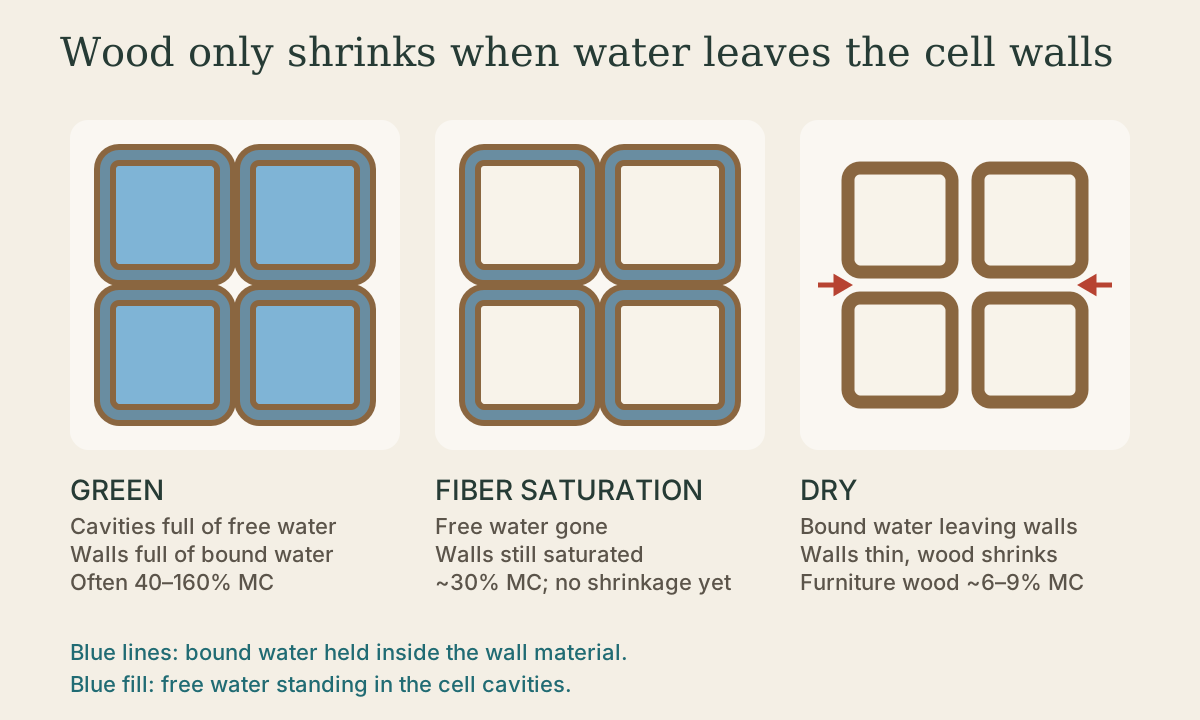
Wood is made of hollow cells, mostly long and tube-like, with walls built of cellulose, hemicellulose, and lignin. Water sits in two places 2:
- Free water is liquid water standing in the cell cavities (the lumens), like water in a drinking straw. It is held loosely, by capillary forces.
- Bound water is held inside the cell wall material itself, attached to the wall’s molecules. It’s held much more tightly; it takes more energy to remove each pound of bound water than free water.
Fiber saturation: the line that matters
As wood dries, free water leaves first. At some point the cavities are empty but the walls are still completely saturated with bound water. That point is the fiber saturation point (FSP). It averages about 30 percent MC, though species and individual pieces vary by several points, and the exact value depends on how it’s measured.
FSP is the most important number in drying, because almost everything about wood changes on one side of it and not the other:
- Above FSP, losing water changes almost nothing. The board gets lighter, but it doesn’t shrink and its strength doesn’t change.
- Below FSP, every bit of bound water that leaves lets the cell walls get thinner. The wood shrinks, gets stiffer and stronger, and starts to become stable in use.
So drying a board from 80 percent to 35 percent mostly costs time and causes stain risk, but no shrinkage. Drying from 30 percent to 8 percent is where all the movement, and almost all the cracking and warping, happens.
In a real board it isn’t that tidy, because the outside dries first. The surface can drop below FSP and start shrinking while the core is still soaking wet. That uneven state is what causes drying stresses, covered later in this module.
Why furniture wood isn’t bone dry
Wood never stays oven-dry in normal life. It trades moisture with the air until it balances, which is the subject of the next lesson. In a heated Wisconsin house, that balance lands around 6 to 9 percent most of the year, which is why the Forest Products Laboratory recommends an average of 8 percent, with individual pieces between 6 and 10, for interior woodwork, flooring, and furniture in most of the United States 1. Framing lumber is graded “dry” at 19 percent or less, a long way from furniture-dry.
What to take from this
Moisture content is figured against oven-dry wood. Green wood holds anywhere from about 30 to over 150 percent, mostly as free water in the cell cavities, which leaves without shrinkage. The fiber saturation point near 30 percent is where bound water starts leaving the cell walls and the wood starts to shrink. Everything you do in drying is about managing what happens below that line.
Practice
Losing free water from the cell cavities doesn’t change the cell walls. Shrinkage starts below about 30%, when bound water leaves the walls.
Practice
Moisture content compares water weight to dry wood weight. Low-density wood has room for a lot of free water, so the water can weigh more than the wood.
Lesson complete
Nice work.
Sources for this lesson
- 1Richard Bergman. Drying and Control of Moisture Content and Dimensional Changes (Wood Handbook, Chapter 13). USDA Forest Service, Forest Products Laboratory, FPL-GTR-282. 2021. verifiedOven-dry and meter methods, outdoor EMC by city incl. Madison (Table 13-1), recommended MC (Table 13-2), kiln schedules (Table 13-3), drying defects, and dimensional change coefficients (Table 13-5). Cited at: Equation 13-1; Table 13-2.
- 2Samuel V. Glass, Samuel L. Zelinka. Moisture Relations and Physical Properties of Wood (Wood Handbook, Chapter 4). USDA Forest Service, Forest Products Laboratory, FPL-GTR-282. 2021. verifiedFree and bound water, fiber saturation (~30%), EMC table (Table 4-2), green moisture by species (Table 4-1), shrinkage by species (Table 4-3), and the shrinkage equation. Cited at: Table 4-1; Fiber Saturation and Maximum Moisture Content.
Further reading
- R. Bruce Hoadley. Understanding Wood: A Craftsman's Guide to Wood Technology. Taunton Press. 2000. verifiedThe woodworker's standard on wood structure, moisture, shrinkage, and drying.