A Six-Board Chest
The oldest vernacular storage piece: six pine boards, rabbets and dadoes, cut nails, and a hinged lid. Why pine, how the cross-grain nailing survives, the build sequence, and finishing with milk paint.
- 4 min
- 6 steps
- 3 questions
- Lesson 47 of 160
In this lesson
- The design
- Why pine
- Nails
- The build
- Finish
- What to take from this
Picking up where you left off.
The design
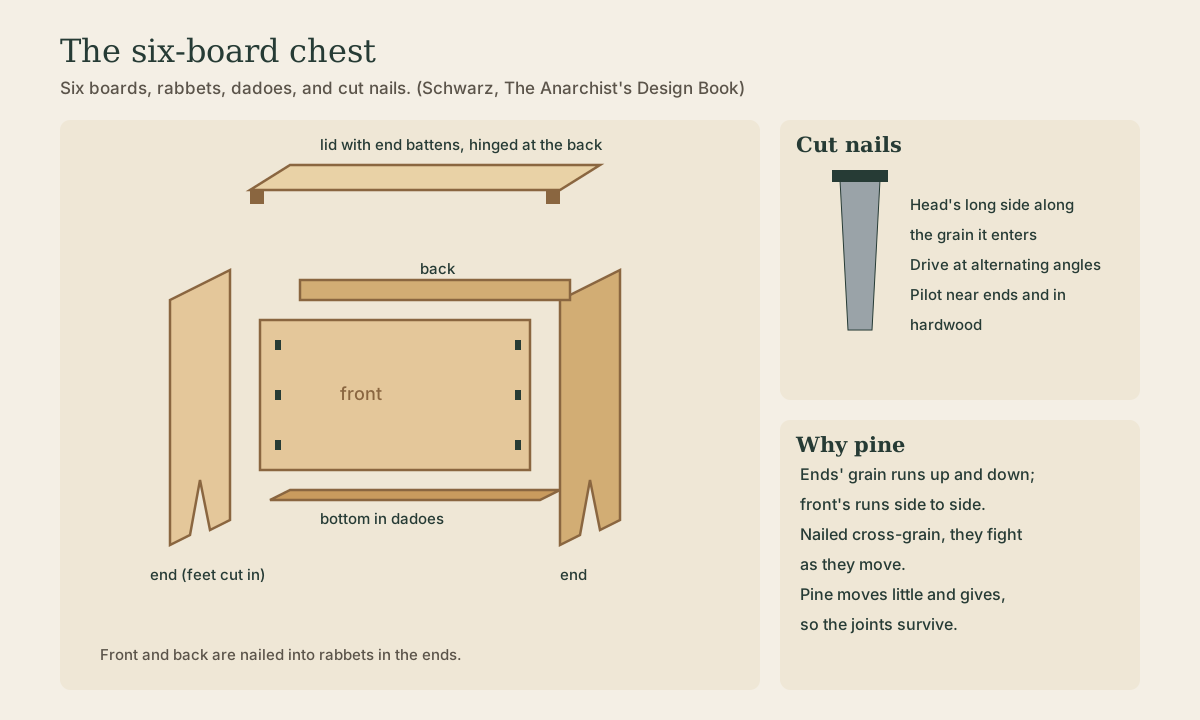
A six-board chest is exactly that: two ends, a front, a back, a bottom, and a lid - six boards. It’s one of the oldest forms of furniture in Northern Europe and colonial America, made by country joiners from wide pine boards, nailed together, and painted 1.
Typical construction:
- The ends run to the floor and become the feet: a V or arch cut from their bottoms leaves two feet each.
- The front and back sit in rabbets or are nailed to the ends’ edges; often the ends have shallow dadoes for the bottom.
- The bottom sits in dadoes in the ends or on cleats, nailed through the front and back.
- The lid is a single board (or two glued up) with battens (cleats) on its ends to keep it flat, hinged at the back.
- Moldings on the lid edge and the top of the base are common.
It’s a perfect second project: wide boards to flatten, rabbets and dadoes, nailing, a lid, and paint, in a form that’s useful forever.
Quick check
The ends run to the floor and carry the chest; the cutout leaves feet and lifts the bottom off damp floors.
Why pine
Schwarz recommends pine because the ends are nailed cross-grain to the front and back: the ends’ grain runs vertically, the front’s horizontally, so their seasonal movement fights each other 1. Softwood moves less than most hardwoods and gives a little around the nails, so the chest survives. Eastern white pine, Wisconsin’s classic cabinet softwood, is ideal.
Quick check
Cross-grain nailing restrains movement; pine’s lower movement and the nails’ flex let the chest survive seasons.
Nails
Traditional boarded furniture uses cut nails: rectangular, tapered, cut from steel plate. Their wedge shape grips the wood far better than a round wire nail, and the heads look right on painted work.
- Drill a pilot hole in hardwood or near ends to prevent splitting.
- Align the long side of the nail head with the grain of the board it enters, so the wedge-shaped shank doesn’t split it.
- Drive nails at slight alternating angles (dovetailed nailing) so the joint resists pulling apart.
Quick check
Align the long side of the head with the grain so the wedge doesn’t split the board, and pilot-drill near ends or in hardwood.
The build
- Mill six wide boards (or glue up panels) flat and to thickness, typically 3/4 to 7/8 inch.
- Cut the ends to length and saw the foot cutouts.
- Cut the dadoes for the bottom in the ends, and the rabbets at the ends’ front and back edges if the design uses them (see Dadoes, Rabbets, and Grooves).
- Fit the bottom in the dadoes. Its grain runs front to back or side to side depending on the design; make sure it’s free to move or nailed only along one edge.
- Nail the front and back to the ends, checking for square.
- Make the lid: glue up if needed, attach end battens with nails or screws in slotted holes so the lid can move, and add a molding.
- Hinge the lid: traditional snipe (cotter-pin) hinges, or butt or strap hinges. Add a lid stay or chain so it can’t slam or fall back.
- Moldings and details: plane or rout simple profiles for the lid edge and base.
Finish
Milk paint is the traditional choice: two coats of color, maybe a contrasting undercoat to show through at worn edges, then a coat of oil or shellac to deepen it and protect it (see the Traditional Paints course, and Mortise & Tenon’s milk-paint finishing 2). Leave the inside bare or oil it.
What to take from this
A six-board chest has two ends that become the feet, a front, a back, a bottom, and a lid, joined with rabbets, dadoes, and cut nails. Use pine because the cross-grain nailing needs a wood that moves little and gives. Pilot-drill and align cut-nail heads with the grain, leave the bottom free to move, batten the lid, and finish with milk paint and oil.
Lesson complete
Nice work.
Sources for this lesson
- 1Christopher Schwarz. The Anarchist's Design Book. Lost Art Press. 2016. verifiedVernacular staked and boarded furniture, including the six-board chest (pine recommended because its cross-grain nailing must tolerate movement); free PDF.
- 2Joshua A. Klein. The Foundations Course (Apprenticeship Series). Mortise & Tenon Magazine. verifiedHand-tool furniture making from pre-industrial originals - tool selection, sharpening, lumber processing, mortise and tenon, through and half-blind dovetails, nailed rabbets, dados, and shellac and milk paint finishes.