Buying Lumber: Grades, Board Feet, and Rough Stock
How hardwood is sold - in quarters, by the board foot, graded by clear cuttings - how to calculate what you need with waste, and what to look for in a rough board at the yard or sawmill.
- 5 min
- 7 steps
- 3 questions
- Lesson 27 of 160
In this lesson
- How hardwood is sold
- Board feet
- Hardwood grades
- Moisture
- At the yard or sawmill
- Working rough stock
- What to take from this
Picking up where you left off.
How hardwood is sold
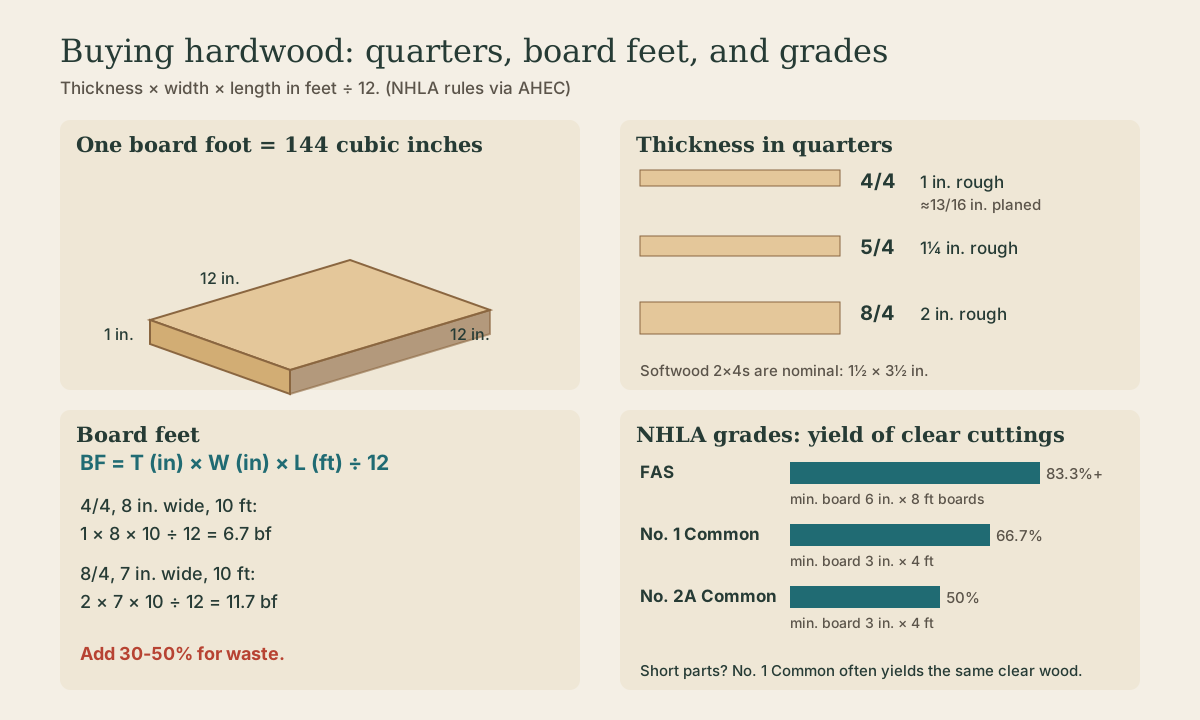
Thickness is given in quarters of an inch of rough (unplaned) thickness: 4/4 (“four quarter”) is 1 inch rough, 5/4 is 1¼, 8/4 is 2 inches. Planed on both faces (S2S), 4/4 typically finishes around 13/16 inch, so buy thicker than your finished part.
Hardwood is sold random width and length (RWL), by volume in board feet. Softwood construction lumber is sold differently, by nominal dimension (a “2×4” is 1½ × 3½ inches) and piece.
Board feet
A board foot is 144 cubic inches: a piece 1 inch thick, 12 inches wide, 12 inches long.
Board feet = thickness (in) × width (in) × length (ft) ÷ 12
Use rough nominal thickness (4/4 = 1, 8/4 = 2) and the actual width and length.
- A 4/4 board 8 inches wide and 10 feet long: 1 × 8 × 10 ÷ 12 = 6.7 bf.
- An 8/4 board 7 inches wide and 10 feet long: 2 × 7 × 10 ÷ 12 = 11.7 bf.
Estimating a project: add up the finished parts in board feet, then add 30 to 50% for waste (defects, crosscut offcuts, planing, mistakes), more for figured wood or Common grades.
Quick check
Board feet = thickness (in) × width (in) × length (ft) ÷ 12 = 2 × 7 × 10 ÷ 12 = 11.67.
Hardwood grades
Hardwood is graded under the NHLA rules by the percentage of the board that can be cut into clear pieces of a minimum size, judged from the poorer face 1:
| Grade | Minimum board | Clear-cutting yield | Minimum cutting |
|---|---|---|---|
| FAS (Firsts and Seconds) | 6” × 8’ | 83 1/3% to 100% | 3” × 7’ or 4” × 5’ |
| F1F / Selects | FAS (F1F) or 4” × 6’ (Selects) | FAS on the better face, No. 1 Common on the poorer | as FAS |
| No. 1 Common | 3” × 4’ | 66 2/3% | 3” × 3’ or 4” × 2’ |
| No. 2A Common | 3” × 4’ | 50% | 3” × 2’ |
The grades describe yield of long clear cuttings, not appearance or quality of the wood between defects. For chairs, boxes, and small cabinets with short parts, No. 1 Common often gives the same clear wood for much less money. For long tabletops and doors, FAS pays off.
Quick check
FAS (Firsts and Seconds) is the top grade. No. 1 Common yields 66 2/3% clear cuttings from boards 3 inches by 4 feet and up.
Moisture
Buy lumber at the right moisture content for its use. Kiln-dried furniture lumber is around 6 to 8%; air-dried lumber from a Wisconsin sawyer is about 12 to 15% and should be brought indoors and allowed to equilibrate for several weeks before final milling 2. A pin or pinless moisture meter is worth owning. Green wood is for green woodworking and timber framing, not cabinets.
At the yard or sawmill
What to look for in a rough board:
- End checks and splits: cut them off; estimate how far they run.
- Cup, bow, twist, and crook: sight down the board. Some is normal in rough stock and planes out; severe twist wastes thickness.
- Knots: tight (sound) knots can be features; loose or black knots fall out.
- Grain: look at the end to see flatsawn, rift, or quartersawn; look at the face for runout if you need strong parts.
- Sapwood: walnut and cherry sapwood is pale; decide whether you want it.
- Stain and insects: sticker stain, mineral streaks, pinholes.
- Thickness: is there enough to plane flat and still reach your finished size?
Bring a block plane or a scraper (with permission) to take a quick shaving and see the color and figure, and a cutting list so you buy for your parts.
Working rough stock
Rough lumber has to be milled before joinery: flatten one face, plane an edge square to it, then bring to thickness and width, by hand (fore plane, jointer plane, panel gauge) or machine. The Hand Tools module covers planing by hand. Mill a bit oversize, let the parts rest a day or two to release stress, then bring them to final size.
What to take from this
Hardwood is sold in quarters (4/4 is 1 inch rough) by the board foot: thickness × width × length in feet ÷ 12. Add 30 to 50% for waste. NHLA grades measure yield of clear cuttings: FAS 83 1/3% from 6” × 8’ boards, No. 1 Common 66 2/3%, No. 2A 50%. Common lumber is often the better buy for short parts. Buy dry wood for furniture, let it acclimate, and inspect each board’s ends, shape, knots, and grain before you pay.
Practice
Grades measure yield of long, wide clear cuttings. If your parts are short, Common lumber gives the same clear wood for less money, and often more character.
Lesson complete
Nice work.
Sources for this lesson
- 1Grading Sawn Lumber: The Grades. American Hardwood Export Council. verifiedNHLA grades - FAS (boards 6 in. and wider, 8 ft and longer, 83 1/3% clear cuttings), F1F/Selects, No. 1 Common (66 2/3%), No. 2A Common (50%), with minimum cutting sizes.
- 2Samuel V. Glass, Samuel L. Zelinka. Moisture Relations and Physical Properties of Wood (Wood Handbook, Chapter 4). USDA Forest Service, Forest Products Laboratory, FPL-GTR-282. 2021. verifiedFree and bound water, fiber saturation (~30%), EMC table (Table 4-2), green moisture by species (Table 4-1), shrinkage by species (Table 4-3), and the shrinkage equation.