Hardwood and Softwood Anatomy
Hardwoods are broadleaf trees with vessels; softwoods are conifers built of tracheids - a botanical split, not a hardness one. Ring-porous, diffuse-porous, earlywood and latewood, and how anatomy shows up under the plane and in a finish.
- 4 min
- 6 steps
- 3 questions
- Lesson 25 of 160
In this lesson
- Hardwood and softwood
- Pores
- Earlywood and latewood
- Resin, color, and smell
- Identifying wood
- What to take from this
Picking up where you left off.
Hardwood and softwood
The names are botanical, not a measure of hardness 1:
- Hardwoods come from angiosperms, broadleaf trees (oak, maple, cherry, walnut, basswood, aspen). Their wood contains vessels, tubes that conduct water, seen as pores in the end grain.
- Softwoods come from gymnosperms, mostly conifers (pine, spruce, hemlock, cedar, tamarack). Their wood is made mostly of tracheids, long narrow cells, with no vessels.
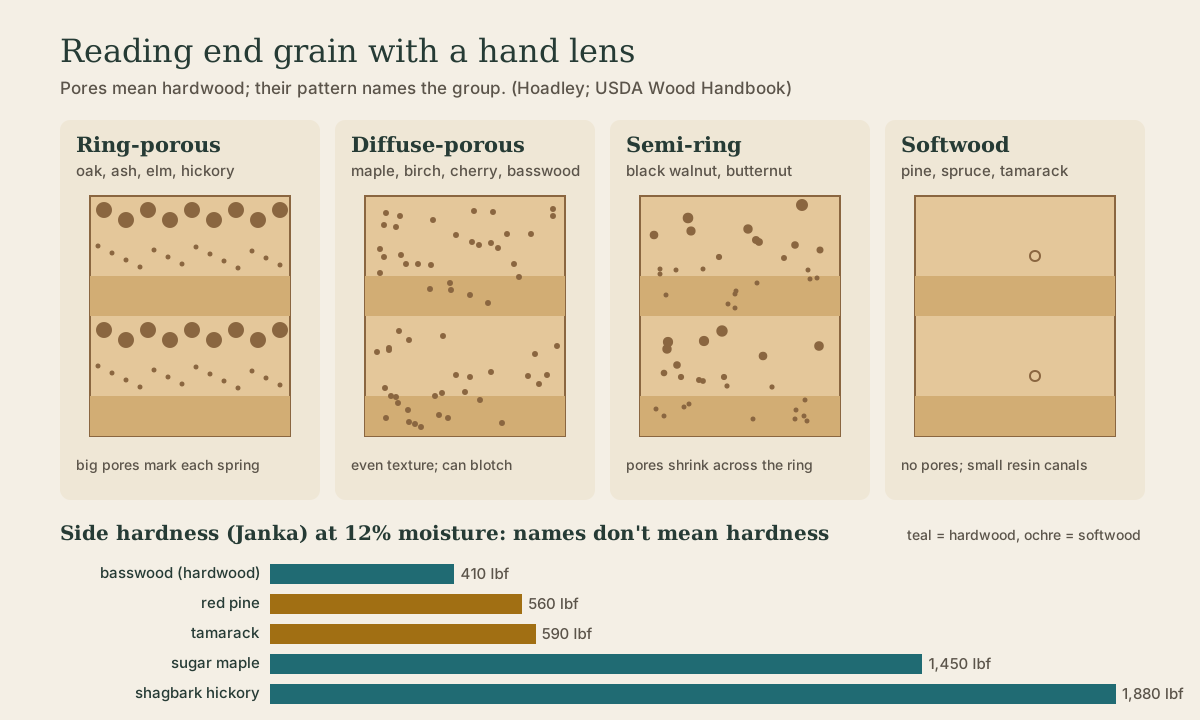
Hardness overlaps widely. At 12% moisture, basswood has a side (Janka) hardness of about 410 lbf, softer than tamarack (about 590) and red pine (about 560), while sugar maple is about 1,450 and shagbark hickory about 1,880 2.
Quick check
The terms are botanical. Basswood (side hardness about 410 lbf) is a hardwood; tamarack (about 590 lbf) is a softwood.
Pores
In hardwoods, the arrangement of vessels is one of the best identification clues and affects how wood works and finishes 1:
- Ring-porous: a band of large earlywood pores each spring, then small pores in latewood. Oak, ash, elm, hickory, chestnut. Coarse and open-grained, with strong figure; earlywood is weaker and splits along the ring.
- Diffuse-porous: small pores spread evenly through the ring. Maple, birch, cherry, basswood, aspen, beech. Fine, even texture; planes smoothly; can blotch under stain.
- Semi-ring-porous: in between. Black walnut, butternut.
Oak has a second trait: very large rays, ribbons of cells running from the pith outward. On quartersawn faces they show as ray fleck, and they help quartersawn oak resist splitting across the rays. Red oak’s vessels are open (you can blow air through a short end-grain piece), while white oak’s earlywood vessels are plugged with tyloses, which is why white oak, not red, is used for barrels and boats.
Quick check
Ring-porous woods put large earlywood vessels in a band each spring. Maple, birch, and cherry are diffuse-porous, with small pores spread evenly.
Earlywood and latewood
Each growth ring has earlywood (springwood: thin-walled, lighter, weaker) and latewood (summerwood: thick-walled, denser, darker) 1. In softwoods like southern yellow pine and Douglas fir, the contrast is strong: a dull tool crushes soft earlywood between hard latewood, leaving a ridged surface, and stain soaks earlywood unevenly. Eastern white pine has gentle contrast and works very evenly.
Resin, color, and smell
- Resin canals in pine, spruce, tamarack, and Douglas fir hold pitch that gums saws and bleeds through finishes; shellac seals knots.
- Heartwood forms as the inner sapwood dies and fills with extractives: darker color, often more decay resistance (white oak, cedar, black walnut). Sapwood is lighter and decays faster.
- Smell identifies many woods when cut: cedar, the vinegar of oak, the spice of cherry, the sour of green ash.
Identifying wood
To identify a board:
- Cut a clean end-grain surface with a sharp knife or razor.
- With a 10x hand lens, look for pores (hardwood) or none (softwood), their arrangement, ray size, and resin canals.
- Check weight, hardness (does a thumbnail dent it?), color, and smell.
What to take from this
Hardwoods are broadleaf trees with vessels; softwoods are conifers built of tracheids, and hardness overlaps (basswood 410 lbf versus tamarack 590). Ring-porous woods (oak, ash, elm, hickory) are coarse with a band of big spring pores; diffuse-porous woods (maple, birch, cherry, basswood) are fine and even. White oak’s tyloses make it watertight; red oak’s open pores don’t. Strong earlywood/latewood contrast punishes dull tools and uneven stain, and an end-grain cut with a hand lens identifies most woods.
Practice
Large earlywood vessels show as pits in a smooth film. Filling them is optional; leaving them open gives a natural texture.
Lesson complete
Nice work.
Sources for this lesson
- 1R. Bruce Hoadley. Understanding Wood: A Craftsman's Guide to Wood Technology. Taunton Press. 2000. verifiedThe woodworker's standard on wood structure, moisture, shrinkage, and drying.
- 2Christopher Adam Senalik, Benjamin Farber. Mechanical Properties of Wood (Wood Handbook, Chapter 5). USDA Forest Service, Forest Products Laboratory, FPL-GTR-282. 2021. verifiedTable 5-3b gives specific gravity and side (Janka) hardness at 12% moisture for U.S. species - e.g., sugar maple 0.63/1,450 lbf, white oak 0.68/1,360, northern red oak 0.63/1,290, black cherry 0.50/950, black walnut 0.55/1,010, basswood 0.37/410, eastern white pine 0.35/380.