Reading Grain and Figure
Grain is the direction of the wood's fibers, and every cut, plane stroke, and joint depends on reading it: flatsawn versus quartersawn faces, grain runout, which way to plane, and where figure comes from.
- 5 min
- 7 steps
- 3 questions
- Lesson 24 of 160
In this lesson
- What grain is
- Flatsawn and quartersawn
- Runout
- Which way to plane
- Figure
- At the bench
- What to take from this
Picking up where you left off.
What grain is
Wood is a bundle of long, hollow cells (fibers in hardwoods, tracheids in softwoods) running mostly along the trunk. Grain is the direction those cells run. Wood is strong and stiff along the grain and weak across it, and it shrinks very little along its length but a lot across it 1 2.
Woodworkers use “grain” for several related things:
- Grain direction: which way the fibers run relative to a surface.
- Growth rings: one year’s earlywood and latewood, seen as lines on faces and arcs on the end.
- Texture: coarse (oak, ash, with large pores) or fine (maple, cherry, birch).
- Figure: the patterns on a surface, such as ray fleck, curl, and burl.
Flatsawn and quartersawn
How a board was cut from the log shows on its end grain:
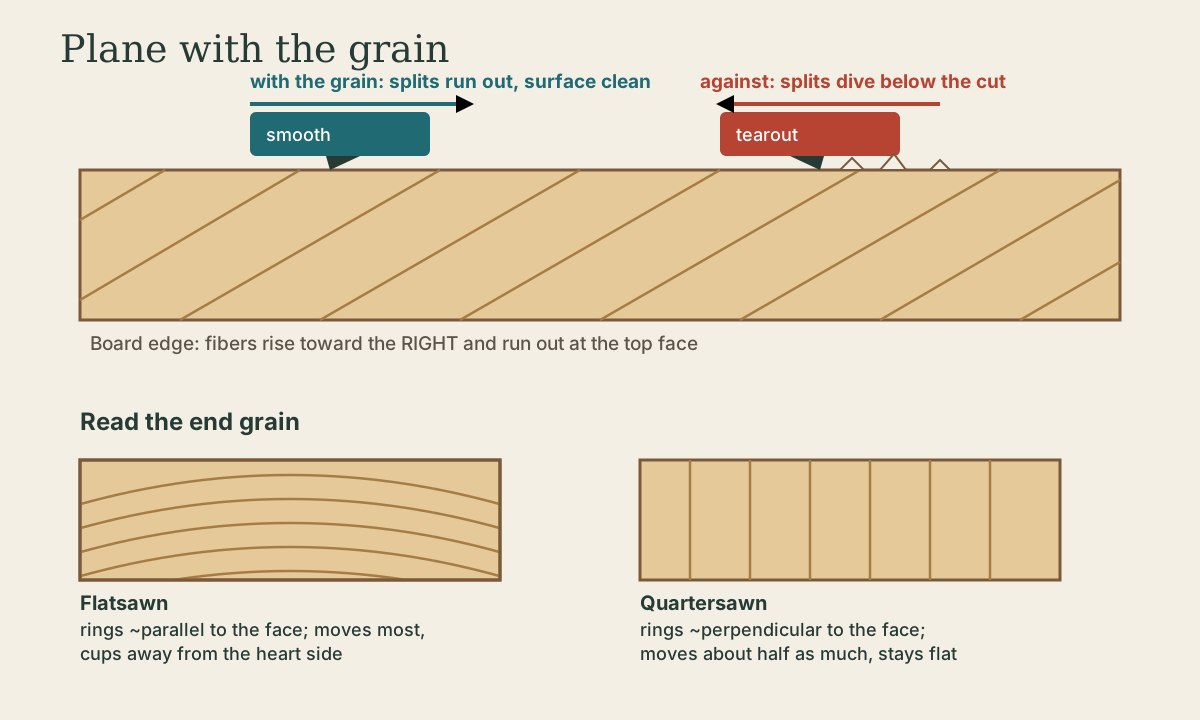
- Flatsawn (plainsawn): growth rings run roughly parallel to the wide face. The face shows cathedral arches. It shrinks most across its width (tangential shrinkage) and tends to cup away from the heart.
- Quartersawn: rings run perpendicular to the face, giving straight stripes and, in oak and sycamore, shimmering ray fleck. Its width changes radially, about half the tangential movement, and it stays flat 2.
- Riftsawn: rings at roughly 30 to 60 degrees; straight lines on both face and edge, favored for table legs.
The Wood Drying course covers movement in detail. For layout: put quartersawn stock where stability matters (drawer sides, door frames, panels, tabletops you want to stay flat), and orient flatsawn boards knowing which way they’ll cup.
Quick check
On a quartersawn face, width changes are radial, about half the tangential movement of a flatsawn face, and quartersawn boards resist cupping.
Runout
Runout is grain that doesn’t run parallel to a part’s length and exits its side. A sawn board often has runout because the saw doesn’t follow the tree’s fibers. Where fibers exit the side, the part is held together only by weak cross-grain strength, so legs, spindles, and chair parts snap there.
That’s why chairmakers and green woodworkers rive (split) their stock: a split follows the fibers, so riven parts have none. In sawn stock, look at both the face and the edge: the grain lines on each should run the length of the part.
Which way to plane
On any face, the fibers rise toward the surface in one direction. Plane with the grain: push the plane the way the fibers rise and run out of the surface. The shaving tends to split a little ahead of the edge, and going with the grain that split runs up and out harmlessly. Going against the grain, the split follows the fibers down into the board below the cut, and the shaving levers out chunks: tearout. Woodworkers compare it to stroking a cat or dog head to tail.
To read direction:
- Look at the edge when planing a face (and the face when planing an edge): find which way the grain lines rise toward the face you’re planing, and push that way.
- Feel it: a hand stroked along the surface often feels smoother going with the grain.
- Take a test stroke and watch: clean shavings and a bright surface mean you’re right.
Reversing grain (curl, interlocked grain, swirls around knots) has no consistent with-grain direction. Handle it with a razor-sharp blade, a fine cut, a tight mouth, a cap iron set close to the edge, a higher cutting angle, or a card scraper.
Quick check
Tearout usually means you’re planing against the grain, so the blade lifts fibers ahead of the cut. Reverse direction, then take a finer cut with a tighter mouth and a close-set cap iron if it persists.
Figure
Figure comes from how fibers and rays are arranged:
- Ray fleck: the large rays of oak shown on quartersawn faces.
- Curl (fiddleback, tiger): fibers that wave up and down, reflecting light in bands; common in maple, cherry, and birch.
- Bird’s-eye: small swirls in sugar maple.
- Crotch figure: feathered grain where a trunk forks.
- Burl: a mass of tangled, budding grain.
- Spalting: dark lines from fungal decay in early stages.
Figured wood is beautiful and harder to work: it tears out in every direction, so it’s usually finished with a scraper or very fine plane cuts.
At the bench
Take a few offcuts of different species. On each, identify flatsawn or quartersawn from the end grain, find the with-grain direction on one face by reading the edge, and plane it both ways. Note how the surface differs, then close the mouth and set the cap iron closer and try the against-grain direction again.
What to take from this
Grain is the direction of the fibers: strong and stable along them, weak and moving across them. Flatsawn faces cup and move more; quartersawn faces move half as much and stay flat. Runout makes weak parts, which is why riven stock is prized. Plane with the grain - the way the fibers rise toward the surface - read the edge to find which way that is, and meet reversing grain with a sharp blade, a fine cut, a tight mouth, a close cap iron, or a scraper.
Practice
Strength runs along the fibers. Where they exit the side, the part depends on weak cross-grain strength. Riving or choosing straight-grained stock avoids runout.
Lesson complete
Nice work.
Sources for this lesson
- 1R. Bruce Hoadley. Understanding Wood: A Craftsman's Guide to Wood Technology. Taunton Press. 2000. verifiedThe woodworker's standard on wood structure, moisture, shrinkage, and drying.
- 2Samuel V. Glass, Samuel L. Zelinka. Moisture Relations and Physical Properties of Wood (Wood Handbook, Chapter 4). USDA Forest Service, Forest Products Laboratory, FPL-GTR-282. 2021. verifiedFree and bound water, fiber saturation (~30%), EMC table (Table 4-2), green moisture by species (Table 4-1), shrinkage by species (Table 4-3), and the shrinkage equation.