Wisconsin Woods and What They're Good For
The local species you'll actually buy or saw - maple, oaks, cherry, walnut, ash, basswood, birch, elm, hickory, white pine, tamarack, cedar - with Wood Handbook density and hardness, and the work each one suits.
- 4 min
- 6 steps
- 3 questions
- Lesson 26 of 160
In this lesson
- Why local wood
- Hardwoods
- Softwoods
- Practical notes
- At the bench
- What to take from this
Picking up where you left off.
Why local wood
Wisconsin has some of the best furniture hardwoods in the world growing in its woodlots, and a portable sawmill or a local sawyer can supply rough lumber for far less than a retail yard. Knowing each species’ character lets you match wood to job.
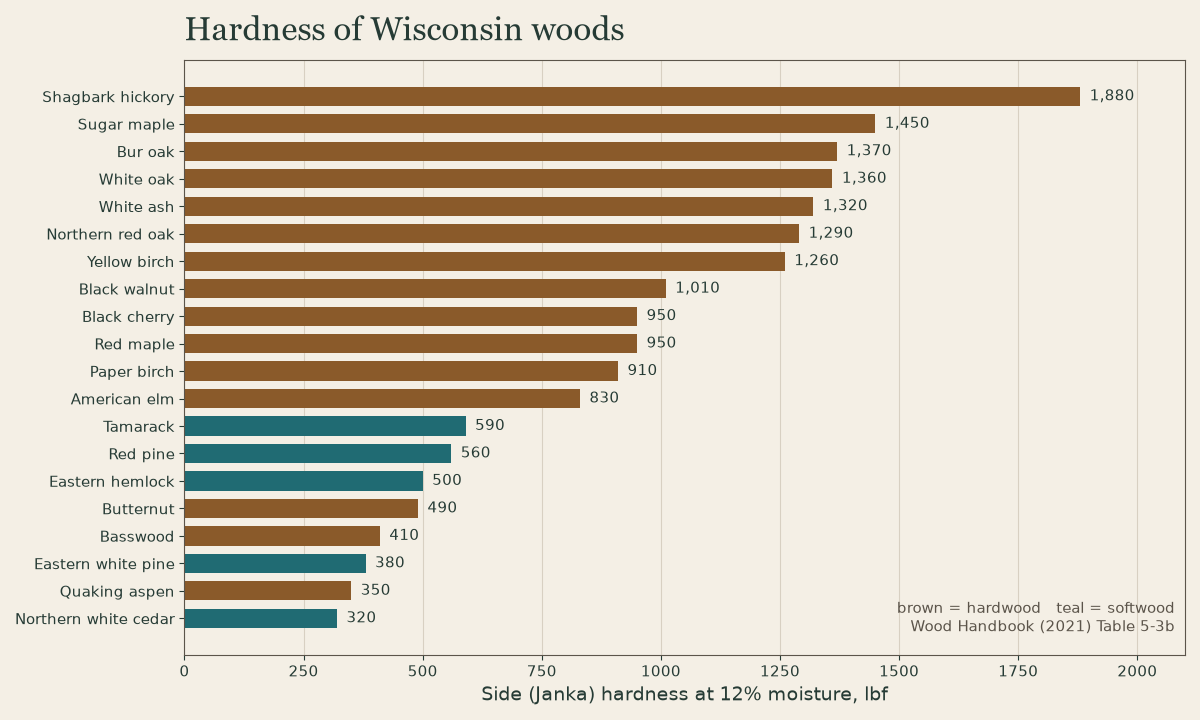
Numbers below are specific gravity (SG, oven-dry weight relative to volume at 12% moisture; higher is denser) and side hardness at 12% moisture from the Wood Handbook 1.
Hardwoods
| Species | SG | Hardness (lbf) | Character and best uses |
|---|---|---|---|
| Sugar (hard) maple | 0.63 | 1,450 | Dense, fine, pale; benchtops, cutting boards, flooring, chairs, tool handles. Burns under dull cutters. Curly and bird’s-eye figure. |
| Red (soft) maple | 0.54 | 950 | Softer and easier to work; good secondary and painted wood. |
| White oak | 0.68 | 1,360 | Strong, decay-resistant heartwood, tight vessels; timber frames, outdoor furniture, chairs, Arts and Crafts quartersawn work. Splits beautifully green. |
| Bur oak | 0.64 | 1,370 | A white oak; same uses. |
| Northern red oak | 0.63 | 1,290 | Strong, open-pored, coarse; furniture, trim, flooring. Not for outdoors or watertight work. |
| Black cherry | 0.50 | 950 | Fine, even, planes beautifully; darkens to rich red-brown in light. Furniture and boxes. Blotches under stain. |
| Black walnut | 0.55 | 1,010 | Dark heartwood, works crisply; fine furniture. Southern Wisconsin. |
| White ash | 0.60 | 1,320 | Tough and springy; tool handles, chair parts, bent work, oars. |
| Yellow birch | 0.62 | 1,260 | Strong, fine; furniture, turning, chairs. Paper birch (0.55, 910) for turning and spoons. |
| American elm | 0.50 | 830 | Interlocked grain that resists splitting; chair seats, hubs. Hard to plane. |
| Shagbark hickory | 0.72 | 1,880 | Hardest and toughest; tool handles, chair spindles, bark seat weaving. |
| Basswood | 0.37 | 410 | Soft, fine, even; carving, drawer parts, painted work. |
| Butternut | 0.38 | 490 | Soft, carves well, walnut-like figure; scarce from canker. |
| Quaking aspen | 0.38 | 350 | Light and soft; drawer sides, sauna benches (doesn’t splinter or get hot). |
Quick check
Basswood (side hardness about 410 lbf) is soft, fine, and even-textured with little grain contrast - the standard carving wood.
Quick check
White oak heartwood’s tyloses and extractives resist decay; northern white cedar is also durable though soft. Red oak, basswood, and aspen rot quickly outdoors.
Softwoods
| Species | SG | Hardness (lbf) | Character and best uses |
|---|---|---|---|
| Eastern white pine | 0.35 | 380 | Light, soft, even, very stable; the colonial cabinet wood. Chests, painted furniture, patterns, and the material of the classic “Anarchist’s Tool Chest.” |
| Red pine | 0.46 | 560 | Harder, more pitch; utility and construction. |
| Tamarack | 0.53 | 590 | Dense for a conifer, durable heartwood; sills, posts, boat knees from root crooks. |
| Eastern hemlock | 0.40 | 500 | Splintery, coarse; framing and barn boards. |
| Northern white cedar | 0.31 | 320 | Very light, decay-resistant, aromatic; shingles, canoe ribs, outdoor work. |
Practical notes
- Ash and emerald ash borer: ash is excellent wood, but emerald ash borer is killing ash trees across Wisconsin. Dead ash dries and checks on the stump; salvage it promptly, and don’t move ash firewood out of quarantined areas.
- Red versus white oak: check the end grain with a lens; white oak’s pores are plugged with tyloses, red oak’s are open 2.
- Cherry and light: leave fresh cherry in sun for a few days to start the darkening evenly before finishing.
- Pine pitch: seal knots with shellac before painting.
- Hard maple needs sharp tools and dulls them fast; it’s worth it for benchtops and handles.
At the bench
Collect a sample board of five local species. Plane each, cut across the end grain with a chisel, and compare effort, surface, smell, and weight. Note which hold crisp corners and which crush. That feel will guide wood choice better than any table.
What to take from this
Wisconsin’s woodlots give sugar maple (hard, fine), white and bur oak (strong, decay-resistant), red oak (strong, open-pored, not for outdoors), cherry (fine, darkens), walnut, ash (tough, threatened by emerald ash borer), birch, elm, hickory (hardest, toughest), and soft basswood, butternut, and aspen. White pine is the soft, stable cabinet softwood; tamarack and white cedar resist decay. Match density, hardness, and character to the job.
Practice
Ash is excellent for handles and chairs, but emerald ash borer is killing it statewide. Salvage it promptly, and follow firewood movement rules.
Lesson complete
Nice work.
Sources for this lesson
- 1Christopher Adam Senalik, Benjamin Farber. Mechanical Properties of Wood (Wood Handbook, Chapter 5). USDA Forest Service, Forest Products Laboratory, FPL-GTR-282. 2021. verifiedTable 5-3b gives specific gravity and side (Janka) hardness at 12% moisture for U.S. species - e.g., sugar maple 0.63/1,450 lbf, white oak 0.68/1,360, northern red oak 0.63/1,290, black cherry 0.50/950, black walnut 0.55/1,010, basswood 0.37/410, eastern white pine 0.35/380.
- 2R. Bruce Hoadley. Understanding Wood: A Craftsman's Guide to Wood Technology. Taunton Press. 2000. verifiedThe woodworker's standard on wood structure, moisture, shrinkage, and drying.