Bending and Scrolling
Putting curves and angles into hot steel: controlling where a bend happens with heat, bending over the horn, edge, and in the vise, sharp right angles that keep their corner, calculating stock for rings and bends, and forging scrolls with tapered ends and a scroll form.
- 4 min
- 5 steps
- 3 questions
- Lesson 88 of 204
In this lesson
- Bending basics
- Right angles
- Stock for bends
- Scrolls
- What to take from this
Picking up where you left off.
Bending basics
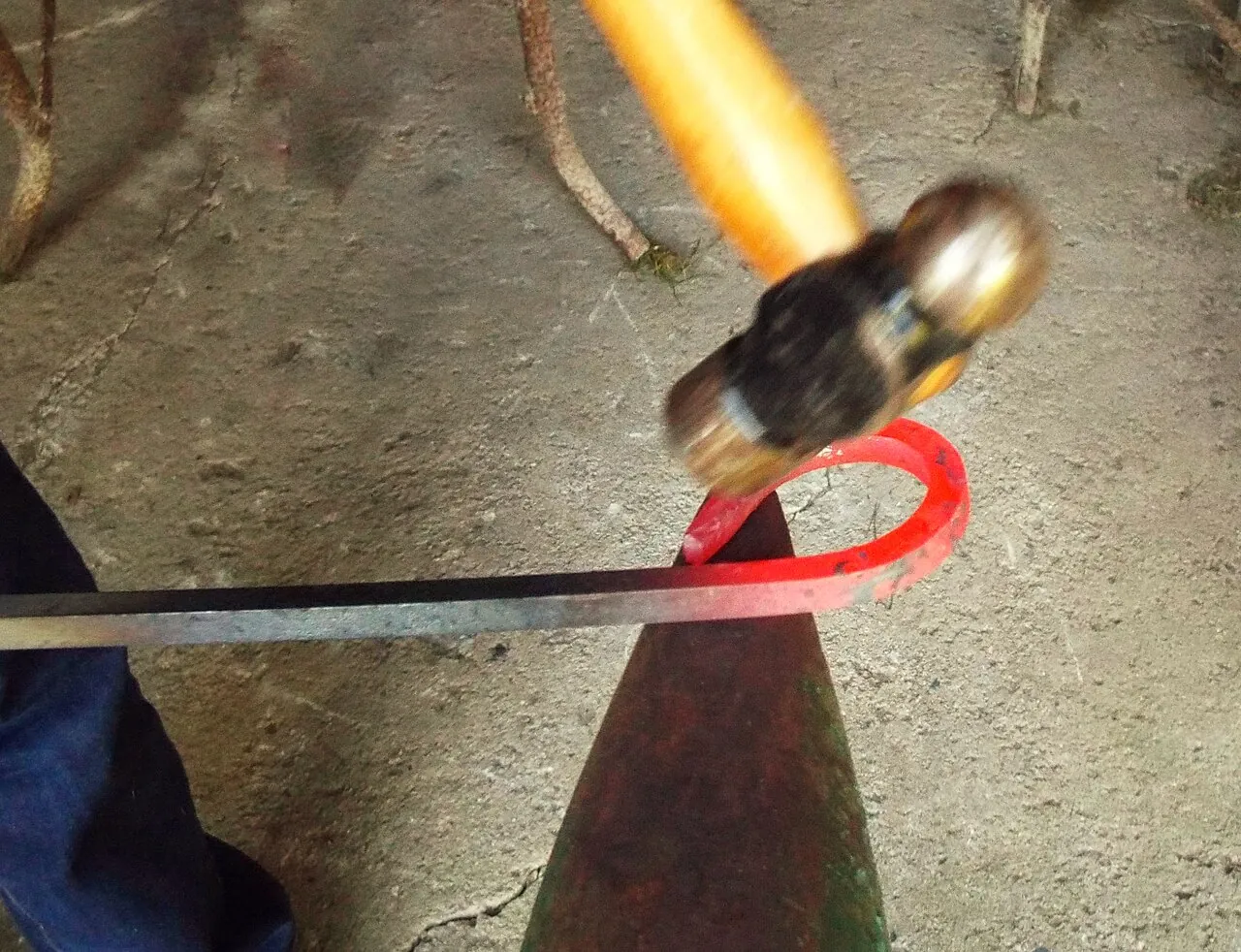
Bend at a high heat - the higher the heat, the easier the bend 1 - and remember the rule from upsetting: the hottest part bends first. Heat only where the bend should be, cooling neighbors in the water bucket if needed.
.jpg)
Places to bend:
- The horn for curves and rings, striking the stock just past where it touches.
- The anvil edge or a bending fork in the hardy hole for angles and offsets.
- The vise, with a bending wrench or scrolling tongs, for controlled bends on long work.
- Bending jigs and forms for repeat shapes.
Hit the part that overhangs the support, not the part on it, and work the bend in steps rather than all at once.
Quick check
Heat placement is the main control in bending, as in upsetting.
Right angles
Bending thins the outside of the corner and rounds it. For a sharp outside corner, Bacon upsets the area of the bend first to put extra metal there, bends, then squares the corner with blows that push metal back into the corner rather than striking straight down 1. For an inside-sharp corner, bend over the anvil’s sharp edge.
Bend the angle slightly past 90, then bring it back, checking with a square.
Quick check
Bacon describes upsetting the bend area and squaring the corner with sliding blows.
Stock for bends
Bending stretches the outside and compresses the inside, while the middle of the stock keeps its length. Bacon’s “calculation of stock for bent shapes” uses that centerline 1:
- Ring: length = π × the mean diameter (inside diameter + stock thickness). A ring of 3-inch inside diameter from 1/2-inch round: π × 3.5 ≈ 11 inches.
- Right-angle bends: add the centerline lengths of each leg; the corner itself takes roughly the stock’s thickness.
- Add a little for forging losses and scale.
Quick check
The inside compresses and the outside stretches; the middle stays the same length.
Scrolls
Scrolls are curls with a tapered end, the backbone of ornamental ironwork.
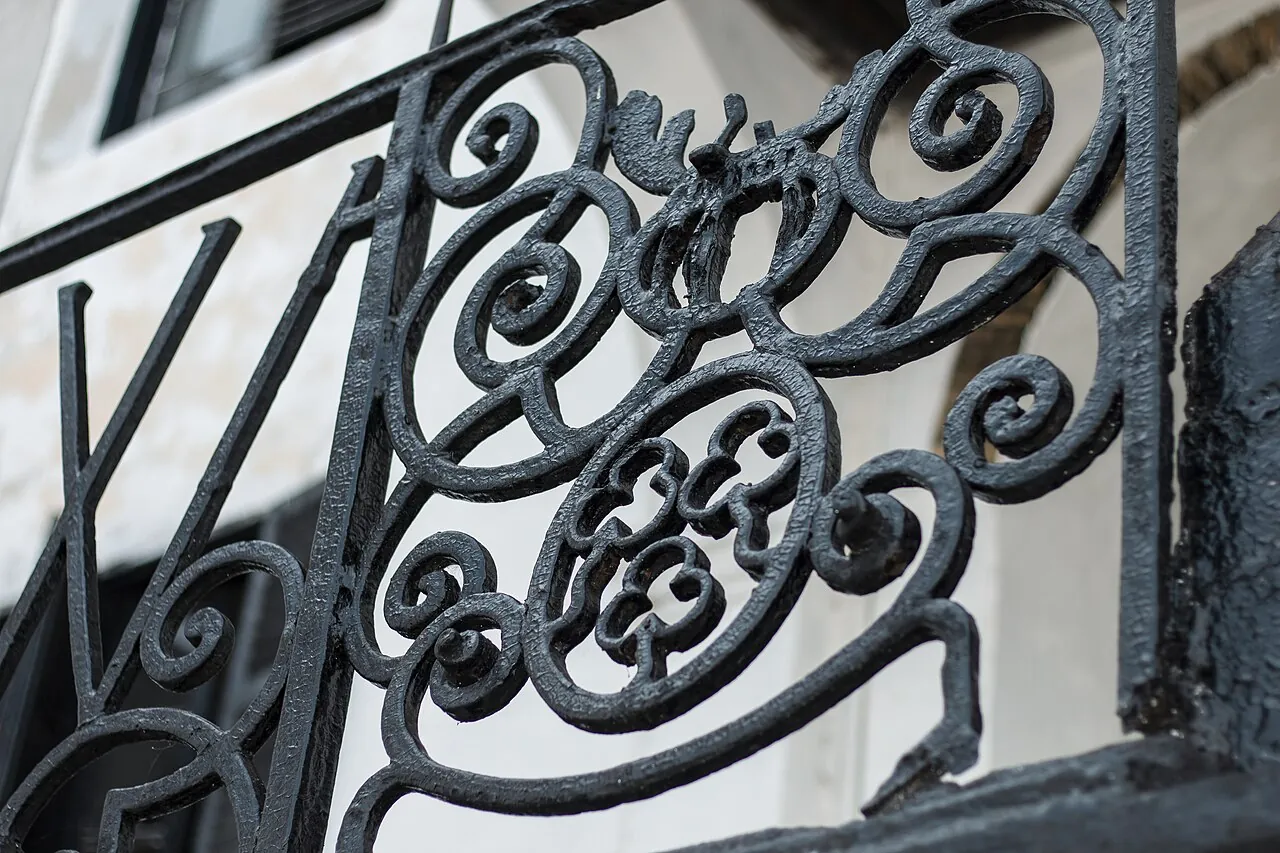

- Taper the end long and even (see Drawing Out); a blunt or uneven taper makes a lumpy scroll.
- Start the curl at the tip over the anvil edge or with scrolling tongs; small, tight start.
- Roll it on the horn or with light blows on the face, letting the scroll “unroll” open as it grows, then close it with a scrolling fork.
- A scroll form - a spiral of bar on a base, held in the vise - bends identical scrolls for gates and railings.
Common ends: the fishtail, the snub end, the leaf, and the penny scroll.
Playback is optional. If the player is unavailable, open the video at its source.
What to take from this
Bend hot, put the heat only where the bend belongs, and strike the overhanging part, over the horn, edge, fork, or vise. For a sharp right angle, upset the corner first and square it with pushing blows. Calculate stock from the centerline (a ring is π × mean diameter). Scrolls start from a long, even taper, curl from the tip, and repeat cleanly on a scroll form.
Lesson complete
Nice work.
Sources for this lesson
- 1John Lord Bacon. Forge-Practice: Elementary. John Wiley & Sons. 1908. verifiedPublic-domain trade-school text from the Lewis Institute; fire building with coking coal, welding heat and fluxes (sand, borax, sal ammoniac), upsetting, drawing out, bending, punching, and tool-steel hardening and tempering colors (430 F pale yellow to 570 F blue, temper gone near 650 F).