Riving the Log and Making Splints
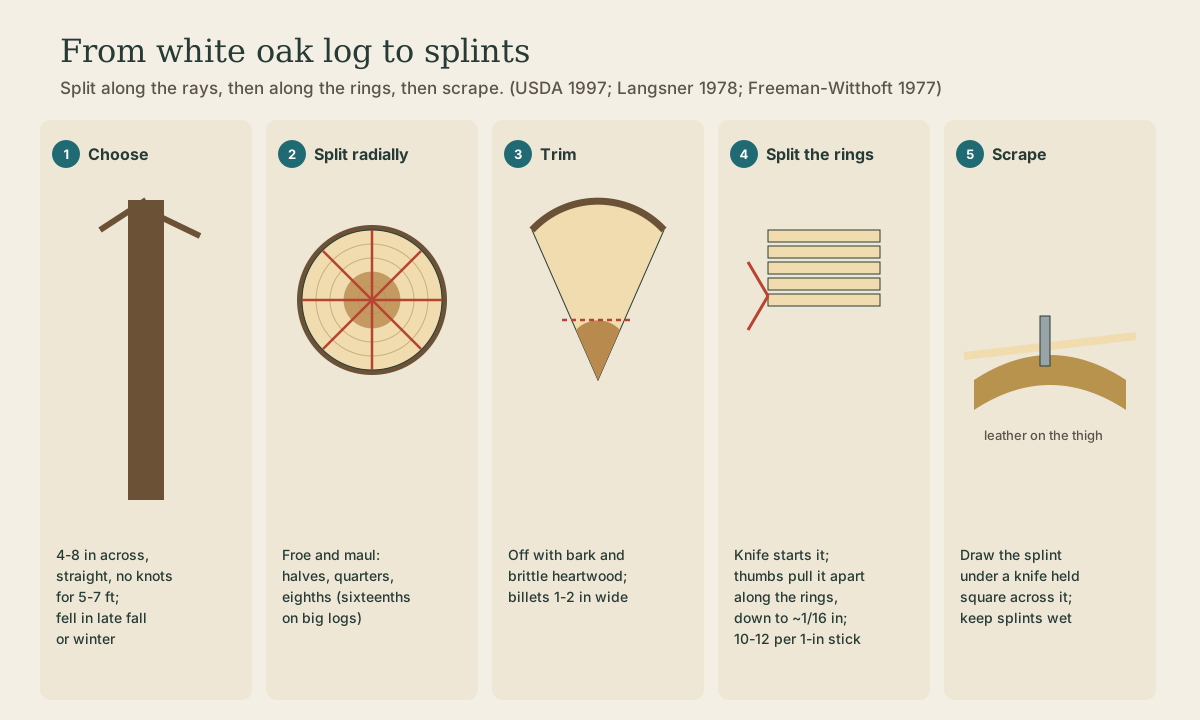
Days one and two: split the bolt radially into halves, quarters, and eighths with froe and maul, cut away the bark and the brittle heartwood, dress the sapwood into billets, then split each billet along its growth rings into splints as thin as 1/16 inch and scrape them smooth over a leather-covered knee. How to steer a split that runs off, and how to store splints.
- 4 min
- 6 steps
- 2 questions
- Lesson 129 of 204
In this lesson
- Split it radially
- Split along the rings
- Scrape
- Sort and store
- Try it
Picking up where you left off.
White oak splints are made by splitting, never sawing, so that every splint follows the wood’s own fibers. It’s two kinds of splitting: first along the rays to make billets, then along the growth rings to make splints.
Split it radially
Strip or leave the bark for now and drive a wedge or froe into the end of the bolt across its center. Split it into halves, then quarters, then eighths; on a bigger log, sixteenths 1 2. These splits run along the rays, from the outside toward the center.
Steering a split. If a split starts running off to one side, turn the piece over and keep going; on thin stock, press down harder on the thicker side as you lever, and the split will drift back toward it 2. A brake holds the piece while both hands work the froe.
Trim the wedge. At the point of each piece is the heartwood, darker and brittle; cut it away along with the bark 1. Some Cherokee makers save the tree’s center for rims and handles 3. Dress each piece of sapwood on the shaving horse into a squarish billet 1 to 2 inches wide 2.
Quick check
Some Cherokee makers use the tree’s center for rims and handles.
Split along the rings
Now the billets are split the other way, along the growth rings, tangentially. Cherokee makers split the sapwood into sticks about 2 inches wide and get “ten to twelve splints from a good oak stick approximately one inch square” 4. White oak’s rings are split apart rather than pounded loose as with black ash 5.
Below about 1/2 inch thick, switch from froe to knife 2:
- Start the split at a corner of the end grain with the knife, along a growth ring.
- Twist the knife to open it.
- Put both thumbs in the opening and pull the two halves apart, using your bent index knuckles as a fulcrum just ahead of the split.
- If the split thickens on one side, bend the thicker half more sharply as you pull; the split runs toward it.
Good stock “will cleave to less than 1/16-in.” 2. Tennessee makers line up a pocketknife blade with the growth rings to strip splits the same way 1.
Quick check
White oak’s rings are split apart, not pounded loose as with ash.
Scrape
Each splint is then scraped: sit with the leather pad on your thigh, hold the knife blade square across the splint, and draw the splint under the blade toward you, taking off the fuzzy, rough surface until it’s smooth and even. Langsner lists a spokeshave, scraper, or penknife for smoothing 2. Getting splints ready takes one to two days of a Cherokee maker’s time 3.
Sort and store
Sort the splints by width:
- Stakes, the wide, thick foundation: about 3/4 inch for this basket.
- Weavers, thinner and narrower: 3/8 to 1/2 inch.
- Rim stock and lashing: rims thicker, lashing narrow (1/8-1/4 inch) 6.
Keep working splints wet. To store them, coil and dry them, then soak them again overnight before use 4 6.
Playback is optional. If the player is unavailable, open the video at its source.
Try it
Before your real bolt, practice ring-splitting on a single billet from a fresh oak branch. The moment a split runs clean for a foot under your thumbs is the moment the craft makes sense.
Lesson complete
Nice work.
Sources for this lesson
- 1Roy M. Overcast Jr.. Basketmaking. Tennessee Encyclopedia. verifiedWhite oak basketmakers choose a sapling 4-6 inches in diameter, straight and free of limbs, knots, or imperfections for at least seven feet; a 6-9 ft section is barked, split into eighths, the heartwood cut out, and splits stripped by lining up a pocketknife blade with the growth rings.
- 2Drew Langsner. The tools and techniques to rive wood. Fine Woodworking (#12, 1978; republished 2026). 1978. verifiedFor basketry use white oak 5-8 inches in diameter with minimal taper; work it promptly after felling or keep the log underwater; bolts no longer than 5-6 ft; good stock cleaves to less than 1/16 inch. Froe 6-10 inch blade at least 3/8 inch thick with a handle 1.5-2 times the blade; 6-16 lb maul, iron wedges, wooden gluts, a club, and a riving brake. To steer a split that runs off, turn the piece and bear down harder on the thicker side. Below about 1/2 inch switch to a knife: start the cleft at a corner, twist it open, then pull apart with both thumbs using the knuckles as a fulcrum. Smooth with spokeshave, scraper, or knife.
- 3Eva Taylor. Hunting the White Oak. Cherokee Central Schools Cultural Department. verifiedTree centers become rims and handles. Preparing splints takes one to two days. Lay 3 splints, cross 3 more, expand with wider sturdier splints, add a border splint around the bottom, bend the stakes up and weave the sides one splint at a time (3-5 hours), fold and tuck the top ends, attach handle and rim; a handle woven in at the bottom is permanent, one added later replaceable. Dyes: bloodroot (orange, 1 hour), yellowroot (yellow, 1 hour), walnut bark (brown) and butternut bark (black), 4-5 hour boils.
- 4Bonita Freeman-Witthoft. Cherokee Indian Craftswomen and the Economy of Basketry. Expedition (Penn Museum) 19(3). 1977. verifiedSapwood is split tangentially into sticks about 2 inches wide; ten to twelve splints come from a good oak stick about an inch square; splints dried in coils and re-wet before use. Dyes: walnut bark or root and butternut root for browns, bloodroot for red; yellowroot nearly exterminated locally.
- 5Peter Follansbee. Basket tour pt 2. Joiner's Notes (blog). 2020. verifiedYou split white oak growth rings apart instead of pounding as with ash. Related posts: filled bottoms use extra splints so small items don't fall through; a double-woven bottom's added splints can be slipped up into the side weaving.
- 6White Oak Baskets (from Bittersweet). Appropedia. verifiedFrom the Lebanon, Missouri, school folklore magazine Bittersweet (maker Lyn Marble). Logs 4-5 ft long and 4-5 inches in diameter, cut in early spring or late fall. A small round-handled basket: bottom strips 24 in long and 1/2-3/4 in wide; side weavers 4 ft long, 3/4-1 in wide; rims two pieces 1 in x 4 ft; lashing 1/8-1/4 in x 4 ft; handle 2 ft, 1/8-1/4 in thick, 3/8 in wide, from bark-side wood. Soak dried splints overnight. Lashing passes under the rims and through the gap beside each stake, crossing in an X at the handle, the end pushed back through the first two wraps.