The Ryijy and What to Buy
Lisa Wiitala's five-day class at the Finnish American Folk School weaves a 12-inch-square ryijy wall hanging of the student's own design. What a ryijy is and how it was used in Finland, the design and its numbers, linen rug warp and rya wool and where to buy them, the loom and tools, and a five-day plan.
- 4 min
- 5 steps
- 2 questions
- Lesson 154 of 204
In this lesson
- What a ryijy is
- The numbers
- Yarn and where to buy it
- Try it
Picking up where you left off.
What you need
| Have it | Material | Spec | Qty | Where to get it |
|---|---|---|---|---|
| Linen rug warp | 8/3 linen rug warp, about 694 yd/lb | 1 tube (500 g); the warp needs about 220 yd | Vävstuga Weaving School (store) | |
| Pile wool | Åsborya 2.5/2 rya wool, about 131 yd per 100 g skein, in 4-6 colors | About 375-400 yd in all: 3-4 skeins, more if you blend many shades | Vävstuga Weaving School (store) | |
| Alternative pile wool optional | Rauma Ryegarn, Norwegian rug yarn, about 80 yd per 100 g | 5 skeins | The Woolery | |
| Ground weft | Åsborya or another soft 2-ply wool in a color that won’t show through | 1 skein (about 100 yd) | Vävstuga Weaving School (store) | |
| Hanging rod | Aluminum tube or 1/2 in wooden dowel, about 14 in, and a cord | 1 | Hardware store | |
| Linen sewing thread | For the hems | 1 small spool | Weaving or sewing supplier |
Tools
Checkmarks are saved on this device.
The plan
-
Day 0
Warp the loom
- Wind about 108 ends of 8/3 linen, 2 yd long
- Sley at 8 ends per inch, 13 in wide, doubling the outer end at each edge
- Tie on and check tension
-
Day 1
Design and start
- Look at old ryijys; choose a palette by twisting strands together
- Draw the design full size on graph paper, one square per knot
- Weave the bottom hem allowance
-
Day 2
First rows
- Cut or wind the first colors
- Tie the first rows of Ghiordes knots, with 6-8 ground picks between
- Keep the edges straight after every row
-
Day 3
Blend and build
- Shade colors by changing one strand at a time
- Knot to about the middle of the design
-
Day 4
Finish the knotting
- Knot the last rows
- Weave the top ground and hem allowance
-
Day 5
Finish the hanging
- Cut off; tie the warp ends
- Sew the hems; slide in the rod
- Mist, settle, and trim the pile
This module reconstructs the Finnish American Folk School’s five-day Ryijy Weaving Workshop in Hancock, Michigan, taught by Lisa Wiitala. Students weave “an approximately 12” square sample of their own design for use as a wall hanging,” learning “design patterns, preparation of materials, color blending, knotting methods, edge treatment and finishing techniques.” The studio opens the day before for warping, and students must be able to warp a floor loom on their own 1. The class plan isn’t published; this follows the sources cited, with the design numbers marked as estimates.
Wiitala trained for three weeks in Finland in 2023 with Ulla Karsikas at Omnia in Espoo, learning design templates, how to choose yarns and colors “that blend well and achieve the right density,” finishing, and how varying yarn lengths changes the height of the surface 2.
What a ryijy is
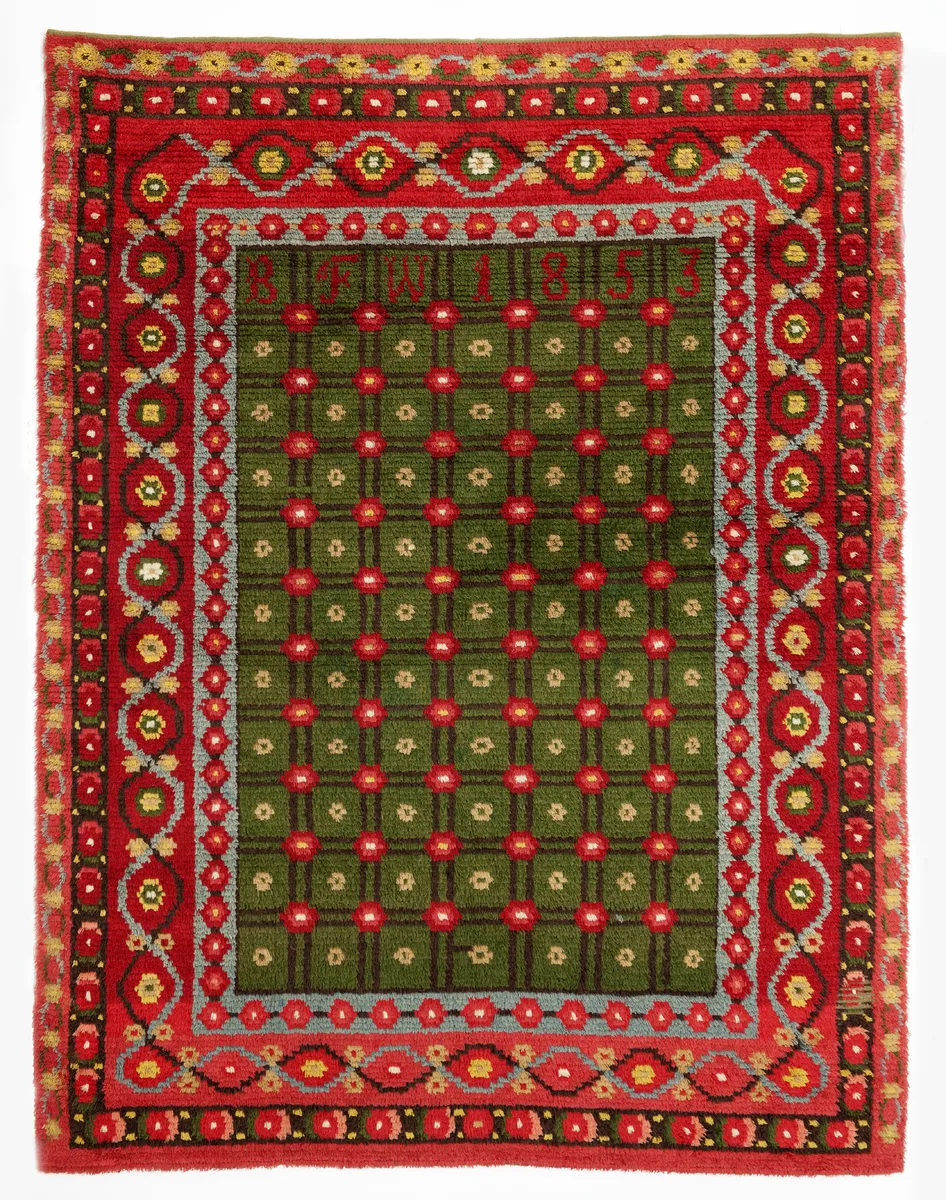
A ryijy (Swedish rya) is a knotted-pile textile: rows of yarn tufts knotted into a woven ground. It came to Finland from Scandinavia in the Viking Age as a tradition of the western coast. In beds, boats, and sleighs the pile faced down for warmth; ryijys appear in inventories under Gustav Vasa and were even used for tax. The golden age of folk ryijys in western Finland ran from about 1770 to 1850, when bridal ryijys showed off a family’s wealth, bought red and blue dyes included 3.
Cotton blankets nearly ended the tradition after the 1850s; national romanticism revived it, and Akseli Gallen-Kallela’s Liekki was made for the 1900 Paris Exposition 4. Compared with an Oriental carpet a ryijy has about a tenth as many knots and much longer pile, and in the 1930s kits spread it to home weavers 5.

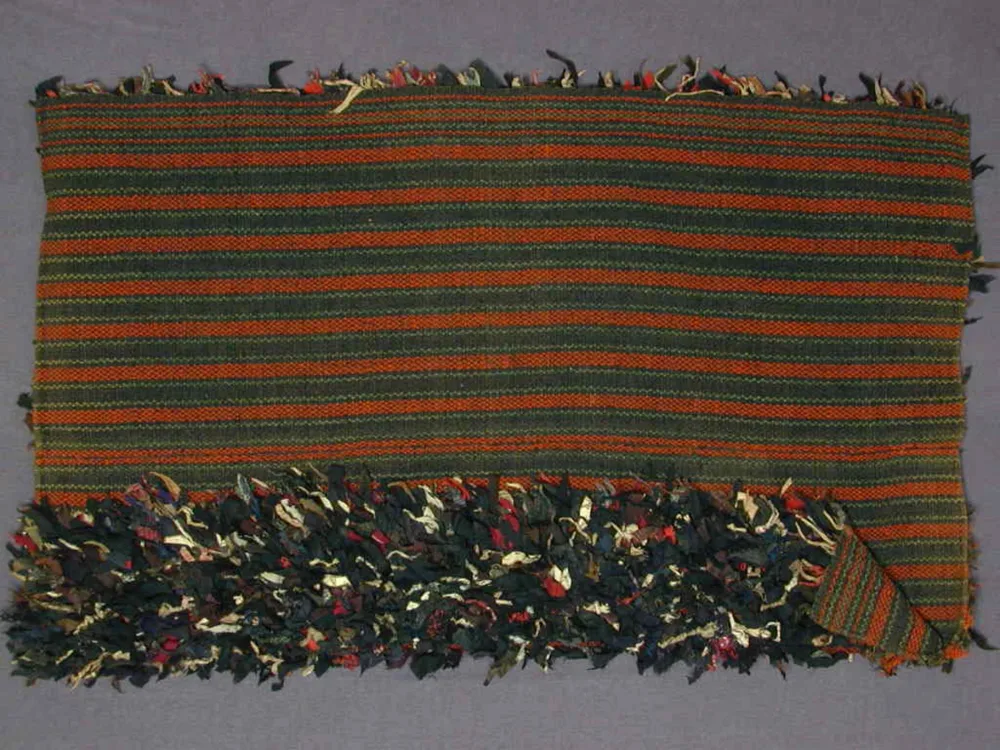
Norway has its own rya. The boat rya (båtrye) was essential in open boats on the North Sea; one could use a farm’s whole season of wool and weigh over 20 pounds, with twill stripes or squares on the smooth side 6.

Quick check
Ryijys were working blankets in beds, boats, and sleighs before they became wall hangings.
The numbers
The Ulvila ryijy of 1853 has a doubled linen warp, 10 picks of ground between pile rows set 7 mm apart, and a 4-strand pile 15 mm long 7. A classic modern rya sample is set at about 8 ends per inch on high-twist 8/3 linen rug warp with Åsborya wool, “the authentic yarn used for rya and flossa” 8.
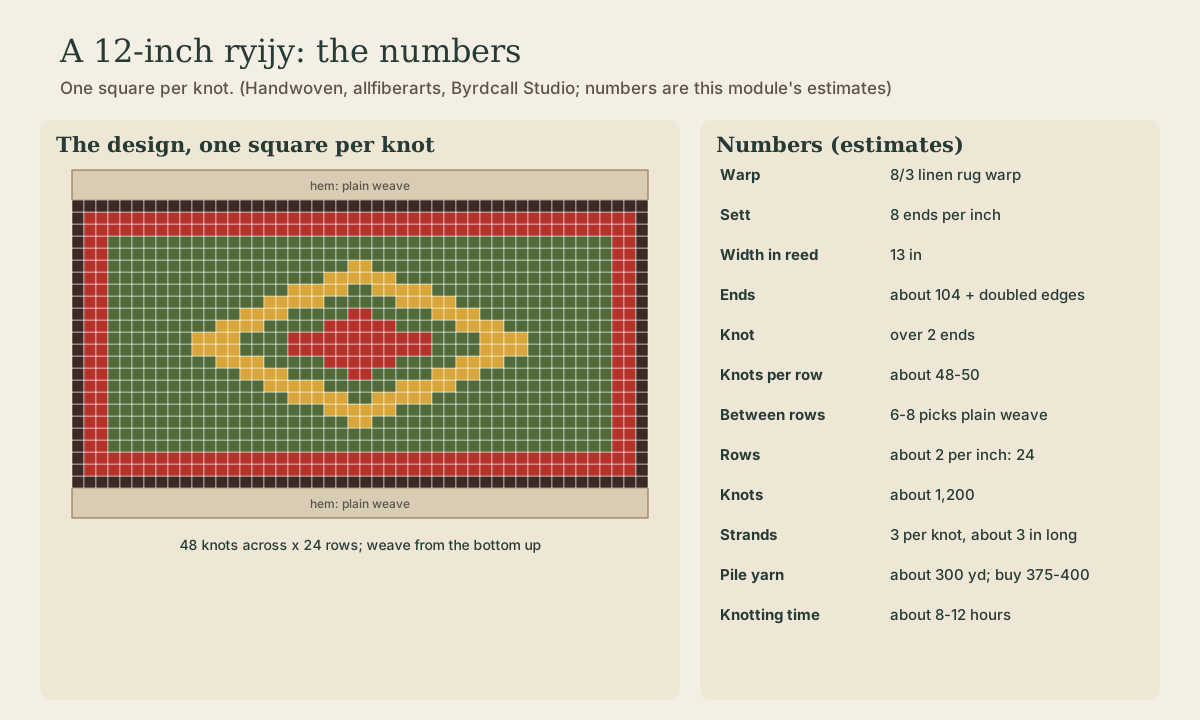
For a 12-inch square, this module’s design (all estimates):
- Warp: 8/3 linen at 8 ends per inch, 13 inches wide in the reed, about 104 ends plus a doubled end at each edge.
- Knots: each over 2 ends, about 48 to 50 to a row.
- Rows: 6 to 8 plain-weave picks between knot rows, about 2 rows per inch, 24 rows in all: about 1,200 knots.
- Pile yarn: strand length is twice the pile; multiply by strands per knot and knots, and add 20 to 25 percent 9. Three strands about 3 inches long per knot gives about 300 yards, so buy 375 to 400.
- Time: at about 150 knots an hour, the rate one studio gives for sewn rya 10, 8 to 12 hours of knotting.
Quick check
Each strand folds in half around two warps, so it is about twice the pile long.
Yarn and where to buy it
- Warp: Bockens 8/3 linen rug warp, 694 yards per pound, about $58 a tube from Vävstuga 11.
- Pile: Borgs Åsborya 2.5/2 wool, 120 m (131 yd) per 100 g skein, $18 12. Buy several shades of each color family; blending needs them.
- Alternative pile: Rauma Ryegarn from The Woolery, a heavier Norwegian rug yarn 13.
Try it
Before buying, twist single strands of your candidate colors together in threes and fours and pin them to a card. A ryijy’s color is mixed in the knot, and a card of twisted bundles shows the result better than skeins side by side.
Lesson complete
Nice work.
Sources for this lesson
- 1Ryijy Weaving Workshop. Finnish American Folk School (Finlandia Foundation). verifiedInstructor Lisa Wiitala, May 28-June 1, 2025, 10-4, FAFS Fiber Studio, Hancock MI; studio open the day before for warping and dressing looms. Class $250, materials $50 with yarn; bring scissors. Covers design patterns, preparation of materials, color blending, knotting methods, edge treatment, and finishing. Each student weaves an approximately 12-inch-square sample of their own design for a wall hanging. Must be able to warp a floor loom alone.
- 2Nordic News, October 2023. Norwegian Textile Letter. 2023. verifiedLisa Wiitala spent three weeks in summer 2023 at Omnia Espoo Adult Education Centre in Finland with Ulla Karsikas, funded by the American Scandinavian Foundation, on a Toika loom: design templates, choosing yarns and colors that blend well and achieve the right density, finishing, non-rectangular shapes, varying yarn lengths to change surface height; she wove three rugs.
- 3Marjo Ahonen. The Meanings of Finnish Folk Rya. Norwegian Textile Letter. 2022. verifiedBy a curator of the Craft Museum of Finland. Rya came to Finland from Scandinavia in the Viking Age as a western coastal tradition; listed in inventories under Gustav Vasa and used as currency and tax; 'castle rya' by professional weavers in white and brown wool. Folk-rya golden age in western Finland 1770-1850; pile turned down for warmth in beds, boats, and sleighs; narrow widths sewn together, later woven in one piece; bridal ryas showed wealth, bought red and blue dyes a status sign.
- 4Ryijy tradition. Wiki-inventory for Living Heritage, Finnish Heritage Agency. verifiedName from Old Scandinavian 'ry'; first Finnish record a Häme Castle official's ryijy in the mid-15th century; cotton blankets nearly displaced ryijy after the 1850s and national romanticism revived it (Gallen-Kallela's Liekki for the 1900 Paris Exposition). Knot: 'Smyrna knot, also known as the Ghiordes knot or Turkish knot'; typically 3-4 yarns per pile. Friends of Finnish Handicraft founded 1879.
- 5Robbie LaFleur. Finnish Ryijy Rugs at the American Swedish Institute. Norwegian Textile Letter. 2014. verifiedRyijy has about a tenth of the knots of an Oriental carpet, with longer pile; bedcover use ended about the 1820s; earliest boat ryijy in the collection dated 1814; ryijy kits widespread in the 1930s. Book: Sopanen and Willberg, The Ryijy-Rug Lives On (2008).
- 6Robbie LaFleur. What is Norwegian Weaving?. Vesterheim Norwegian-American Museum and Norwegian Textile Letter. 2020. verifiedNorwegian rya pile faced down on beds; the boat rya (båtrye) was essential in open North Sea boats, could use a farm's whole season of wool, and weighed over 20 lb; the smooth side often twill stripes or squares. Krokbragd, 'crooked pattern', coverlets dense and warm, called tjukk-åkle in parts of Gudbrandsdal; Vesterheim has over 150 historic coverlets.
- 7Wedding ryijy, Ulvila 1853. Satakunta Museum (Finna). verified186 x 145 cm; warp of doubled linen yarn; 10 weft picks between pile rows, rows 7 mm apart; 4-strand pile 15 mm long.
- 8Becky Ashenden. Yarn Lab: Swedish Yarns. Handwoven. 2019. verifiedÅsborya 2.5/2 wool, 595 yd/lb, 61 colors, 'the authentic yarn used for rya and flossa'; rya sample at 30 ends per 10 cm (8 epi) with doubled-tabby ground; traditionally paired with high-twist 8/3 linen rug warp.
- 9Rya Rug Yarn Calculations. All Fiber Arts. 2024. verifiedStrand length = 2 x pile; multiply by strands per knot, knots per row, and rows; add 20-25% contingency. Example: 16 x 30 in at 4 knots/in and rows 1/2 in apart is 3,840 knots; at 2.75 in x 3 strands, 880 yd, or 1,100 with 25%.
- 10Lesson 4: Calculating How Much Rya Yarn You Will Need. Byrdcall Studio. 2014. verifiedSewn rya at about 150 knots an hour.
- 11Bockens 8/3 Linen Rug Warp, Unbleached. Vävstuga Weaving School (store). verified700 m per 500 g (694 yd/lb), $58 per tube.
- 12Borgs Åsborya 2.5/2 Wool. Vävstuga Weaving School (store). verifiedRya and flossa wool, 120 m per 100 g (595 yd/lb), $18 per 100 g skein.
- 13Rauma Ryegarn; Klippan Fårö 6/1; Belgian 12/4 Linen Rug Warp. The Woolery. verifiedRauma Ryegarn Norwegian spælsau rug wool, about 80 yd per 100 g, $17.75, 78 colors. Klippan Fårö 6/1, 656 yd per 100 g, $20.80 (woolery.com/products/klippan-faro-wool-yarn). Belgian 12/4 linen rug warp, about 450 yd per 8 oz, $18.30 (woolery.com/products/natural-linen-rug-warp-yarn-12-4). Prices 2026.