Stringing, Tuning, and Playing
Day four: string the kantele from the varras to the zither pins, tune it by fifths and fourths and then the third, the way Arja Kastinen teaches, and learn to hold it and play the basic pattern: right index and thumb on strings 1 and 5, left fingers on 4, 3, and 2. Chords by damping, and D major and D minor.
- 3 min
- 5 steps
- 2 questions
- Lesson 171 of 204
In this lesson
- String it
- Tune it
- Hold it
- Play
- Try it
Picking up where you left off.
String it
Musicmakers’ method for a zither pin 1:
- Fix the string at the varras end: hook a loop-end string over the varras, or wrap plain wire around the bar and twist the end back on itself several times.
- Run the string to its pin and cut it 2 to 3 inches longer than needed to reach the pin.
- Push the end through the hole in the pin so it barely shows on the other side.
- Turn the pin with the tuning key about half a turn clockwise, leaving the string loose.
- Pull the string taut with your other hand and wind it up with the key.
Use .016-inch wire for strings 1 to 3 and .014 for 4 and 5 (lesson 1). New strings stretch, so expect to retune often the first day; Musicmakers suggests new strings yearly for the best tone 1.
Tune it
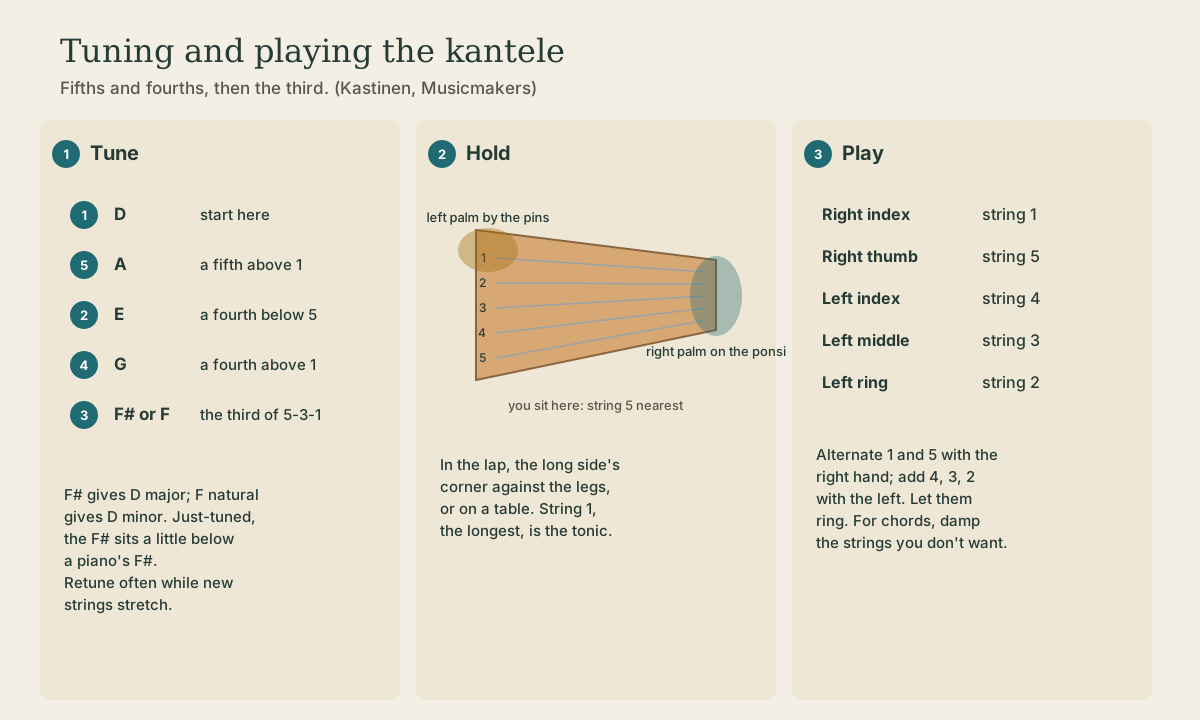
Strings are numbered from the longest, string 1, which is the tonic. Kastinen tunes by intervals 2:
- String 1 to D.
- String 5 a fifth above string 1: A.
- String 2 a fourth below string 5: E.
- String 4 a fourth above string 1: G.
- String 3 to complete the triad 5-3-1: F♯ for D major.
For D minor, lower string 3 to F natural: D E F G A 3. Tuned by ear in just intonation, as five-string kanteles traditionally are 4, the F♯ sits a little lower than a piano’s.
Quick check
Kastinen numbers from the longest string, which is the tonic, D.
Quick check
Only the third changes: D E F G A.
Hold it
Lay the kantele in your lap with the corner of the long side against your legs, so the shortest string is nearest you, or on a table. Rest the right palm on the edge of the ponsi and the left palm at the corner where the pin side meets the short side, with the upper pins inside the palm 2.
Play
Kastinen’s basic pattern 2:
- Right hand: the index finger plucks string 1 and the thumb string 5, back and forth.
- Left hand: the index finger plucks string 4, the middle finger string 3, the ring finger string 2.
- Let the strings ring. The kantele’s sound comes from strings that keep sounding into each other, with no nut or bridge to damp them 4.
To play a chord, lay fingers lightly on the strings you don’t want and strum or pluck the rest. Folklore Village’s class spends its last day on these first techniques 5.
Playback is optional. If the player is unavailable, open the video at its source.
Try it
Tune by the interval order above with only your ear, then check each string with an electronic tuner. The F♯ will read a little flat on the tuner; that’s just intonation, and it’s why the chord rings so clean.
Lesson complete
Nice work.
Sources for this lesson
- 1Kantele finishing and stringing instructions. Musicmakers. 2012. verifiedTen-string kantele with loop-end steel strings .014-.020 in (D5 .014 down to A3 .020); restringing: trim 2-3 in long, pass the wire through the pin, turn about a half turn, then pull the string taut and wind it up with the tuning key; change strings yearly for tone.
- 2Arja Kastinen. Playing the five-string kantele. Research Catalogue. 2025. verifiedHold in the lap with the corner of the long side against the legs, shortest string nearest you, or on a table; right palm on the ponsi edge, left palm at the corner where the peg side meets the short side. String 1 is the longest and the tonic. Basic pattern: right index plucks 1, right thumb 5; left index 4, middle 3, ring 2. Tune 1-5 (fifth), 5-2 (fourth), 1-4 (fourth), then the triad 5-3-1 with the chosen third.
- 3Michael J. King. 5 String Kantele. Michael J. King. verifiedFive-string kanteles 25 x 4.5 in, 2 in deep; spruce with an open back, tulip poplar standard, or walnut or cherry with cedar; steel strings tuned D E F# G A, or D minor D E F G A; pentatonic therapy tuning D E G A C.
- 4Kantele. Wikipedia. verifiedStrings run from tuning pins to a metal bar, the varras, held in a wooden bracket, the ponsi; no nut or bridge. Five-string kanteles typically tuned in just intonation to D major or minor. In the Kalevala, Väinämöinen's first kantele is of pike jawbone strung with hair from Hiisi's stallion; the second of birch.
- 5Making and Playing a Finnish Kantele with John C. Van Orman. Folklore Village, Dodgeville, Wisconsin. verifiedStudents build the traditional five-string small kantele: first the sound box is constructed and finished, then the instrument strung; on the final day, rudimentary playing. Materials fee $50 to the instructor. Van Orman has built folk instruments professionally since 1976. The listing is for October 7-10, 2021, $320-350.