Stick Stools and Benches
Staked furniture: a thick slab seat with legs driven into tapered or cylindrical holes and wedged from above. Choosing the slab, rake, splay, sightlines and the resultant angle, boring and reaming, tapering tenons, wedging across the grain, and leveling the legs.
- 4 min
- 8 steps
- 3 questions
- Lesson 16 of 204
In this lesson
- What staked means
- The slab
- Rake, splay, and sightlines
- Boring and reaming
- Tenons and wedges
- Leveling the legs
- A bench
- What to take from this
Picking up where you left off.
What staked means
Staked furniture drives legs into holes bored through (or into) a thick seat or top and locks them with wedges. No aprons, no frame - the slab itself carries the load. It’s the oldest European furniture form: milking stools, Welsh stick chairs, backstools, and sawbenches. Christopher Schwarz’s The Anarchist’s Design Book lays out staked and boarded vernacular furniture for a modern shop 1.
It suits green woodworking exactly: a riven or hewn slab, legs shaved on the horse, and a brace and bit.
Quick check
The thick slab does the work aprons do in a frame table.
The slab
- Thick: about 1 3/4-2 in. (45-50 mm) for a stool, so the hole has enough length to grip the leg.
- Dry, or close to it, for the seat. Legs and tenons should be drier still at assembly; a dry tenon in a slightly wetter seat gets gripped tighter as the seat dries around it - the same water-as-a-clamp idea used in post-and-rung chairs 2 (see the Chairs lesson on the chairmaker’s joint).
- Species: oak, ash, elm, or a dense softwood for the seat; ash, oak, hickory, or maple for legs.
- A half-log slab with the bark side down makes a traditional bench.
Rake, splay, and sightlines
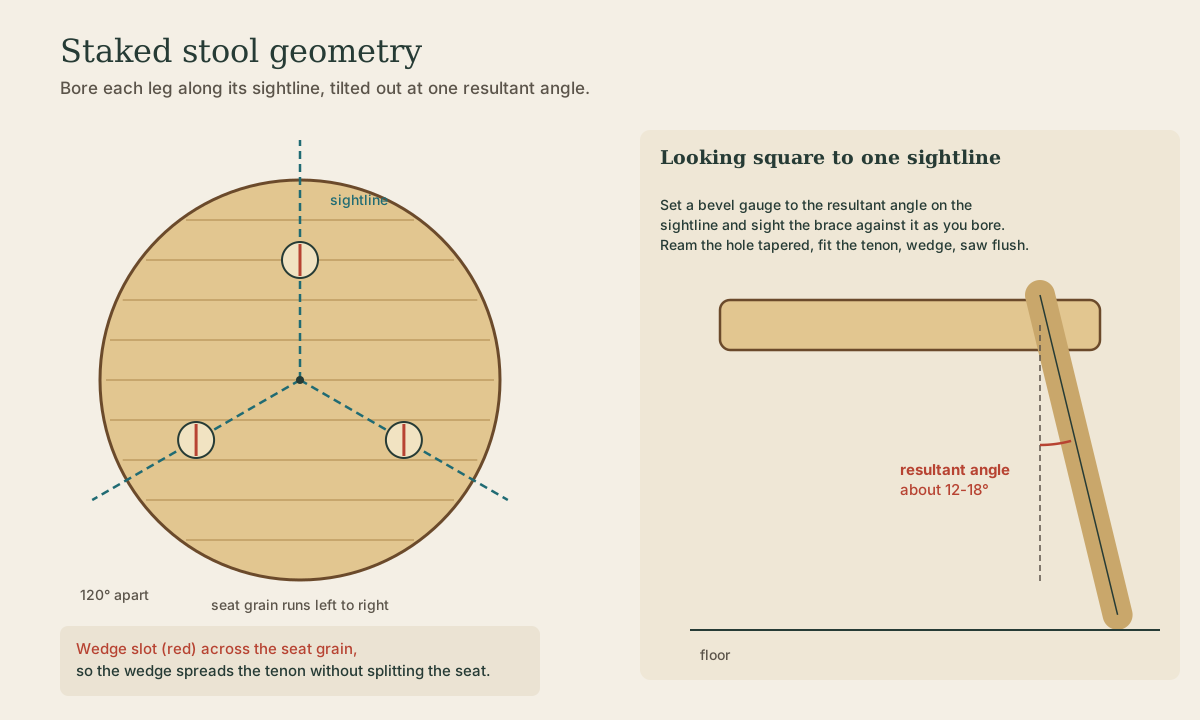
Legs lean outward for stability. Seen from the front, the lean is splay; from the side, rake. Together they combine into one resultant angle, the true lean along the leg’s sightline - the line on the seat, seen from above, that the leg leans along 1.
For a three-legged stool with legs evenly spaced, the sightlines simply run from the center through each leg, and every leg gets the same resultant angle - typically about 12-18 degrees. Benches with four legs need a little geometry: draw the sightlines on the underside, then set a bevel gauge to the resultant angle.
Quick check
Rake and splay seen in front and side views combine into one resultant angle along the sightline.
Boring and reaming
- Mark leg positions and sightlines on the underside of the seat.
- Set a bevel gauge on the sightline at the resultant angle.
- Bore with a brace and auger, sighting the bit against the bevel gauge from the side and keeping it on the sightline from above (a mirror or a helper helps). Bore through.
- For tapered joints, ream the hole with a tapered reamer, checking the angle as you go. Cylindrical holes are simpler; tapered holes self-tighten under load 1.
Tenons and wedges
- Shape the tenon to match: a tapered tenon cut with a tapered tenon cutter or drawknife and spokeshave, or a cylindrical tenon sized to the actual bit.
- Saw a kerf for the wedge in the top of each tenon, oriented so the wedge will run across the seat’s grain - a wedge running along the grain acts like a splitting wedge 1.
- Glue (hide glue is traditional) or drive the legs dry, then drive a dry hardwood wedge into each kerf, and saw and pare flush.
Playback is optional. If the player is unavailable, open the video at its source.
Quick check
A wedge driven along the grain acts like a splitting wedge on the slab.
Leveling the legs
Stand the stool on a flat surface, shim the legs until the seat is at the height and tilt you want, then scribe all the legs at once with a pencil on a block of the right thickness, saw to the lines, and chamfer the foot of each leg so it won’t splinter when dragged.
A bench
A staked bench is the same work with a longer slab and four (or six) legs. Keep legs well in from the ends and edges, and choose a slab thick enough not to bounce; long benches benefit from a stretcher or a slightly thicker top. Langsner’s Country Woodcraft includes country benches made this way from riven and hewn stock 3.
What to take from this
Staked furniture wedges legs into holes in a thick slab. Use a 45-50 mm seat, drier tenons, and ash, oak, or hickory legs. Draw sightlines on the underside, bore and ream each hole at one resultant angle (12-18 degrees is typical), wedge each tenon across the seat’s grain, then shim, scribe, and saw the legs level.
Lesson complete
Nice work.
Sources for this lesson
- 1Christopher Schwarz. The Anarchist's Design Book. Lost Art Press. 2016. verifiedVernacular staked and boarded furniture, including the six-board chest (pine recommended because its cross-grain nailing must tolerate movement); free PDF.
- 2Jennie Alexander. Make a Chair from a Tree: Third Edition. Lost Art Press. 2021. verifiedPublisher contents and excerpts for post-and-rung construction, moisture management, bending, assembly, and hickory-bark seating.
- 3Drew Langsner. Country Woodcraft: Then & Now. Lost Art Press. 2020. verifiedExpanded edition of the 1978 book that seeded American green woodworking; shavehorses, riving, spoons, bowls, and country tools.