The Border, Warping, and Heddles
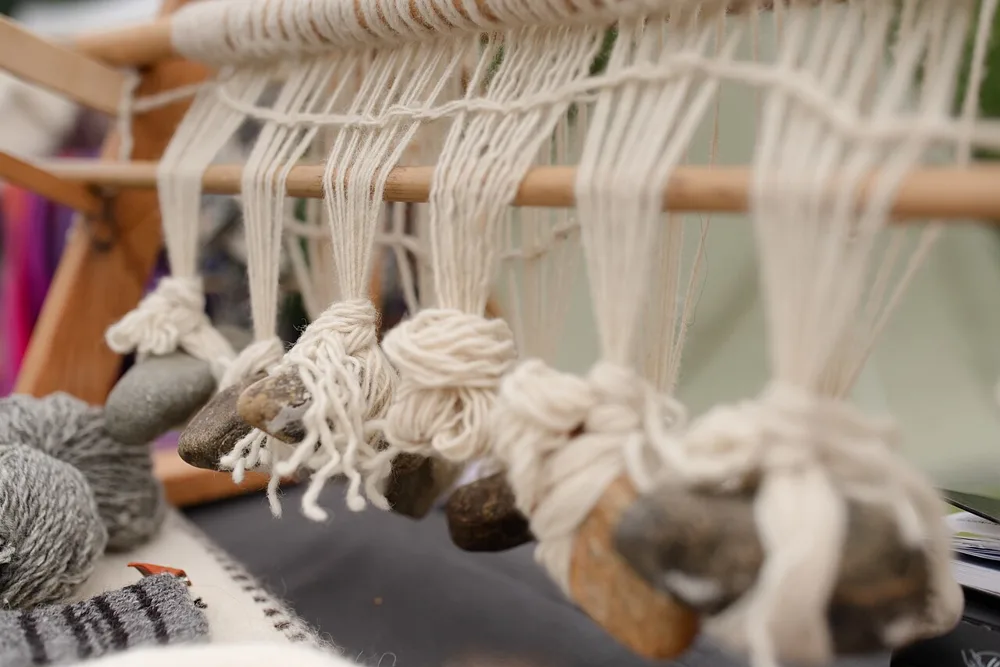
Days two through four: make the starting border, a tablet-woven band or a twisted cord carrying the warp, fasten it to the beam, hang the warp in bundles from level rows of weights, chain it to spacing, set the shed rod, and knit string heddles to the heddle rod so both sheds open.
- 3 min
- 4 steps
- 2 questions
- Lesson 182 of 204
In this lesson
- The starting border
- Hang the warp
- Heddles
- Try it
Picking up where you left off.
The starting border
The warp hangs from a starting border fastened to the beam. Two ways:
- Tablet-woven band: weave a band on cards, letting the weft loop out long on one side; those loops become the warp. The video below shows it.
- Twisted cord: Marta Kløve Juuhl’s åkle heading is a four-strand twisted cord lashed to the beam, with the warps inserted “at so many threads per centimeter” 1. In the Norwegian tradition the warp’s top loops are threaded on a cord, spread to width, and sewn to the beam through its holes 2.
Space the warp at your chosen sett, 6 ends per cm for the sample in lesson 1, and make the warps a little longer than the cloth you want plus 30 cm for the weights.
Playback is optional. If the player is unavailable, open the video at its source.
Hang the warp
- Lash or sew the border to the beam and set the beam in its hooks 2.
- Divide the warp into front and back layers: alternate ends go to each.
- Tie each layer’s ends in bundles to weights: 20 ends to a 1 kg weight for the sample, or 10 to a half-kilo. Hang the front weights in one row and the back weights in a second row behind, all at one level, side by side, in a row as wide as the cloth or a little wider 3. The double-cloth experiment tied 15 warps to each 1 kg weight 4.
- Chain the warp to space it: a finger-crocheted chain over pairs of warps, just above the weights, holds the spacing 2.
Juuhl’s 2013 class at Vesterheim weighted, heddled, and chained in that order 1.

Heddles
The shed rod near the bottom holds the back layer behind it, which opens the natural shed between front and back warps. The heddle rod is tied to the back warps by string heddles; pulling it forward onto its brackets brings the back warps in front of the front ones and opens the counter-shed 5.
- Set the shed rod across the uprights at the bottom brace, the back warps passing behind it.
- Rest the heddle rod on its blocks.
- Knit a heddle around each back warp and the rod with strong twine, working from right to left, each loop the same length 2.
For plain weave, heddle every other warp to one rod. Three- and four-shaft twills add heddle rods 2; Juuhl’s diamond twill used “3 heddle rods and a 4th natural shed,” and threading it took three days 6. Museum boat rugs have point-twill grounds; for a first piece, plain weave with one heddle rod is enough.
Playback is optional. If the player is unavailable, open the video at its source.
Quick check
The shed rod gives the natural shed; the heddle rod gives the other.
Quick check
Juuhl’s diamond twill used three heddle rods plus the natural shed.
Try it
Before knitting all the heddles, make five, pull the heddle rod forward, and look at the shed. If the back warps don’t clear the front ones, lengthen the heddles; if the rod has to travel too far, shorten them.
Lesson complete
Nice work.
Sources for this lesson
- 1Melba Granlund. Warp-Weighted Loom Classes at Vesterheim, July 2013. Norwegian Textile Letter. 2013. verifiedMarta Kløve Juuhl taught a Sámi grene in handspun wool, then an åkle or rya. The heading is a four-strand twisted cord lashed to the beam; warps are inserted at so many threads per centimeter, then weighted, heddled, and chained; weft carried up the selvedge at color changes; 'be sure you have enough rocks!' Uneven stones made a weaving draw in.
- 2Eli Wendelbo, Audun Dybdahl. Oppstadvev. Store norske leksikon. verifiedTwo heavy side posts lean against a wall, carrying a rotating cloth beam with a row of holes for sewing on the warp; the warp's top loops are threaded on a cord, spread to width, and sewn to the beam; warps tied to weights; a finger-crochet chain over pairs of warps spaces them; heddling with thick thread; tabby from heddling every other warp, three- and four-shaft twill from more heddle rods. Weaving goes from the top down: weft laid in arcs, pushed up with the fingers, beaten with a sword or weaving spoon; the cloth rolls onto the beam; the weaver stands.
- 3Linda Mårtensson, Eva Andersson, Marie-Louise Nosch, Anne Batzer. Technical Report Experimental Archaeology Part 3: Loom Weights. Centre for Textile Research, University of Copenhagen. 2007. verifiedExperiments with 22 ceramic weights of about 275 g, 11 per row; wool of about 1,000 m per 100 g needed about 20 g per thread, so 14 threads per weight. Weights should hang side by side at one level; the row of weights should be the same as or slightly wider than the fabric; flat-sided weights work best.
- 4Jan Larson, Marta Kløve Juuhl. Norwegian double-cloth: warp-weighted loom experiments. Archaeological Textiles Review 64. verified1 kg weights with 15 warps per bundle (about 66 g per thread); warp 125 cm wide at 6 ends per cm per layer, about 15 cm clear of each upright; coin-bag weights 4-6 cm thick.
- 5Warp-weighted loom. Wikipedia. verifiedTwo posts; a cylindrical beam onto which cloth can be rolled; a shed rod for the natural shed; a heddle bar tied to warps by string leashes, pulled forward to give the counter-shed; extra warp can be wound around the weights.
- 6Marta Kløve Juuhl. Diamond Twill Woven on a Warp-weighted Loom. Norwegian Textile Letter. verifiedSpelsau single yarn at 10 ends per cm, 600 ends over 60 cm; a heading cord as in weaving åkler; '50 grams per warp end'; '3 heddle rods and a 4th natural shed'; threading took 3 days.