Growing, Pulling, and Retting
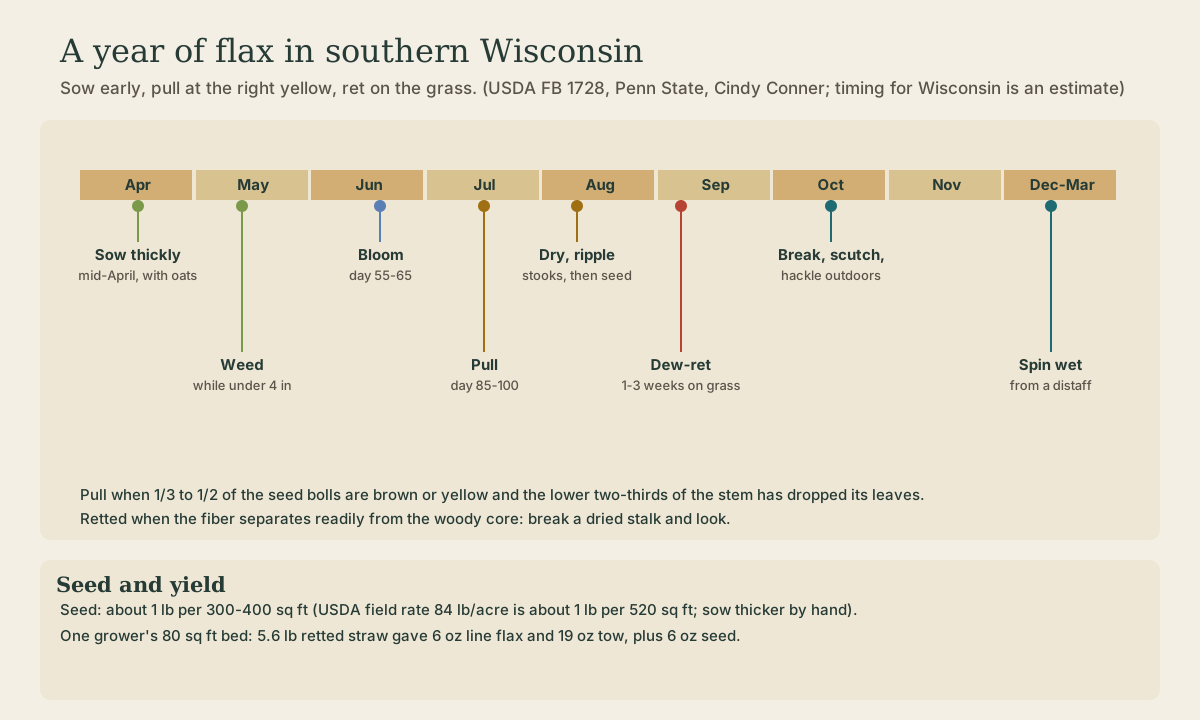
April to September: sow fiber flax thickly when you plant peas, weed it young, pull it by the roots when a third to a half of the bolls have turned, dry it in stooks, ripple off the seed, and dew-ret it on grass until the fiber parts from the woody core, then dry and store it.
- 4 min
- 7 steps
- 2 questions
- Lesson 179 of 204
In this lesson
- Sow
- Grow
- Pull
- Ripple
- Ret
- Dry and store
- Try it
Picking up where you left off.
Sow
Flax is “one of the first crops planted,” sown when oats or barley go in; young plants survive a few degrees of frost, and sowing late costs straw: in an Oregon trial, sowing one, two, and three weeks after April 11 gave 64, 46, and 14 percent of the yield 1. Conner plants “about the time you plant peas” 2; in southern Wisconsin that is usually mid-April.
Grow
Pull weeds while the flax is only a few inches tall; once it’s up, you can’t get between the stems 1. Fedco warns that fiber flax sown heavily may lodge, fall over in wind and rain 5; run strings around and across the bed on stakes if it starts to lean. Schroeder selects her Wisconsin varieties partly for lodging resistance 6.
Bloom starts 55 to 65 days after sowing; the blue petals drop by mid-morning 1. Penn State saw its first flowers on day 57 3.
Pull
Pull “when one third to one half of the seed bolls are brown or yellow” and the leaves have fallen from about two thirds of the stem; too early gives fine, weak fiber, too ripe coarse, brittle fiber 1. That’s 85 to 100 days; Penn State pulled on day 87 3.
Pull the plants by the roots, never cut them, because the fiber runs from the ground to the lowest branches 1 7. Keep the roots even, tie handfuls into bundles, and stand the bundles in stooks to dry, about a month 3.
Quick check
Too early gives fine, weak fiber; too ripe gives coarse, brittle fiber.
Ripple
Comb the dry seed heads off by drawing each bundle through a ripple, a row of long nails or teeth set in a board 7. Save the seed for next year’s bed.
Ret
Retting lets microbes rot the gum that binds the fiber to the woody core.
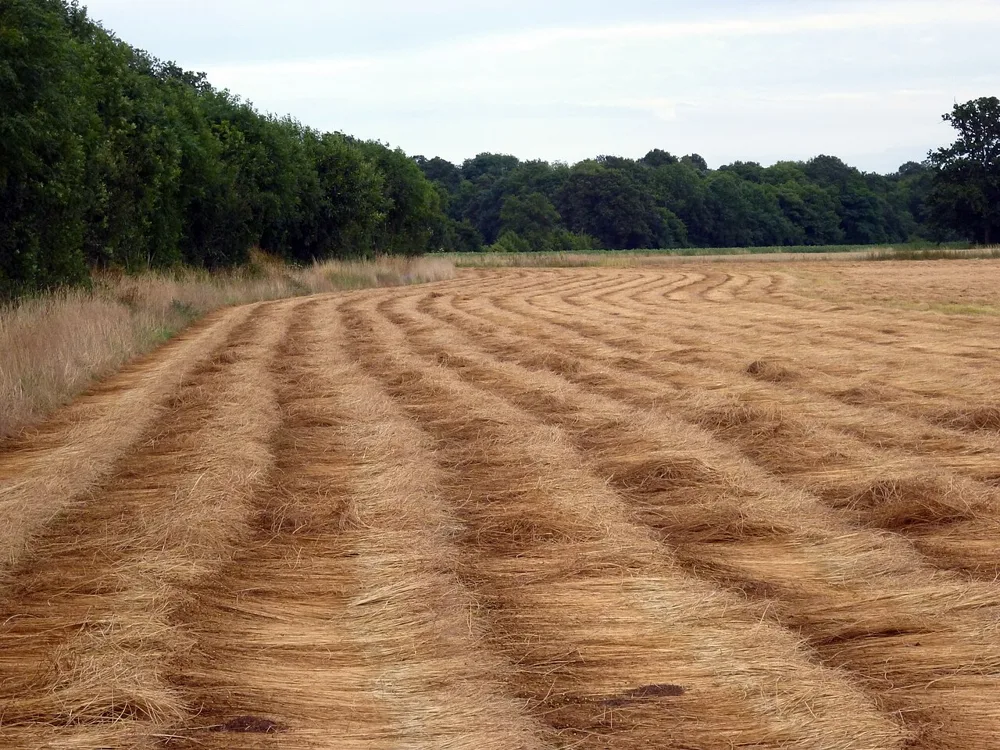
- Dew retting: spread the straw thin on short grass and turn it once. It takes a week to ten days when warm and moist, up to a month when cool 1. Penn State flipped its flax after a week and called it retted at two weeks 3.
- Water retting: about 4 to 5 days at 32°C (90°F), about two weeks at 10°C (50°F) 8; the USDA gives 6 to 8 days in tanks at 80°F 1.
Test every couple of days. Dry a few stalks and break them: when retting is done, the fiber “separates readily from the woody inner part” 1; Penn State’s test was being able to break the stalks and see the fibers inside 3. If the fiber comes away too easily, it’s over-retted and weak 8.
Dew-retted flax turns silver-gray, and its mold spores are a health risk, so do the dusty work outdoors 8.

Quick check
Over-retted fiber comes away too easily and is weak; test every couple of days.
Dry and store
Gather the retted straw, stand it to dry completely, tie it in bundles, and store it somewhere dry. It must be very dry before breaking 8.
Playback is optional. If the player is unavailable, open the video at its source.
Try it
During retting, pull three stalks each time you check, label them by date, and dry them indoors. Breaking the series side by side shows the moment the fiber starts to come free, better than any description.
Lesson complete
Nice work.
Sources for this lesson
- 1B. B. Robinson. Flax-Fiber Production (Farmers' Bulletin 1728). U.S. Department of Agriculture. 1940. verifiedIssued 1934, revised 1940. Ideal locations around the Great Lakes, with a cool, moist spring; medium-heavy well-drained silt loam. Sow early, with oats or barley; 'a very common rate is 84 pounds' per acre. Season 85-100 days, bloom at 55-65 days. Pull 'when one third to one half of the seed bolls are brown or yellow' and the leaves have fallen from two thirds of the stem; fiber runs from the ground to the lowest branches. Dew retting 1-3 weeks, spread thin and turned, lifted when 'the bark containing the fiber separates readily from the woody inner part'; tank retting 6-8 days at 80 F. Yield per acre about 1 ton retted straw to 400 lb scutched fiber with tow.
- 2Cindy Conner. Grow Flax for Linen in Your Garden. Mother Earth News. 2017. verifiedLandis Valley's 1 lb package plants 400 sq ft (Heinrich's Linen: From Flax Seed to Woven Cloth says 300); plant 'about the time you plant peas'; harvest in 90-100 days.
- 3Growing Flax. Penn State College of Agricultural Sciences (exhibition). 2022. verifiedSowed April 22, 8 lb on 1/16 acre; 'One pound of seeds can cover a 17 by 17-foot area.' First flower June 17 (day 57); pulled July 19 (day 87); dried in stooks about a month; rippled Aug 23; dew-retted from Aug 23, flipped after a week, retted at two weeks; dried and stored by mid-September. 'Retting is complete when you can break the stalks and see the flax fibers inside.'
- 4Linore Flax. Truelove Seeds. verifiedOregon fiber flax of 1962 grown with the Pennsylvania Flax Project, 115 seeds $5; for fiber sow 3-4 in apart, don't cover the seed, and lay out stems to ret about 3 weeks.
- 5Sussex Flax 5081. Fedco Seeds. verifiedFiber flax, 110 days; 'If growing for fiber, sow more heavily'; larger packets in 14, 28, and 112 g sizes when in stock.
- 6Maureen McCollum. The flax-to-linen dream weaves its way into Wisconsin. Wisconsin Life (PBS Wisconsin / WPR). 2025. verifiedLeslie Schroeder trialed 53 USDA germplasm flax varieties on southern Wisconsin farms and kept 16, selected for germination, height, and lodging resistance; seed heads rippled through a wood-and-nail comb; the brake is 'like a large dull, wooden paper cutter'; then scutching and hackling.
- 7Ingun Grimstad Klepp. Lin. Store norske leksikon. verifiedPlant 60-120 cm tall, season 90-100 days; in Norway sown in May and harvested August-September, pulled up by the roots, bundled, and dried; seed capsules stripped with a comb; retted on grass or in ponds; line 60-90 cm, tow 20-25 cm; linen fiber 20-25% stronger wet.
- 8Linberedning. Swedish Wikipedia. verifiedAfter Kewenter, Lin & linne (1999): water retting 4-5 days at 32 C, about two weeks at 10 C; land-retted flax turns silver-gray to blackish, and its mold spores are a health risk, so process outdoors. Ret test: dry a few stalks and break them to see how easily the fiber releases; a snap test on knotted fiber. The straw must be very dry before breaking.