The Tine and What to Buy
Vesterheim's four-day bentwood box class with Hal Bitzer and North House's sveiping class. What a tine, laup, and sveipeske are, museum tines and their sizes, the wood, root, and tools, where to get thin bending stock in Wisconsin, and a four-day plan.
- 3 min
- 5 steps
- 2 questions
- Lesson 203 of 204
In this lesson
- What a tine is
- Wood and root
- Tools
- Try it
Picking up where you left off.
What you need
| Have it | Material | Spec | Qty | Where to get it |
|---|---|---|---|---|
| Band stockOcooch’s stock is 24 in long; ask for a custom length. | Straight-grained, knot-free birch, aspen, or basswood, 1/8 in (3 mm) thick, 2 in (5 cm) wide, at least 32 in (80 cm) long | 2 (one spare) | Ocooch Hardwoods, Viola, Wisconsin | |
| Bottom and lid wood | Pine, birch, or basswood about 3/8-1/2 in thick | A board about 10 x 18 in | Lumberyard or hardwood dealer | |
| Root for lacingNo US seller was found; North House classes gather it in the forest. | Split spruce or birch root | Several feet | Dig your own from your land or a landowner's, with permission | |
| Copper tacks optional | #1 or #2 copper tacks, for a tacked lap instead of root | 1/2 oz | D.B. Gurney | |
| Wooden pegs | Round toothpicks or small dowel | A handful | Grocery or hardware store |
Tools
Checkmarks are saved on this device.
The plan
-
Day 1
Wood and form
- History; the parts of a tine
- Thin the band to about 3 mm; draw the ellipse and cut the form
- Soak the band and the root
-
Day 2
Bend
- Heat the band; bend it on the form and clamp
- Mark the lap; split and prepare the root
-
Day 3
Lap and bottom
- Shape the lap; drill and lace it with root
- Groove for the bottom; fit and peg it
-
Day 4
Lid and finish
- Fit the two posts and the lid between them
- Sand; decorate if you like
This module reconstructs Vesterheim Folk Art School’s four-day Bentwood Box with Hal Bitzer, which teaches the history, then how to “select the wood, make a mold, wet the wood, and bend it on a form,” different types of lacing, and fitting the bottom and lid 1, and North House’s Sveiping: Bent Wood Box, which binds the joints with hand-split birch root gathered in the forest 2. The class plans aren’t published; this follows the sources cited.
What a tine is
Sveiping is the Norwegian craft of bending a thin band of wood into a box; its names include sveipeske, øskje, laup, tine, and butt, and objects from the Oseberg ship were made this way 3. A laup is an oval box, especially for butter, today often called a tine, and “the lid is clamped between two staves at the ends” 4. In Sweden the svepask has many different lid locks 5.
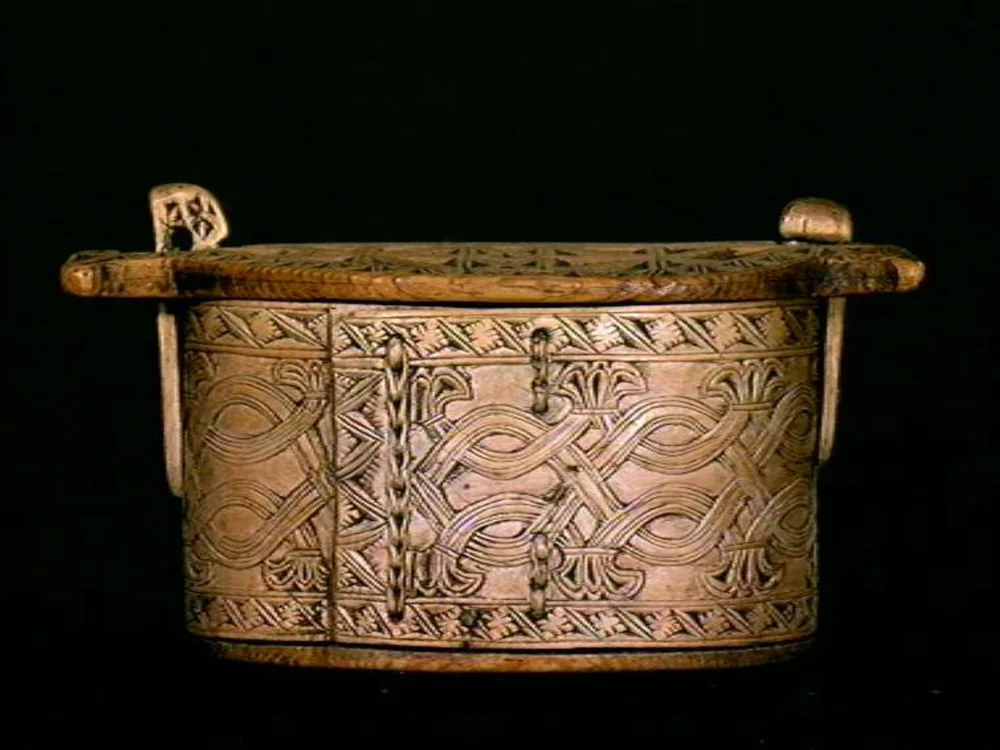
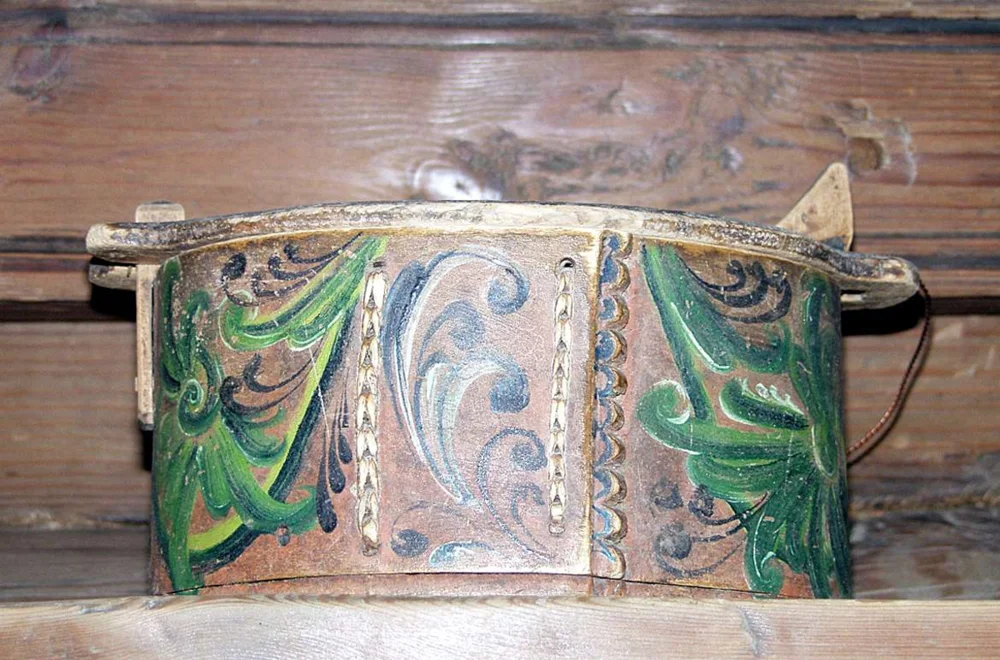
A carved tine from Kvinesdal at the Norsk Folkemuseum is 22.3 by 10.8 cm and 12.4 cm tall, of spruce and birch with root lacing, with “two side clamps” holding the lid 6. A rosemaled pine tine from Valle is 25.5 by 14 cm 7. A tiny one at Vesterheim has a cover that “snaps between vertical posts at each end” 8.
Quick check
On many old tines one post can be moved inward to lock the lid.
Wood and root
The band should be straight-grained and knot-free, planed to 2 to 4 mm; sallow and pine both suit 3. Split blanks keep the surface fibers whole better than sawn ones 9. Seams are sewn with roots of spruce or birch 3. A Norwegian school project uses a band of knot-free pine or birch 80 by 5 cm and 3 mm thick, with a 13 mm lid and a 10 mm bottom 10.
Ocooch Hardwoods in Viola sells thin aspen, basswood, and maple, in 24-inch lengths or custom lengths up to 8 feet on request 11. If you’d rather tack the lap than lace it, D.B. Gurney sells US-made copper tacks 12.
Quick check
Thin enough to bend around an oval form after soaking or heating.
Tools
Vesterheim’s shared tools: a hand router with a 3/8-inch bit, a hand drill with 7/64- and 3/32-inch bits, sandpaper, round toothpicks, a pencil that writes on wet wood, glue, clamps, and a 3-foot trough with a camp stove to soak the wood and root lacing 1.
Try it
Soak a scrap of your band stock overnight and bend it around a coffee can. If it cracks on the outside, it’s too thick or the grain runs out; plane it thinner or choose straighter stock.
Lesson complete
Nice work.
Sources for this lesson
- 1Bentwood Box (archived). Vesterheim Folk Art School (Wayback Machine). verifiedHal Bitzer, Aug 21-24, 2025, four days, $365-405 plus $20 materials; some wood and knife experience needed. Learn history, 'select the wood, make a mold, wet the wood, and bend it on a form. Different types of lacing… construct and fit the bottom and lid.' Shared tools: hand router with 3/8 in bit, hand drill with 7/64 and 3/32 in bits, sandpaper, round toothpicks, an indelible pencil that writes on wet wood, glue, C-clamps and bar clamps, a 3 ft trough with a camp stove to soak wood and root lacing, carving knives and gouges.
- 2Sveiping: Bent Wood Box. North House Folk School. verifiedNorwegian bent wood boxes (sveiping) from a mix of dry and green wood; 'Hand-split birch root is used to bind joints'; an afternoon gathering supplies in the forest.
- 3Eivind Falk. Sveiping - sveipet beholder. Store norske leksikon. 2025. verifiedStraight-grained, knot-free wood planed to 2-4 mm; sallow and pine both suit; seams sewn with roots (tæger) of spruce or birch; heated, steamed, or bent green around a form, holding its shape once dry; bottom fixed with wooden pegs. Names: sveipeske, øskje, laup, tine, butt; Oseberg objects were made this way.
- 4Laup. Norwegian Wikipedia. verifiedAn oval box, especially for butter, today often called a tine; 'lokket klemmes fast mellom to staver i endene' (the lid is clamped between two staves at the ends).
- 5Svepask. Swedish Wikipedia. verifiedThe band is heated over fire or boiled; sewn with root thread, the commonest stitch like chain stitch; in the south the band wraps around the bottom, in the north the bottom is set in a rabbet; pegged bottoms; many different lid locks.
- 6Tine (NF.1898-0884). Norsk Folkemuseum (DigitaltMuseum). verifiedOval tine of spruce and birch with root lacing, Kvinesdal, 22.3 x 10.8 x 12.4 cm; 'To sideklemmer holder lokket' (two side clamps hold the lid); carved all over. Photo Anne-Lise Reinsfelt, CC BY-SA.
- 7Tine (NF.1911-0847). Norsk Folkemuseum (DigitaltMuseum). verifiedRosemaled pine tine from Valle, Setesdal, 25.5 x 14 x 15 cm. Photo Haakon Michael Harriss, CC BY-SA.
- 8Bentwood Box (2003.036.003). Vesterheim Norwegian-American Museum. verified'Cover snaps between vertical posts at each end'; birch-root lacing; about 2 x 4 3/8 x 2 in.
- 9Sveiping. Norwegian Wikipedia. verifiedSallow most sought after; split rather than sawn blanks keep the surface fibers whole; dry blanks soaked or steamed; sewn with birch root, spruce also used; generous overlap allows decoration; bottom pegged through small holes. Literature: Johan Hopstad, Sveiping av øskjer og tiner (1983).
- 10Sveip. NDLA (Norwegian Digital Learning Arena). verifiedSchool project: an oval about 22 x 15 cm; band 80 x 5 cm, 3 mm thick, of knot-free pine or birch, bark side inward; lid of 13 mm solid wood, bottom 10 mm. Soak the band a day or steam it over a pot under a plastic bag; bend on the form and clamp until fully dry. Lid alternative: two posts fixed outside at the ends and a lid cut about 5 mm oversize, shaped to wedge between them. Form drawn as an ellipse with two pins and string; this version is glued.
- 11Veneers and Project Ready Wood. Ocooch Hardwoods, Viola, Wisconsin. verifiedThin hardwood: 1/16 in aspen or basswood 8 x 24 in $7.75, hard maple $8.90, 1/8 in also; custom lengths to 8 ft on request; project-ready stock to 3/4 in thick in beech, hard maple, and others.
- 12Basketry and Shaker Box Supplies. D.B. Gurney. verifiedUS-made copper tacks for box laps: #1 (3/16 in) $24.88 per oz (about 658 tacks), #2 (1/4 in) $22.33 per oz.