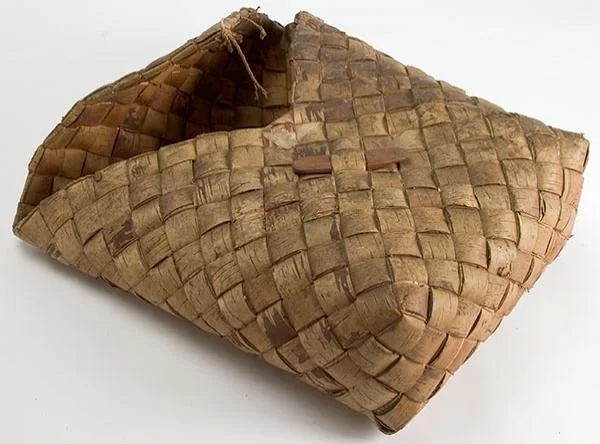
Birch Bark and What You Need
North House's three-day field pouch and two-day lidded basket classes, and the Finnish American Folk School's bias-woven basket. Birch-bark weaving in Finland and Scandinavia, getting bark legally and with the least harm in Wisconsin, the few tools it needs, and a plan from harvest day to finished basket.
- 3 min
- 6 steps
- 2 questions
- Lesson 196 of 204
In this lesson
- Bark in the North
- Getting bark
- The rules in Wisconsin
- Tools
- Try it
Picking up where you left off.
What you need
| Have it | Material | Spec | Qty | Where to get it |
|---|---|---|---|---|
| Birch barkPrepared bark comes with the Finnish American Folk School class materials. | Outer bark of paper birch, sheets at least 30 cm long, from a felled, storm-downed, or firewood tree | Several sheets | Your own land or a landowner's, with permission; or prepared bark through a class | |
| Leather or antler optional | A strip of leather for a flap or strap, and a toggle | Scraps | Leather supplier |
Tools
Checkmarks are saved on this device.
The plan
-
Harvest day (late June)
Get the bark
- Landowner’s permission; a felled or downed tree first
- Test cut; take outer bark only
- Press the sheets flat, white sides together
-
Day 1 (half day)
Prepare
- Split the bark to even thickness; wet it if dry
- Cut strips of equal width; grade them
- Practice: a bark ring
-
Day 2
Weave
- Weave the diagonal base from the center
- Turn the walls; weave up with clips holding the work
-
Day 3
Finish
- Fold the strips over the rim and weave back down inside
- Tuck the ends; add a flap, toggle, and strap
This module reconstructs North House Folk School’s three-day Birch Bark Field Pouch and two-day Lidded Woven Birch Bark Basket, both taught by Beth Homa Kraus, and the Finnish American Folk School’s Intro to Bias Woven Birch Bark Basketry with Karen Tembreull. The field pouch spends day one on birch ecology, sustainable harvesting, and processing bark, day two weaving “diagonally up and down the basket,” and day three on a leather flap and handle 1. The lidded basket starts with a horizontal base, has students “split, snip, and grade raw bark,” and finishes about 6 by 4 by 4 inches 2. The bias weave makes “four layers which are strong, useful, flexible and repairable” 3. The class plans aren’t published; this follows the sources cited.
Bark in the North
In Finland, Karelia, and Scandinavia, bark woven on the diagonal made salt bottles, backpacks, and shoes. A salt bottle from Repola in East Karelia, plaited from 2.2 cm strips with each side made from two strips, is 18 cm tall 4. A backpack (tuohikontti) at the Finnish Forest Museum is about 50 cm tall, of 3 cm strips in a diagonal double plain weave 5. In diagonal work the walls rise entirely from the base strips, all the same width 6.
Getting bark
Bark peels best from mid-June to early July; Minnesota Extension advises a small test cut at the base first. Take only the outer bark, usually 1/8 to 1/4 inch thick, never the inner bark beneath it, which is two to three times thicker 7. Norwegian practice takes bark in the four or five weeks around midsummer from trees 8 to 30 cm across, cutting without touching the inner bark 8.
Peeling a live tree harms it: the bulletin warns that up to 20 percent of trees peeled may die, and advises taking bark first from trees due to be cut 7. In Finland even a small wound usually leaves the trunk bare and brown 6. So look first for felled, storm-downed, or firewood trees. Dead and downed bark is more fragile but usable 7.
Press fresh sheets flat under weight or roll them, and store them white sides together 7 6.
Quick check
Bark taken outside that window is ‘winter bark’ and much harder to remove.
The rules in Wisconsin
- DNR land: no one may remove “any natural growth” from DNR properties except the listed items, such as edible fruits, nuts, and mushrooms; bark isn’t on the list 9. That covers state parks and forests.
- Private land: removing raw forest products without the owner’s consent carries a forfeiture of $100 to $10,000 10. Get permission in writing.
- National forests and state land elsewhere: permits are required 7.
Quick check
On private land you need the owner’s consent; on national forests, a permit.
Try it
Ask a tree service or a neighbor with a firewood pile for a freshly cut birch log in late June. A log 6 inches across gives a sheet about three times as wide as the tree 7, enough for a small basket.
Lesson complete
Nice work.
Sources for this lesson
- 1Birch Bark Field Pouch. North House Folk School. verifiedBeth Homa Kraus, July 23-25, 2026 (day 1 2-6 pm, days 2-3 9-5); tuition $275, materials $120. Day 1: history and ecology of birch, sustainable harvesting, processing bark; day 2: weave diagonally up and down the basket; day 3: a leather flap and handle. Required: scissors; optional: clothespins, sloyd knife, thimble, pliers.
- 2Lidded Woven Birch Bark Basket. North House Folk School. verifiedTwo days: start with a horizontal base; students 'split, snip, and grade raw bark'; the lid fits on a natural root or stick hinge; finished about 6 x 4 x 4 in. Tools: scissors and clothespins; optional sloyd knife and fid.
- 3Intro to Bias Woven Birch Bark Basketry. Finnish American Folk School (Finlandia Foundation). verifiedKaren Tembreull, Oct 5, 2025; class $80, materials $75 for prepped bark and a detailed pattern; the bias weave makes 'four layers which are strong, useful, flexible and repairable.' Bring 12 small toothless alligator clips, a pocket knife, scissors, and an old towel.
- 4Suolapullo (salt bottle), Repola. National Museum of Finland (Finna). verifiedEast Karelia, before 1942: diagonally plaited from 2.2 cm strips, four-sided, each side from two strips; base side 7 cm, height 18 cm, neck 7.5 cm; wooden stopper. CC BY 4.0.
- 5Tuohikontti (birch-bark backpack). Lusto - Finnish Forest Museum (Finna). verifiedEarly 1900s: about 50 cm tall, base 15 x 33 cm, strips about 3 cm, diagonally plaited double plain weave, over one and under one; strips turned at the top for a straight edge; wooden toggle. CC BY 4.0.
- 6Tuohi. Finnish Wikipedia. verifiedPeels best in May-June until midsummer; even a small wound usually stops new white bark forming. Store sheets white sides together; long strips wound in rolls. In diagonal work the sides are formed entirely from the base strips and all strips are the same width; straight work needs extra horizontal strips.
- 7Harvesting Birch Bark. University of Minnesota Extension / Minnesota Forest Stewardship (hosted by UW-Madison Forestry Extension). verifiedBest between mid-June and early July; make a small test cut at the base. Take only the outer bark, usually 1/8-1/4 in thick; the inner bark is 2-3 times thicker. Roll fresh bark or store it flat under weight. Usually from trees 6 in and up; sheet width about 3 times the diameter; dead and downed bark is more fragile but useful. Landowner permission; state land requires a permit and fee; the Forest Service requires a permit. Up to 20% of trees from which bark is removed die; harvest first from trees due to be cut.
- 8Never. Norwegian Wikipedia. verifiedBest taken before and around midsummer, for about 4-5 weeks after the leaves are full-grown; trees 8-30 cm in diameter; cut vertically without cutting the inner bark; the tree carries a black scar; new bark can be taken again after 7-8 years. Fresh bark curls within hours, so it is stacked under press.
- 9Wis. Admin. Code NR 45.04: Protection of natural resources (department lands). Wisconsin Legislature. verifiedNR 45.04(1)(a) bars removing natural growth from DNR lands; (1s) allows collecting edible fruits, edible nuts, wild mushrooms, wild asparagus, and watercress by hand for personal consumption, and removing listed invasive herbaceous plants.
- 10Wis. Stat. 26.05: Unlawful cutting or removal of raw forest products. Wisconsin Legislature. verifiedNo person may cut or remove raw forest products from land without the owner's consent; forfeiture $100-$10,000.