Brushes and What to Buy
North House's two-day brushmaking class with Marybeth Garmoe, and the Swedish brushmakers' tradition behind it. Brush fibers and what each is for, wood for the blocks, suppliers for tampico, horsehair, and bristle, and a two-day plan for a glued bench brush and a drawn scrub brush.
- 2 min
- 5 steps
- 1 question
- Lesson 201 of 204
In this lesson
- Swedish brushmakers
- Fibers
- Buying
- Try it
Picking up where you left off.
What you need
| Have it | Material | Spec | Qty | Where to get it |
|---|---|---|---|---|
| Tampico fiberCaddy Supply sells it by the 10 lb for $59.99. | Natural tampico, about 10 in long | A small bundle (enough for two to four small brushes) | Lee Valley | |
| Horsehair or bristle optional | Horse tail for a soft table brush; boar bristle for a stiff one | 1 bundle | Troy Bungart Studios | |
| Block wood | Beech or hard maple, about 5/8-3/4 in thick | Two blocks about 9 1/2 x 2 3/4 in, plus a thin back board | Ocooch Hardwoods, Viola, Wisconsin | |
| Drawing wireThese sources don’t give the trade’s wire gauge; any fine annealed wire that bends without breaking works. | Thin annealed stainless or brass wire, about 0.020 in | A small coil | Hardware or aircraft supply (safety wire) | |
| Glue | Epoxy or wood glue for the glued brush; wood glue for the back board | Small | Hardware store |
Tools
Checkmarks are saved on this device.
The plan
-
Day 1 morning
Fibers and blocks
- Compare tampico, horsehair, and bristle by hand
- Choose brush types; draw a half-pattern and hole layout
-
Day 1 afternoon
A glued bench brush
- Drill 3/8 in holes 1 in deep, square to the face
- Size bundles; glue them in; trim when cured
-
Day 2 morning
A drawn brush
- Bore entering holes and smaller wire holes
- Draw the knots in row by row; trim each row
-
Day 2 afternoon
Finishing
- Glue on the back board
- Shape, sand, and oil
This module reconstructs North House Folk School’s two-day Bench Brushes and Beyond: Introduction to Handmade Brushes with Marybeth Garmoe: brushes for “cleaning off a workbench, lettering calligraphy, applying makeup, decorating ceramics,” a variety of plant and animal fibers, and “Multiple methods for constructing brushes”; students can bring figured wood, old brushes to revamp, even pet fur 1. The class plan isn’t published; this follows the sources cited.
Swedish brushmakers
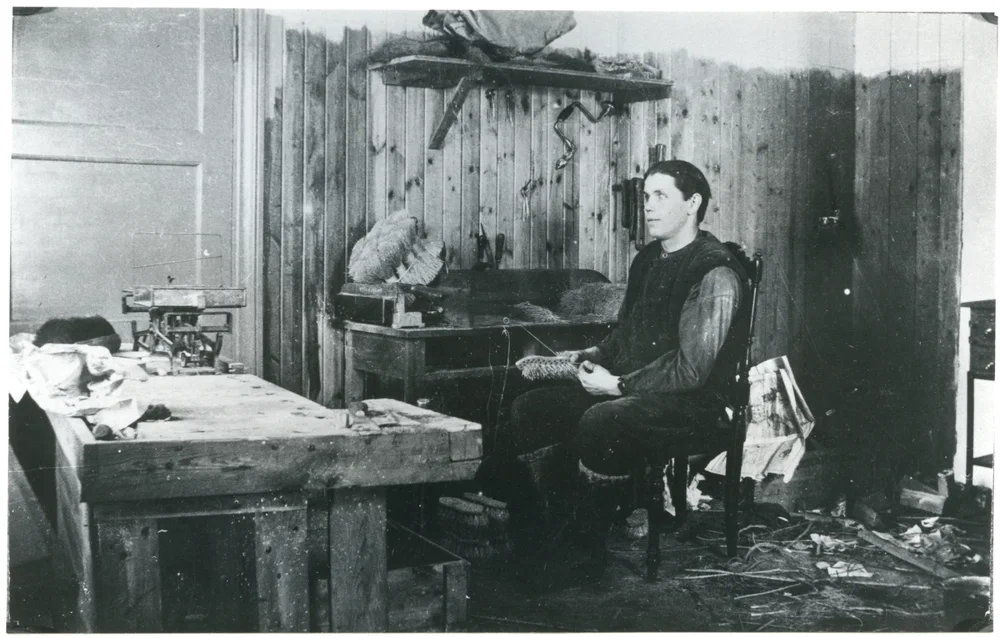
Sweden and Finland had a brushmakers’ guild from 1749 to 1846, and brushmaking was long a common trade for the blind, organized by De Blindas Förening; about 800 brushmakers still worked in the 1950s 2. Stockholm’s Iris Hantverk grew from a workhouse for visually impaired craftsmen founded in 1870; there the block is sawn, milled, and sanded, holes drilled, and “bristle knots are wired through the holes” 3.
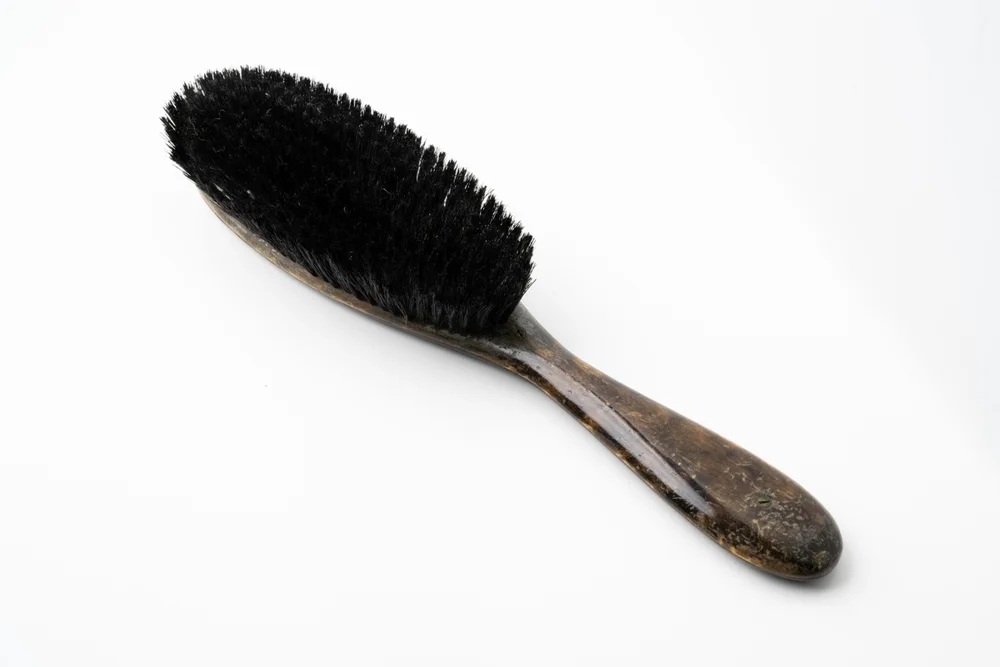
Edvin Ågren of Jönköping, trained in Stockholm in 1911-12, ran his own brush shop working one-handed; his clothes brush is 308 mm long 4.
Fibers
- Tampico, from an agave in Mexico: creamy white, used wet or dry, resistant to heat, alkali, and acid 5. The scrub and bench brush fiber. Tampico has been used in brushes since the 1850s, when it reached Liverpool from the Mexican port it’s named for 6.
- Horsehair: soft and resilient, for dusting and polishing, used dry 5.
- Hog bristle: “the stiffest natural material” 5.
Quick check
Horsehair is soft and best dry, for dusting and polishing.
Buying
- Tampico: Lee Valley sells a 10-inch bundle, enough for two to four small brushes, from $19.90 7; Caddy Supply sells 10 pounds for $59.99 8.
- Horsehair and bristle: Troy Bungart Studios sells horse tail at $30 a bundle and boar bristle at $20 9.
- Wood: Ocooch Hardwoods in Viola, Wisconsin, sells project-ready beech and hard maple and thin stock for back boards 10. Kiddier’s scrub-brush board is beech, 9 1/2 by 2 3/4 by 5/8 inch 6.
Try it
Take a pinch of tampico and a pinch of horsehair, wet both, and press them on the back of your hand. Feeling which springs back and which goes limp tells you more about choosing a fiber than any table.
Lesson complete
Nice work.
Sources for this lesson
- 1Bench Brushes and Beyond: Introduction to Handmade Brushes. North House Folk School. verifiedMarybeth Garmoe, two days, 9-5; tuition $230, materials $55. Brushes 'with uses ranging from cleaning off a workbench, lettering calligraphy, applying makeup, decorating ceramics'; a variety of plant and animal fibers and 'Multiple methods for constructing brushes'; hand and power tools; bring figured wood, old brushes to revamp, pet fur.
- 2Borstbindare. Swedish Wikipedia. verifiedA brushmakers' guild existed in Sweden and Finland 1749-1846; brushmaking was long a common trade for the blind, organized by De Blindas Förening; about 800 working brushmakers in the 1950s.
- 3Iris Hantverk. Ingebretsen's blog. verifiedStockholm brushmakers: in 1870 Dr. Axel Beskov founded a workhouse for visually impaired craftsmen; De blindas förening founded 1889; the wood block is 'sawed, milled, and sanded… Holes are then drilled… bristle knots are wired through the holes'; horsehair, root fiber, goat hair, coconut.
- 4Borste (JM.55405). Jönköpings läns museum (DigitaltMuseum). verifiedBrush by Edvin Ågren (1885-1946), who trained in Stockholm in 1911-12 as a brushmaker and turner and ran a brush shop in Jönköping, working one-handed; 308 x 75 mm, oval head, black bristle. CC0.
- 5Brush Fillings. Precision Brush. verifiedTampico from Agave lechuguilla in Mexico, creamy white, used wet or dry, 'heat, alkali and acid resistant'; horsehair soft and resilient for dusting and polishing; hog bristle 'the stiffest natural material'. Wire-drawn brushes: each tuft sewn into the block with wire that pulls the filling into the hole.
- 6William Kiddier. The Brushmaker and the Secrets of His Craft. Pitman, London. verifiedDrawing is 'a process in which the knots are drawn into the holes, from the back of the brush, with wire'; holes bored from a perforated pattern board, an 'entering' hole for the bristle and a smaller hole bored through for the wire; the knot is caught in the wire loop, doubled, and drawn in; each row cut level against a gauge; 'In all ordinary drawn work the brush has a separate piece of wood glued upon the back to conceal and protect the wire.' Example scrubbing-brush board 9 1/2 x 2 3/4 x 5/8 in, preferably beech. Pitch setting: pitch kept hot but never boiled; knot dipped, tied with a thrum, dipped again, pushed into holes bored at angles for spread. Mexican fiber (istle) from Tampico; bassine and Mexican fibre make an excellent union for scrubbing brushes.
- 7Tampico Fiber. Lee Valley. verifiedFrom $19.90; natural about 10 in long, about 1.75 lb in a 3 in bundle, or black 6 1/2 in and stiffer; 'enough fiber for two to four small brushes.'
- 8Natural Tampico Fiber. Caddy Supply Co.. verified$59.99 per 10 lb, lengths 9 3/4-14 in, 'flexible enough to be bent in half and staple set'.
- 9Brush Making Supplies. Troy Bungart Studios. verifiedTampico about 1 lb bundle $22; white or brown horse tail, double cut, $30 a bundle; boar bristle $20 a bundle.
- 10Veneers and Project Ready Wood. Ocooch Hardwoods, Viola, Wisconsin. verifiedThin hardwood: 1/16 in aspen or basswood 8 x 24 in $7.75, hard maple $8.90, 1/8 in also; custom lengths to 8 ft on request; project-ready stock to 3/4 in thick in beech, hard maple, and others.
Further reading
- Berg sn, Hallstahammars kn. Borstbindare Lövgren. C:a 1930 (Vlm-E 8554). Västmanlands läns museum (DigitaltMuseum). verifiedA brushmaker at his bench, about 1930. Public Domain Mark.