What Sloyd Is
Slöjd as Nordic household craft and as a school subject: Cygnaeus and Salomon, the Nääs training school, the knife-first teaching sequence, and why green wood and a few edge tools are the heart of it.
- 4 min
- 6 steps
- 3 questions
- Lesson 1 of 204
In this lesson
- Two meanings
- Educational sloyd
- Household sloyd today
- Why green wood
- The basic kit
- What to take from this
Picking up where you left off.
Two meanings
Slöjd (sloyd in English) means handicraft - the things a household made for itself from wood, birch bark, fiber, and metal through the long Nordic winters: spoons, bowls, boxes, tool handles, baskets 1. It’s the same family of words as English sleight, skill of hand.
.jpg)
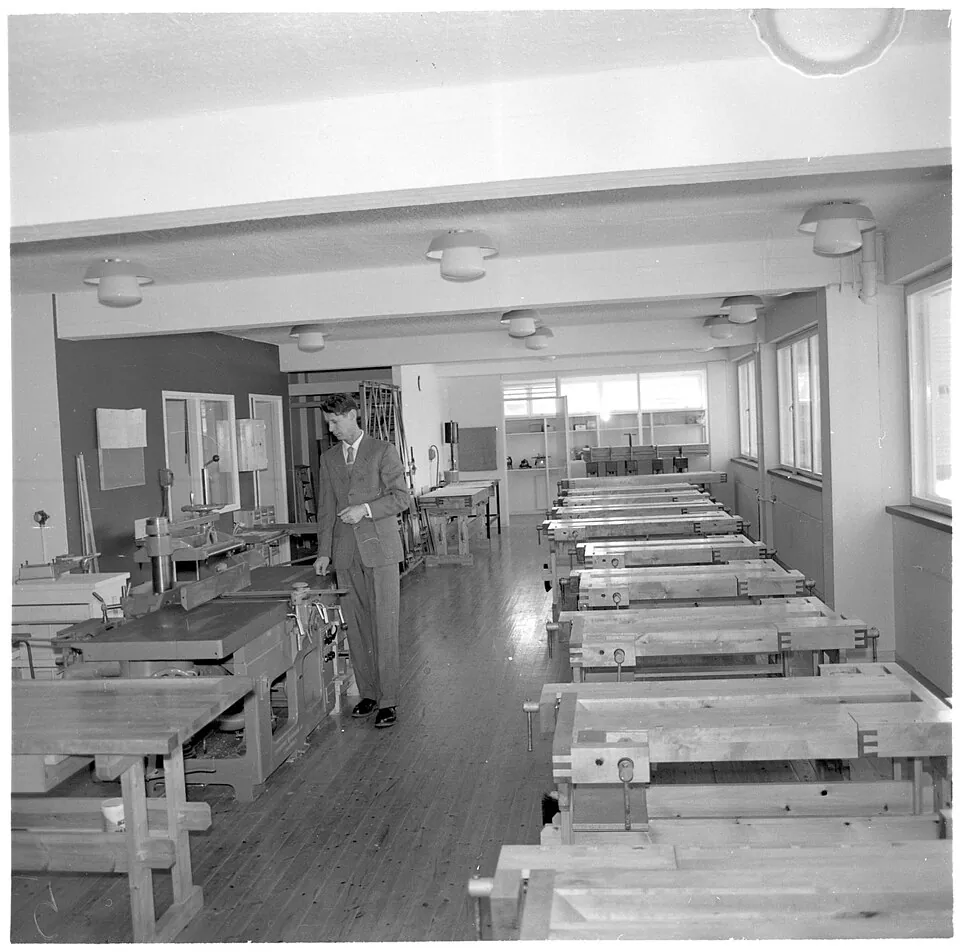
It also became a school subject. In Sweden, Finland, Norway, and Denmark, sloyd is still taught in schools today 1. This course is mostly about the first meaning, household craft in green wood, but the school version shaped how the craft is taught.
Quick check
The English ‘sloyd’ and the related ‘sleight’ (of hand) share the root idea of skill.
Educational sloyd
- Uno Cygnaeus founded sloyd as a school subject in Finland in 1865 1.
- Otto Salomon built a teacher-training school at Nääs, an estate near Gothenburg, in the 1870s. Teachers came from all over the world, and the school ran until about 1960 1.
- Sloyd reached the United States through teachers like Gustaf Larsson, whose training school was based at North Bennet Street in Boston 1.
Salomon wasn’t training carpenters. The aim was general education: pleasure in and respect for physical work, independence, order, accuracy, attention, and physical strength 2. The method:
- Go from easy to difficult, simple to complex, known to unknown 2.
- Make useful objects that go home with the student, not abstract exercises.
- Arrange models in a series, each adding only one new exercise, or two at most 2.
- Begin with the knife, which Salomon called the most characteristic sloyd tool 2.
That sequence still works for a grown beginner: a butter knife before a spoon, a spoon before a bowl, a bowl before a box.
Quick check
Each model in the series introduces only one or two new exercises.
Quick check
The knife is what separated the sloyder from the carpenter.
Household sloyd today
In living Swedish practice, sloyd means green wood, few tools, and work held in the hands. Jögge Sundqvist’s Slöjd in Wood starts the same way Salomon did, with a butter knife, then moves to spoons, bowls, hooks, and a sheath for the knife itself, finishing pieces with paint and carved decoration 3. In America, Drew Langsner’s Country Woodcraft (1978) brought the same green-wood, hand-tool approach to a generation of makers 4.
Playback is optional. If the player is unavailable, open the video at its source.
Why green wood
Freshly cut wood is full of water. It cuts like firm cheese compared with dry wood, so an axe and a knife can do work that would need a saw and plane in a dry shop. The price is movement: green wood shrinks as it dries, and it shrinks about twice as much around the rings as across them (see the Wood Drying course). Sloyd works with this instead of against it - carve green, let the piece dry, then finish-cut. Later lessons use shrinkage on purpose: a shrink pot’s walls tighten around a dry bottom.
The basic kit
| Tool | Job |
|---|---|
| Carving axe (hatchet) | split and rough-shape blanks |
| Sloyd knife | all the shaping and detail |
| Hook (spoon) knife | hollow spoon bowls and kuksas |
| Froe, wedges, mallet or club | rive logs into straight-grained pieces |
| Shaving horse and drawknife | shape longer parts quickly |
| Saw | crosscut to length |
| Stones and strop | keep every edge sharp |
The axe, knife, and hook knife are enough for spoons, butter knives, and cups. The next four lessons cover the rest.
What to take from this
Slöjd means handicraft, and it’s also a Nordic school subject founded by Uno Cygnaeus in 1865 and spread by Otto Salomon’s training school at Nääs. Salomon’s method runs from easy to difficult, makes useful objects, adds one new skill per model, and starts with the knife. Household sloyd works green wood with an axe, a knife, and a hook knife, carving wet and finishing dry.
Lesson complete
Nice work.
Sources for this lesson
- 1Sloyd. Wikipedia. 2026. verifiedOverview of Uno Cygnaeus (Finland, 1865), Otto Salomon and Nääs, and sloyd in Nordic and American schools.
- 2Otto Salomon. The Teacher's Hand-Book of Slöjd, as Practised and Taught at Nääs. 3rd ed. Silver, Burdett & Co.. 1907. verifiedPublic-domain English translation; aims of educational sloyd, progression from easy to difficult, and the knife as the characteristic sloyd tool.
- 3Jögge Sundqvist. Slöjd in Wood. Lost Art Press. 2018. verifiedPublisher excerpt (PDF) of the English translation of the Swedish classic; butter knife, spoons, bowls, sheath, hooks, and painted decoration in the Västerbotten tradition.
- 4Drew Langsner. Country Woodcraft: Then & Now. Lost Art Press. 2020. verifiedExpanded edition of the 1978 book that seeded American green woodworking; shavehorses, riving, spoons, bowls, and country tools.