A Glued Brush and a Drawn Brush
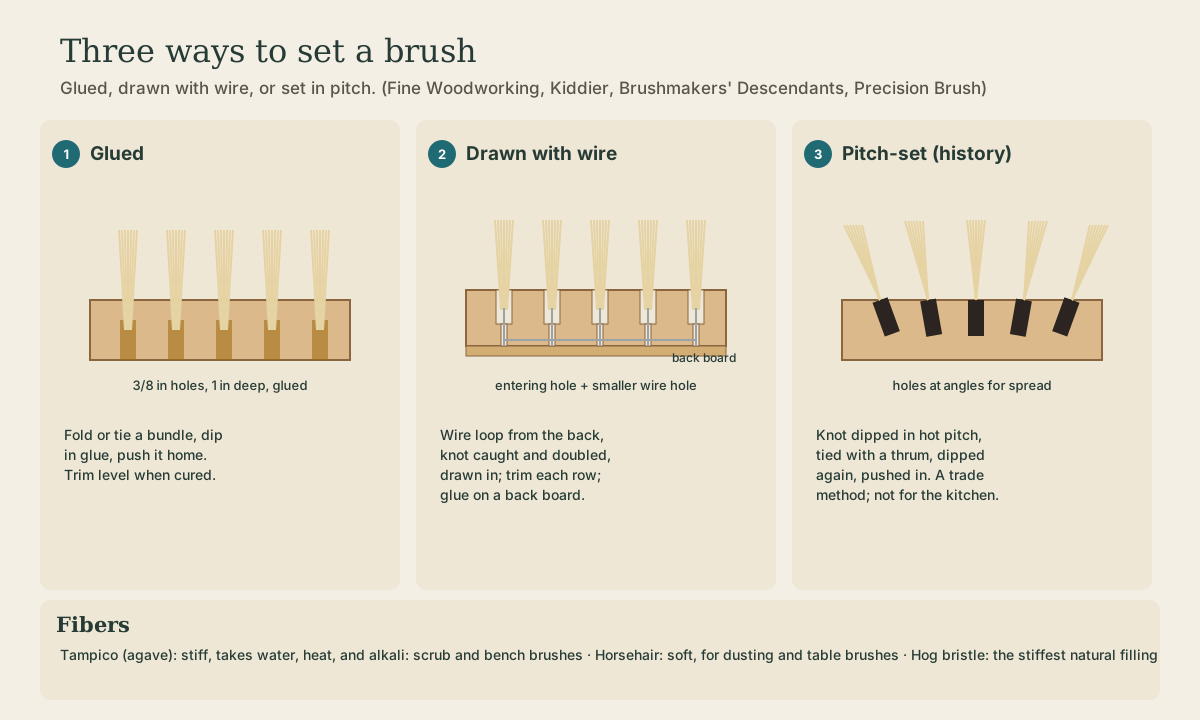
Both class days: lay out and drill a block, glue tampico bundles into a bench brush, then make a wire-drawn scrub brush the way the trade did, with entering holes, wire holes, knots doubled and drawn in, rows trimmed against a gauge, and a back board over the wire; and pitch setting as history.
- 3 min
- 5 steps
- 2 questions
- Lesson 202 of 204
In this lesson
- Lay out the block
- A glued bench brush
- A drawn scrub brush
- Pitch setting
- Finish
Picking up where you left off.
Lay out the block
Draw a half-pattern of the brush’s outline and its hole layout, flip it to draw the other half, and transfer both to the block 1. Saw the outline, then shape the handle and edges with knife, rasp, and sandpaper.
A glued bench brush
Aspen Golann’s method 1:
- Drill the bundle holes 3/8 inch across, “the Goldilocks diameter” for tampico, and at least 1 inch deep, straight and square to the face.
- Gather a bundle of tampico that fills a hole snugly when folded or tied at the root end.
- Put glue in the hole, push the bundle home, and do the next.
- When the glue has cured, trim the fiber level with sharp shears.
Playback is optional. If the player is unavailable, open the video at its source.
Quick check
3/8 inch is the ‘Goldilocks diameter’ for tampico bundles.
A drawn scrub brush
Drawing is “a process in which the knots are drawn into the holes, from the back of the brush, with wire” 2:
- Bore each hole in two sizes: a larger entering hole for the bristle, partway, then a smaller hole through to the back for the wire 2. Ken Doughty drills each hole with two bits, so half its length is wider 3.
- Draw: from the back, pass a loop of wire through a hole. Lay a knot of fiber, about two inches long 3, in the loop, then pull the wire from behind so the knot is “caught and doubled and drawn into the hole” 2. Kiddier wraps two turns of wire around a leather hand-band to pull 2.
- Carry the wire to the next hole and repeat, working the body rows first and tying the wire off after each row 3 2.
- Trim each row level against a narrow wooden gauge 2.
- Back: “In all ordinary drawn work the brush has a separate piece of wood glued upon the back to conceal and protect the wire” 2. Doughty adds four small brass screws 3.
Iris Hantverk’s brushes are still made this way: holes drilled and the knots wired through 4.
Playback is optional. If the player is unavailable, open the video at its source.
Quick check
Kiddier: in all ordinary drawn work a back is glued on.
Pitch setting
The old trade also set knots in hot pitch, never allowed to boil: the knot is dipped with its roots fanned, tied with a short piece of yarn, dipped again, and pushed into a hole bored at an angle for spread 2. Hot pitch is a fire and burn hazard; the glued and drawn methods do the same job at home.
Finish
Sand the block, and oil it if it’ll stay dry; a scrub brush that lives wet is better left bare.
Try it
Draw one row of five knots on a scrap block before the real one. Pull the wire until the knots seat firmly but the wire doesn’t cut the fiber; that feel is the whole of drawing.
Lesson complete
Nice work.
Sources for this lesson
- 1Aspen Golann. Make a Wooden Brush. Fine Woodworking 296. 2022. verifiedGlued bench brush: bundle holes 1/4-1/2 in, '3/8 in. is the Goldilocks diameter' for tampico; drill 'at least 1 in. deep,' straight and square to the handle; half-patterns for face, edge, and hole layout.
- 2William Kiddier. The Brushmaker and the Secrets of His Craft. Pitman, London. verifiedDrawing is 'a process in which the knots are drawn into the holes, from the back of the brush, with wire'; holes bored from a perforated pattern board, an 'entering' hole for the bristle and a smaller hole bored through for the wire; the knot is caught in the wire loop, doubled, and drawn in; each row cut level against a gauge; 'In all ordinary drawn work the brush has a separate piece of wood glued upon the back to conceal and protect the wire.' Example scrubbing-brush board 9 1/2 x 2 3/4 x 5/8 in, preferably beech. Pitch setting: pitch kept hot but never boiled; knot dipped, tied with a thrum, dipped again, pushed into holes bored at angles for spread. Mexican fiber (istle) from Tampico; bassine and Mexican fibre make an excellent union for scrubbing brushes.
- 3Ken Doughty. Brush Drawing. Society of Brushmakers' Descendants. verifiedEach hole drilled with two bits so half its length is wider; a bundle about two inches long pushed through the wire loop and drawn from behind; wire tied off after each row; a thin back glued on with fish glue and four small brass screws; 'To hand-draw a good hairbrush would be a day's work!'
- 4Iris Hantverk. Ingebretsen's blog. verifiedStockholm brushmakers: in 1870 Dr. Axel Beskov founded a workhouse for visually impaired craftsmen; De blindas förening founded 1889; the wood block is 'sawed, milled, and sanded… Holes are then drilled… bristle knots are wired through the holes'; horsehair, root fiber, goat hair, coconut.
Further reading
- Brush Fillings. Precision Brush. verifiedTampico from Agave lechuguilla in Mexico, creamy white, used wet or dry, 'heat, alkali and acid resistant'; horsehair soft and resilient for dusting and polishing; hog bristle 'the stiffest natural material'. Wire-drawn brushes: each tuft sewn into the block with wire that pulls the filling into the hole.