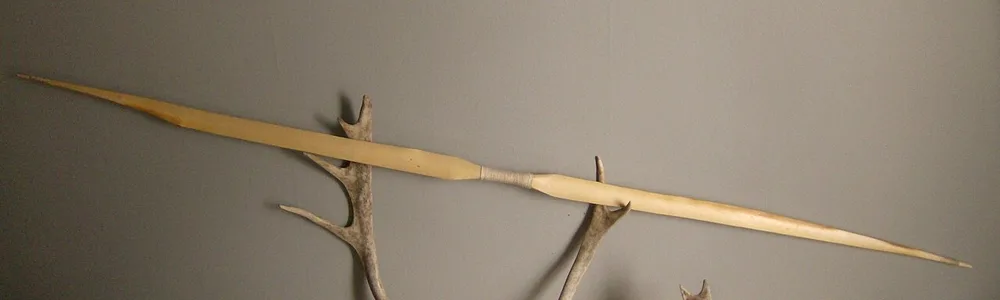
The Holmegaard Bow and What to Buy
Steve Daughton's four-day Vesterheim class makes a working bow after the Mesolithic elm bows from Holmegård bog. What the original bows were and how they measure, the design and why it works, choosing a white-wood stave and drying it, the tools and string material with suppliers, and a four-day plan.
- 4 min
- 6 steps
- 2 questions
- Lesson 172 of 204
In this lesson
- The bows from the bog
- How the design works
- Choosing a stave
- Buying
- Try it
Picking up where you left off.
What you need
| Have it | Material | Spec | Qty | Where to get it |
|---|---|---|---|---|
| Bow staveKustom King’s floor-tillered hickory stave is $109; or split a stave from a straight elm or ash log 3-5 in across. | Straight-grained white wood with the bark-side back intact: elm, ash, hickory, or maple, about 70 in long and 2 in wide | 1, plus a spare if you split your own | Kustom King Archery | |
| String material | Polyester bowstring material (BCY B55 or B-50) | 1/4 lb spool, enough for many strings | Kustom King Archery | |
| Tillering cord | A long string with loops, longer than the bow, for the first tillering | 1 | Kustom King Archery | |
| Finish | An oil or wax finish to slow moisture changes | Small can | Hardware store |
Tools
Checkmarks are saved on this device.
The plan
-
Day 1
Archaeology and the stave
- The Holmegaard bows and their measurements
- Check the back is one unbroken layer; snap a centerline
- Lay out the handle, parallel inner limbs, steps, and tapering tips
- Rough out the sides and belly with hatchet and drawknife
-
Day 2
Down to bending
- Bring the inner limbs to even thickness; shape the handle
- Cut rough nocks; floor tiller
- Long string on the tillering stick; scrape the stiff places
-
Day 3
Brace and tiller
- Low brace, then full brace at about 6 in
- Tiller an inch at a time with the scale, never past the target weight
- Watch for hinges and chrysals
-
Day 4
Full draw, string, and finish
- Tiller to full draw; finish the nocks
- Make a Flemish twist string
- Scrape, sand, and finish; shoot it in and check the set
This module reconstructs Vesterheim Folk Art School’s four-day Build Your Own Holmegaard-Style Bow, taught by Steve Daughton. Students “shape, tiller, and finish their own functional wooden bow” with drawknives, rasps, files, scrapers, and shave horses, from a $150 “premium, seasoned white wood bow stave”; the class warns that bow building is physically demanding 1. North House runs a similar three-day longbow class from a rough-cut hickory stave 2. The class plan isn’t published; this follows the sources cited.
The bows from the bog
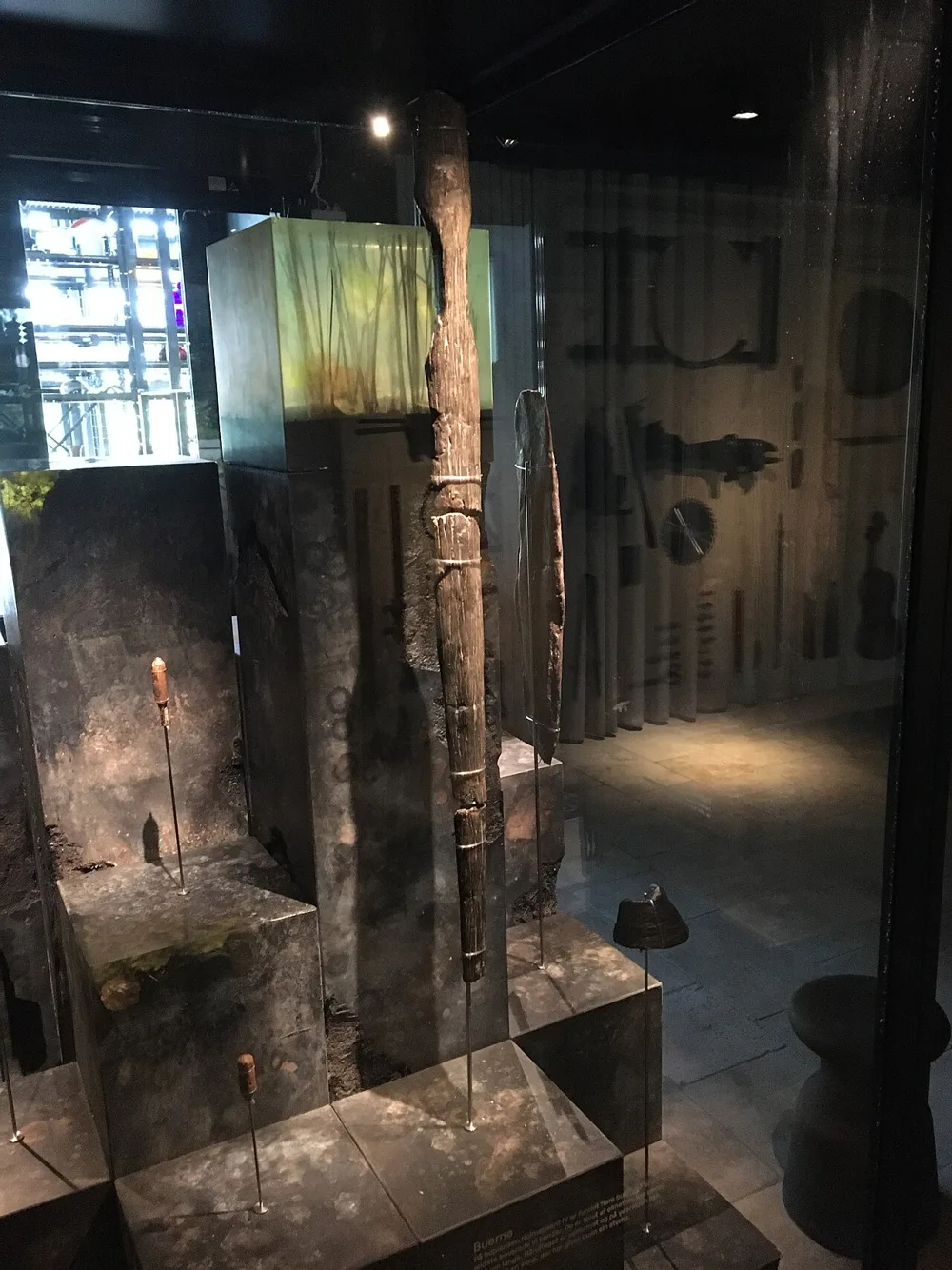
At Holmegårds Mose on Zealand, Denmark, the remains of five bows were found, dated to around 7000 BC. Yew hadn’t reached Denmark yet; the hunter “used a thin elm trunk,” shaping it with “the flexible sapwood… at the back” and the harder heartwood toward the archer 3. Dates vary by source: Jan Sachers gives about 6,500 BC for the complete Holmegård IV bow 4, and Vesterheim’s page says about 6,000 BCE 1.
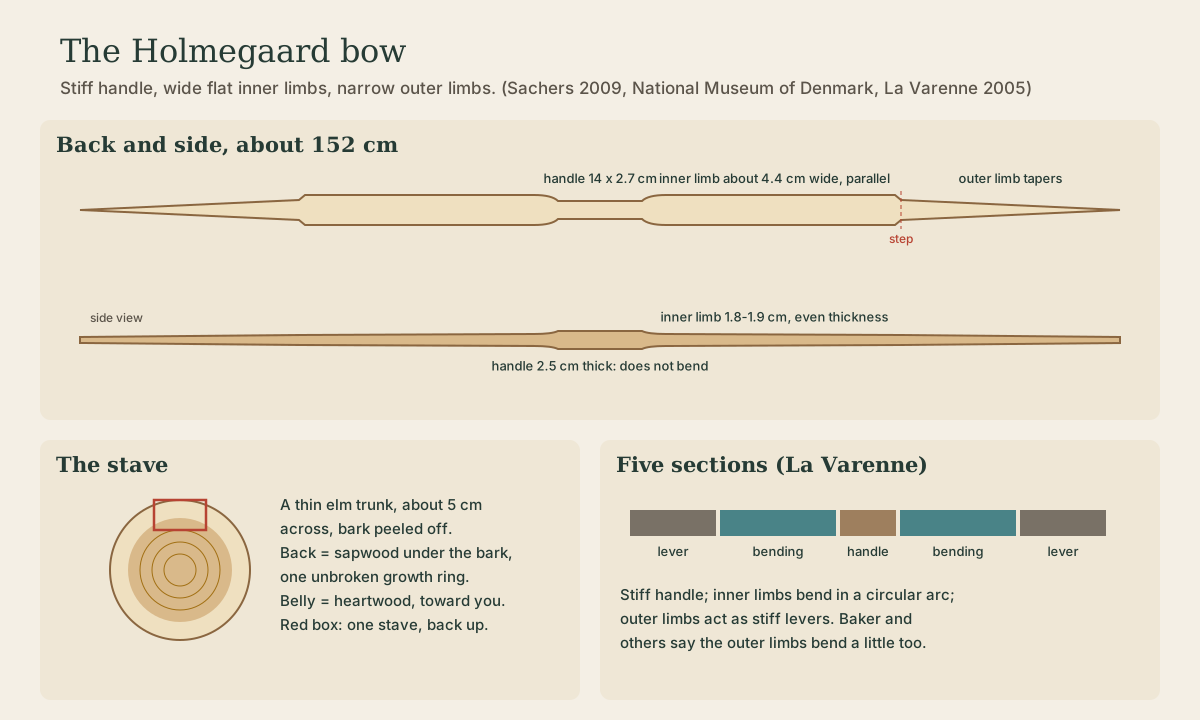
The complete Holmegård IV bow, in wych elm with very narrow growth rings, measures 4:
- Length: about 152 cm (60 in).
- Handle: about 14 cm long, 2.7 cm wide, and 2.5 cm thick: narrow and deep, so it doesn’t bend.
- Limbs: flat, about 4.4 cm (1 3/4 in) wide and 1.8 to 1.9 cm thick, narrowing toward the tips.
- Stock: an elm trunk only about 5 cm across, with the de-barked round surface as the back.
About a dozen bows of this type are known, from 6,500 to 1,700 BC and 115 to 194 cm long 4.
.jpg)

Quick check
Yew had not yet reached Denmark; the hunters used thin elm trunks.
How the design works
Modern Holmegaard-style bows are typically 170 to 180 cm long with wide, parallel-sided limbs and a deep, narrow, stiff handle 5. Dennis La Varenne describes five sections: a non-bending handle, two inner limbs that do the bending, and two narrow outer limbs that act as stiff levers 6. Tim Baker and others say the outer limbs bend a little too 5. Either way, the wide inner limbs spread the strain over a lot of wood, which suits a modest wood like elm.
A self bow’s bending length should be about 2.3 times your draw length 7: for a 28-inch draw, about 64 inches of working limb. La Varenne’s own Holmegaards were 62 to 64 inches 6. A bow of 66 to 68 inches with a 5-inch handle fits a 28-inch draw.
Choosing a stave
The back must be one continuous layer of fibers: with white woods, the surface just under the bark 7. Maple, ash, elm, and oak make excellent flatbows 7. The Wood Handbook’s figures for clear wood at 12 percent moisture show why hickory is forgiving and elm needs wide limbs 8:
| Wood | Specific gravity | Modulus of rupture (psi) | Stiffness (million psi) |
|---|---|---|---|
| American elm | 0.50 | 11,800 | 1.34 |
| Rock elm | 0.63 | 14,800 | 1.54 |
| White ash | 0.60 | 15,000 | 1.74 |
| Sugar maple | 0.63 | 15,800 | 1.83 |
| Shagbark hickory | 0.72 | 20,200 | 2.16 |
La Varenne starts a 50-pound-plus Holmegaard from a stave 45 to 50 mm wide and about 10 to 12 mm thick at the crown, and gets two staves from a log 60 to 75 mm across 6.
Drying. Outdoors in Madison the wood’s equilibrium moisture stays between about 12.5 and 15.7 percent through the year, while wood indoors settles near 8 percent 8. So rough a green stave close to size, seal its ends, and finish drying it indoors for several weeks before tillering.
Quick check
Cutting through growth rings on the back leaves fiber ends that pull apart under tension.
Buying
- Stave: Kustom King sells a 72-inch floor-tillered hickory stave for $109, plus a tillering stick ($29), a digital bow scale to 110 pounds ($19.99), a tillering cord, a farrier’s rasp, curved scrapers, and BCY B55 string material 9.
- Kit: 3Rivers sells a bow-building tool kit with tillering rope, rasp, stick, nock file, scrapers, and a DVD for $119.99 10.
Try it
Measure your draw length: stand as if drawing a bow, bow arm out and string hand at the corner of your mouth, and have someone measure from the front of your bow hand’s grip to your mouth. That number, times 2.3, is the bending length, and it sets the bow’s length before you buy a stave.
Lesson complete
Nice work.
Sources for this lesson
- 1Build Your Own Holmegaard-Style Bow. Vesterheim Folk Art School. verifiedSteve Daughton, June 18-21, 2026, 9-5, beginner friendly. Inspired by the 'Holmgaard Bow', 'thought to date from around 6,000 BCE', with 'narrow limbs, a defined handle, and balanced tiller.' Students shape, tiller, and finish a functional bow with drawknives, rasps, files, scrapers, and shave horses; physically demanding. Materials fee $150 to the instructor for a premium seasoned white-wood bow stave and use of tools.
- 2Bows and Arrows: Crafting the Traditional Longbow & Arrow Making. North House Folk School. verifiedThree days with Rick Yonker: students start from a rough-cut hickory stave, back it with flax linen, make a Flemish twist string and an arrow; 2020 tuition $285, materials $260.
- 3The world's oldest bows. National Museum of Denmark. verifiedElm bows the length of a man are known from Ertebølle settlements; yew had not yet reached Denmark. The hunter 'used a thin elm trunk' with 'the flexible sapwood… at the back' and the harder heartwood at the front. Remains of five bows 'dating to around 7000 BC' were found at Holmegårds Mose, Zealand.
- 4Jan H. Sachers. The Dawn of Archery. Bow International. 2022. verifiedFirst given in 2009. Holmegård IV: a complete bow and a fragment, about 6,500 BC, wych elm (Ulmus glabra) with very narrow rings; the complete bow about 152 cm; handle 2.7 cm wide, 2.5 cm thick, about 14 cm long; flat, wide limbs about 4.4 cm wide and 1.8-1.9 cm thick, tapering to narrow tips; made from an elm trunk about 5 cm across with the de-barked surface as the back. About a dozen bows of the type, 6,500-1,700 BC, 115-194 cm long.
- 5Holmegaard bow. Wikipedia. verifiedWide, parallel limbs and a biconvex midsection; a deep, narrow, stiff handle; modern versions typically 170-180 cm and under 6 cm wide; the claim that only the inner limbs bend is called incorrect, citing Tim Baker.
- 6Dennis La Varenne. Tillering the Holmegaard Bow. Fiarc forum (archived). 2005. verifiedFive sections: a non-bending handle, two bending inner limbs, two stiff outer levers. The inner limb must be of parallel thickness; a taper running into it causes frets; aim for a circular bend. Reduce the handle hump in stages. For a 50 lb+ bow, a stave 45-50 mm wide and about 10-12 mm thick at the crown; one 60-75 mm log can give two staves. Judge tiller with a straightedge between the steps. His bows 62-64 in.
- 7Self bow. Wikipedia. verifiedThe back's fibers must be continuous: the under-bark surface of white woods, or a single chased ring. Maple, ash, elm, and oak make excellent flatbows; bending length about 2.3 times draw length; flatbows need a narrow, thick, non-bending handle.
- 8Wood Handbook: Wood as an Engineering Material (FPL-GTR-190). USDA Forest Service, Forest Products Laboratory (copy hosted by California Air Resources Board). 2010. verifiedTable 5-3b, clear wood at 12% MC (SG / MOR psi / MOE Mpsi / work to max load in-lbf/in3): American elm 0.50 / 11,800 / 1.34 / 13.0; rock elm 0.63 / 14,800 / 1.54 / 19.2; slippery elm 0.53 / 13,000 / 1.49 / 16.9; white ash 0.60 / 15,000 / 1.74 / 16.6; shagbark hickory 0.72 / 20,200 / 2.16 / 25.8; sugar maple 0.63 / 15,800 / 1.83 / 16.5; yellow birch 0.62 / 16,600 / 2.01 / 20.8; paper birch 0.55 / 12,300 / 1.59 / 16.0. Table 13-1: outdoor EMC at Madison, Wisconsin 12.5-15.7% by month; Table 13-2: interior wood about 8% (6-10%).
- 9King Stave - Hickory Floor Tillered Stave - 72". Kustom King Archery. verifiedFloor-tillered hickory stave, 72 in, $109. Kustom King also sells a 35 in tillering stick with 28 notches ($29), a digital hanging bow scale to 110 lb ($19.99), a B-50 tillering cord ($19.99), a farrier's rasp ($38.99), curved scrapers ($29.99), and BCY B55 string material ($39.99 per lb).
- 10Bow Building Tool Kit. 3Rivers Archery. verifiedTillering rope, rasp, tillering stick, nock file, scrapers, and DVD, $119.99; a tillering stick alone $21.99.